Almost done….
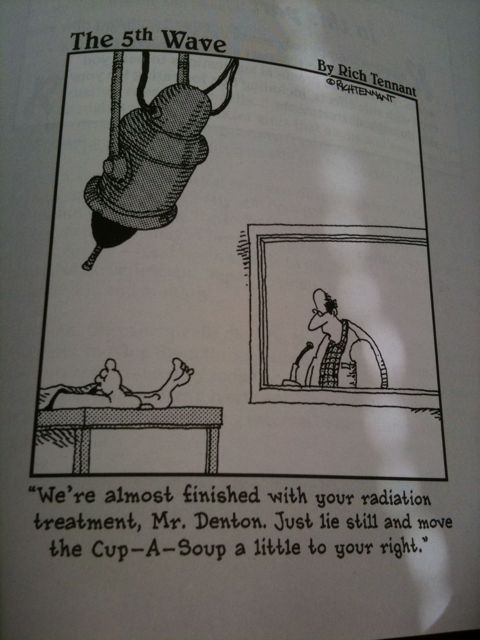

Almost done….
I’ve taken to taking pictures of beautiful things to eat. Here’s to the Moveable Feast.

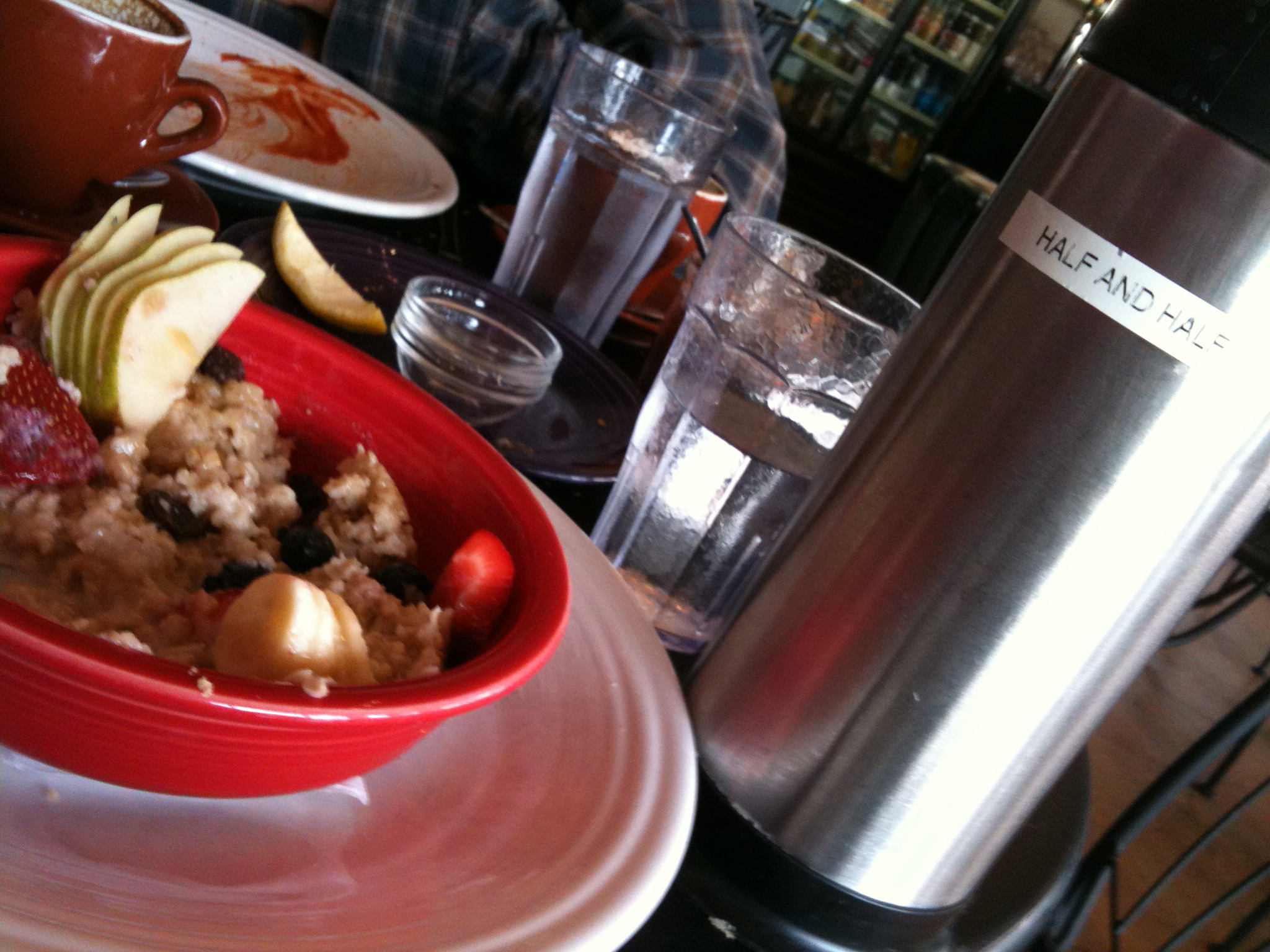


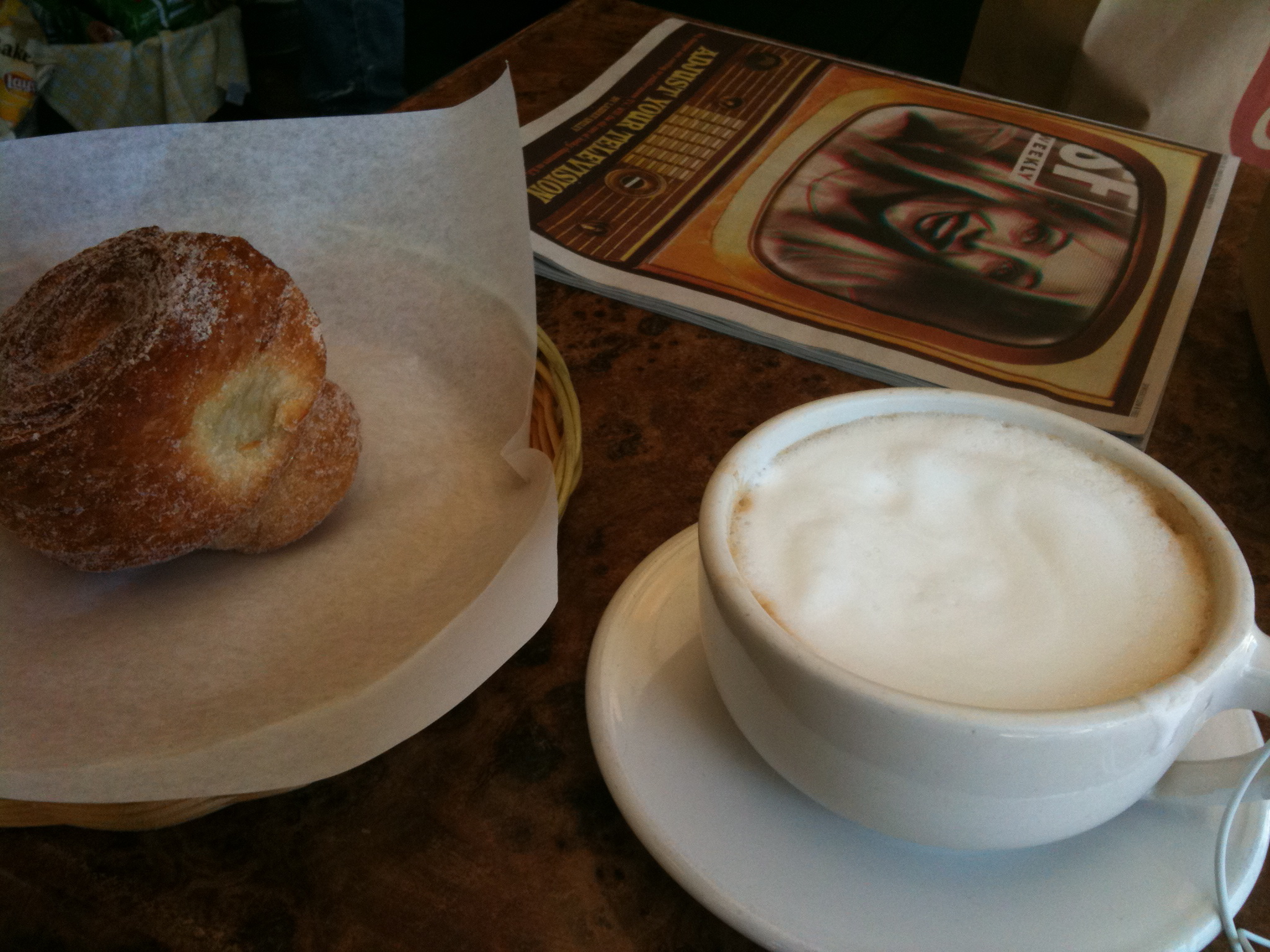
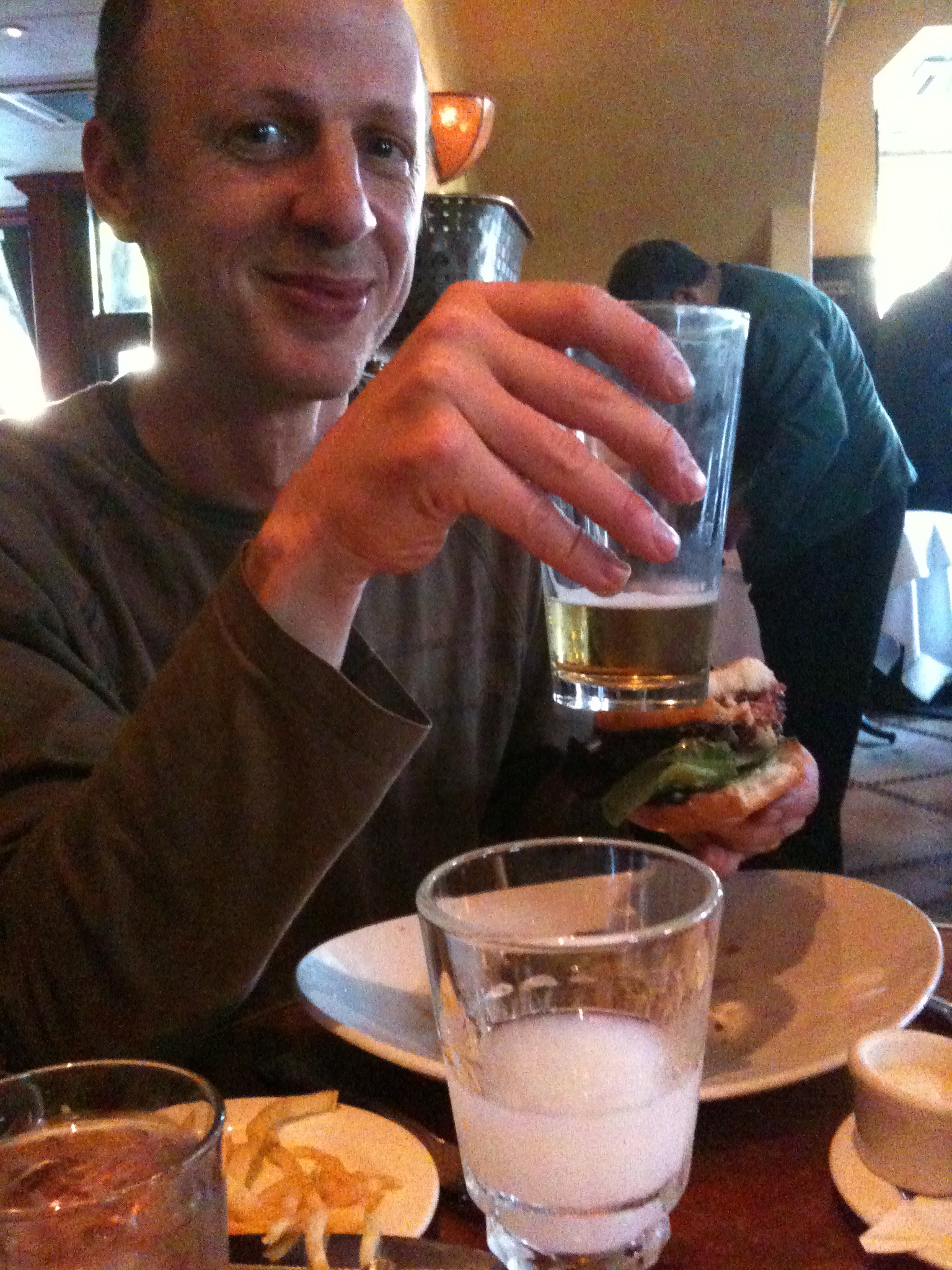









The day broke with sunlight this morning. And warmth even. Eating on the porch looking out over the Headlands, I actually felt pretty good. If I chew on the left side of my mouth, Cowgirl cottage cheese tasted like cottage cheese. A bit of tamale tasted tamale-like. I can drink Pellegrino water (I wonder if the carbonation pushes it toward alkaline and so boosts the pH in my mouth…).
I ate piki. I could taste that deep old corn taste. The piki came from Shungopovi. I thought of a woman making the thin batter and of her prayers. I thought of the man who grew the corn and the other man who burnt the salt bush to make the ash. I thought of the saltbush and the corn and the springs. I thought of the rock and the fire beneath the rock and the wood that fed the fire and the woman’s hand moving deftly across it. I thought of layer after layer after layer of infinitely thin batter being spread, lifted and folded. We call this food.
Afterwards I brushed and cleansed my mouth and still no mucusitis. I’m tired, but I’m still without sores or sore throat and I don’t know whom or what to thank for that. Perhaps the salt and bicarbonate of soda. Or perhaps the piki. Or perhaps all of you.
I think of all those things, sentient and otherwise, that create food, that create a community of health.

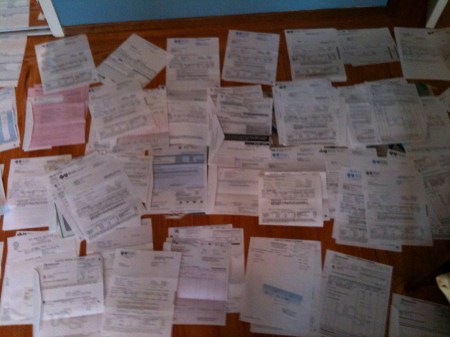
A couple days ago I spread out all my medical bills to date to make better sense of them. For each procedure it seems I receive six or so different pieces of paper (with accompanying return envelopes): the initial bill, a notification from Blue Cross Arizona that the claim will be processed by Blue Shield California, a statement of benefits from Blue Shield California, an adjusted bill from the provider, and a secondary bill because by now the whole thing is 60-days past due.
It amounts to a whole lot of paper. Multiply by the 50 or so million people receiving medical care in this country and, well, we can leave it to Harper’s Index to figure it out. After laying it all down on the floor and clumping by month, I went through and organized by procedure and date (something like 35 procedures, 35 dates). Now it’s somewhat graspable. Some of the bills actually itemize individual widgets, sub-contractors, and sub-procedures: it’s a bit like going out for a plate of spaghetti and at the end of the meal receiving an itemized tab with seperate charges for the tomatoes, parmesan, semolina, salt and pepper, soux chef, head chef, dishwasher, and maitre de. Yes, perhaps someone else needs that for their internal accounting, but do I as a consumer? It gives the illusion of information, but is largely unactionable. Am I in a position to dispute the wage or hours worked by the dishwasher? Am I truly able to assess the value of a foley catheter? In the end it all amounts to the same thing: I pay it.
So what, in this case, do we pay? I received my surgery bill last month. My nine hour nap cost $85,868.32. I think I’m pretty much good for the 32 cents part.
That’s just the surgery. I also go in for radiation every morning for a 15 minute treatment. Each 15 minute fraction costs $7000.00. I’m going to have 30 of them. You could say my rent runs about $28,000 an hour. In the end after you add in ancillary costs, the whole radiation circus is going to cost about $300,000 give or take. When all is said and done, for everything, I’m technically probably going to be down for something close to half a mil. Interestingly, most of the wonderful providers involved with my care most likely have no idea what they charge. I’ve asked some, and hey, they just deliver care, what someone pays for their services is a mystery to them. At least in the restaurant, the dishwasher can step out into the dining area on break and take a look at the prices on the menu.
Now it remains to be seen how much of this I owe, and don’t get me wrong, by all means I think it’s worth it. What’s the value in a human life, and my life in particular? And in a world where Wall Street bankers get $20 million for doing their jobs badly, my surgeon and rad onc are probably underpaid. My surgeon took my life in his hands and spent 9 hours doing incredibly painstaking work (with pre and post-op rounds it was probably a 13 hour day for him) in which he managed to remove a bunch of tumors and save my facial nerve to boot. There are only a handful of human beings on the planet who could have adequately done what he did that day. And as for my radiation oncologist, she and her team and their computers are responsible for pointing a big ol’ x-ray gun at my skull every morning and they better have very, very, very steady hands. If they know what they’re doing, they’re worth it.
But it begs the question, what happens if you don’t have health insurance? One unexpected medical issue (and isn’t that the nature of medical issues, that they’re unexpected?) would quickly and effectively ruin most people. I heard a story when I was in Lancaster, PA this summer from a family practice doc who has some Amish and Mennonite as patients. As a rule, Plain Folk pay cash for medical services – they exist outside any governmental or institutional systems – no insurance, no subsidies, no government aid, no nothing – and as a rule, private physicians tend to love ’em. In this one instance, an Amish woman had contracted cancer. She and her husband met with the physician to decide on a course of care. The recommended action was a run of chemotherapy or radiation, but the chances of it doing any good were pretty uncertain. Treatment would cost somewhere between 50 to 70,000 dollars. Husband leaned back in his chair and explained that that was the cost of the new tractor that they had been saving for. The wife and husband discussed that matter, and given the odds of a cure, the age of their children, and the certainty of heaven, they decided that the money would probably be better spent on the tractor.
But that’s not us. Or at least most of us. We want our MTV, and unfortunately few of us are in a position to pay for it. And if you don’t have insurance you are in big, big, big trouble. How in the 21st century, in reputedly the richest country in the world, is this possible?
Now, what about that insurance? At the beginning of the year I needed to have a standard x-ray done. I dropped into Northern Arizona Radiology in Flagstaff, was all set to do the procedure, they asked for my insurance, I slipped them my Government Employee Health Association (GEHA) insurance card, they looked at it, and politely slipped it back. No go, they said. We’re not a preferred provider.
And where was the nearest provider? Prescott, Arizona – 3 1/2 hours from my house. But that’s not all. I needed a pre-approval. If they were to grant it at all, it would take at least a week. And sometimes they didn’t even grant it.
What if I had Blue Cross?, I asked.
You’d be done by now, the receptionist answered.
I left the desk, promptly called my wife and we switched our insurance plan. We had that luxury.
For anybody who is still afraid that health reform is going to jeopardize your freedom of choice, let me be clear on this: GIVE IT UP. You don’t have freedom of choice. Unless you pay out of pocket, you are bounded by the providers in your insurance network. You do not have a choice. In my case, it might have made more sense to have my entire treatment done at the Mayo Clinic in Phoenix. They’re closer to home, and they’re one of the leading tumor/cancer facilities in the country. But guess what? They’re not a preferred provider under my plan. Instead I’m now (gratefully) receiving my care in California. Fortunately they were in network. But what if they weren’t?
But that’s not all. I’m now set to go through my medical bills, figure out my copays and whatever and cut a bunch of checks. Let’s assume I can afford it. But Blue Cross/Blue Shield – and I’m speaking to you now – you have not yet pushed back. And apparently you’re capable of it. Within your cubicles you have a legion of actuaries and hospitalists who are trying to drive down costs by determining what expenses are allowable and not allowable, what fall under my deductible and what do not, and if you wanted, with a single keystroke you could point to some fine-print of your making and put the kibosh on the whole thing. We no payee. Get attorney. End of story.
My friend CatsM? She started her second round of chemo yesterday. Her choice? Get this. You have no more options. Her insurance company’s initial response? We won’t cover it. (Fortunately her doctor went to bat for her on this one).
I love you guys. But why should any of us, including you, have to put up with that?
Lastly (and forgive me if this is sounding interminable), but what of the future? My wife is a federal employee working in a remote location (we drive 120 miles to buy our milk). At some point we will have to move. When we move, we will most likely have to change insurance companies. I have a condition that by definition is recurrent. Odds are that it may be coming back. If it comes back, it will most likely be classified as a pre-existing condition. So in theory, here’s our choice: a) for the next 20 years continue to drive 120 miles to buy our milk, or b) sock away half a million.
And then there’s a third choice. c) the choice of our Amish farmer.
For those who don’t know, my wife is a doctor. She is a highly trained and highly capable physician. She works for the Indian Health Service that, due to the Federal trust obligation, provides more or less free medical care to Native Americans (if any fringe elements want to quibble on this one – give me a call. Please. I’d love to have a sitdown). People love to bitch about IHS. But at least from a doctor’s perspective the system more or less works. My wife can prescribe the needed care based on the medical need and not be second-guessed by second-party payers. She can do her job as a doctor. And the patients pretty much don’t need to worry about the bill. True, they have a hard time attracting doctors (who wants to drive 120 miles to buy groceries?), but it basically works.
But as for our health care? We’re not covered by IHS and so are part of the system that the rest of the country has to contend with. And even for us – get this – even for us, the system is potentially broken. My wife is a damn doctor and even we don’t get a Get Out of Jail For Free card. This summer I talked with family practice docs in Pennsylvania who were up and ready to just quit. They hated their jobs. What did they hate? The insurance companies. They felt that they couldn’t deliver the needed care because they had to constantly fight with 2nd-party billing. The CEO of one of the state Blue Shield franchises has publicly stated on record that the system is broken. A staff member in one of the UCSF billing offices confided to me the same – the system is broken. Every day he has to fight on behalf of patients to make sure that their care is covered. Another friend who makes a living negotiating drug prices with pharmaceuticals contends the same. (Big Pharma’s lobbying tab, by the way, is set to top $150 million dollars this year). Truthfully, most of the people I know, myself included, who work in and around the health care industry feel the system is broken.
For those who are against health care reform: We are the system. And the system is saying: we are broken. The system is broken.
Last night I was at a celebration party / gathering of force for CatsM. It was, well, San Franciscan – with lots of media and video gaming industry, and inventor, and softwary kinds of folks. All really nice. I learned a lot.
In the midst I got a call from Paha from back home. He was just checking in. He wanted to make sure I was okay, he said. And then he added – they were all praying for me, he said. I had tucked myself in a back alley and was sitting beside a dumpster and I started crying because I don’t think anyone really knows how much that means to me.
If CatsM has a gathering of force, then I have a full on army of the most extraordinary sort. And I felt so lucky, so incredibly lucky for myself and for my wife and for my daughter to be where we have been for the last six years. And I want everyone – all the people from home who’ve been calling Anna and asking her at work, and sending messages my way, to know how extraordinary they are and what they have given, what in me they have changed. I will never in my life run the same way again. I will never drink water or eat food in the same way again. I will never see a plant, touch a plant, be with a plant, in the same way again. I will never feel the beat of the sun in the same way again. I will never understand darkness in the same way again. I will never know rain in the same way again. The word Life is a new word for me, and I will never hear it or say it in the same way again.
Wait. I need to be clear. I DON’T HAVE CANCER.
I have a tumor. And I’m getting radiation. And I’m experiencing all the weird side effects of that. And they’re so weird, that I find them compelling enough. Though I’m pretty easy.
At my weigh in yesterday I clocked in at 148, down 3 pounds. To be expected. Each Tuesday they basically query me on symptoms. They offer some small remedies, but their main job I think is to simply observe and make sure things don’t get too out of hand.
I mentioned the hair loss. Apparently the radiation kills hair follicles. Not all, just 50% of the ones they hit. And of the ones that die, I think there’s a 50-50 chance they may grow back. I asked if they could change my treatment plan so that the radiation could spell a word or something on the back of my head.
No, the rad onc said. Because there’s only a 50-50 chance that we’ll destroy the follicle. Good answer. Now I realize, of course, that she probably gets asked this question by a new patient every week. Dang it.
This life now consists mainly of finite rituals of excoriation. The best antidote to prevent or minimize mucusitis (the dreaded mouth fungus that can render the mouth and throat into a mass of aching sores) is to swish regularly with a concoction of water, salt, and baking soda. The salt kills bacteria. The baking soda restores a bit of the saliva pH (the radiation also destroys the sub-mandibular salivary gland on one side which makes my saliva more acidic – hence brush brush brush – and also affects taste). The baking soda also supposedly helps with the mucous consistency. It’s become uncomfortably thick, lining my throat with a dense layer so that behaves something like a clogged artery. I feel a fairly constant impulse to gag. Mornings and around food are the worst. I was swishing 3 times a day after each brushing. Yesterday my rad onc recommended six times a day. People who swish do a lot better, she said. I decide on a routine of salt and baking soda before each meal, after I brush, and everytime I enter the bathroom or walk by the sink. That should cover it.
I also brush every time I eat. 20 times on each surface with just water. 20 times with toothpaste on each surface. Floss. Swish and gargle with hyper-salinated baking soda water. Rest.
Eating becomes a dogma. I awoke at 3:30 am famished with no desire to place anything in my mouth. This morning, breakfast was grape nuts, half an apple and yogurt. All animal products – fat, milk, yogurt, meats – taste cloying; imagine lathering the inside of your mouth with a dollop of metallic tasting lard. The first bite of breakfast tasted, well, like poison. I arrived at the following routine. Place bowl of cereal on deck balcony and face the headlands. Place food in mouth. Pace forth and back on the deck, chewing once for each step. I must swallow the bite by the time I return to the bowl again. Repeat. When finished: brush, floss, swish and gargle with hyper-salinated baking soda water. Rest.
Water tastes uncomfortably like metal. Apparently it comes from the salts and minerals, but also its the flavor of dead tissue in my mouth sloughing off. It makes it difficult to stay hydrated. New routine: Brew 1 cup of green angel tea from chinatown. Sip. Imagine nectar. Sip. Imagine nectar. Repeat until tea is gone. Brush. Gargle. Rest. Repeat three times a day.
The right side of my neck now sports a burn. I bought an aloe/water spray at Whole Foods. Just straight aloe – no dyes, alcohol, whatever. Upon returning from rtx, spray on neck. Repeat three times a day.
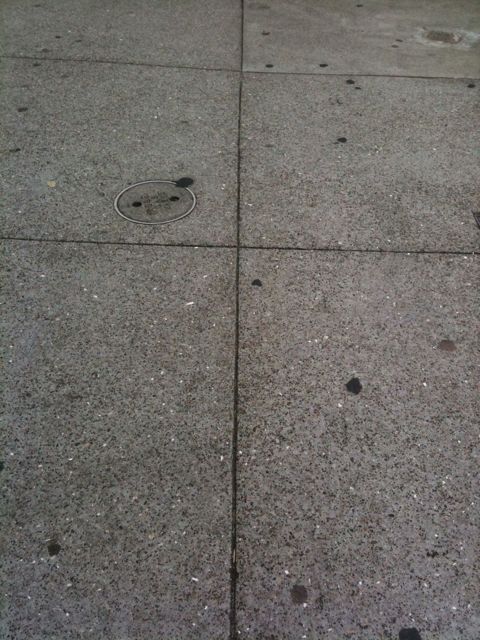
Today after treatment I felt like I’d been kicked. Not in the way that everyone else here feels kicked, but just a shadow of it. I guess I say this mainly for them – if I’m feeling this cruddy, my god, how do they endure? I have 12 more days of this. Twelve never before seemed like such a big number. I wrapped my arms around myself, looked down and beetled slowly down the street. I trained my sight on the line in the pavement. One step after another, just following the line. The tiny crack was filled with detritus – pollen, bits of plastic, crushed leaves, dirt. So much that we leave invisible.
I thought of a Russian ascetic, he was a priest, I think, in the 17th or 18th century and he and his sister (or perhaps it was his wife) were banished to the frozen barrens of Archangelisk or someplace. They trudged for weeks through the fields of snow and ice.
His companion was famished and exhausted. How much further must we walk? she asked.
To the end, he replied. To the very end.
And he continued walking.
I spoke with my friend Evan this morning. Tomorrow he starts back teaching third grade for a great school in Oakland Unified.
They notified him yesterday that instead of the promised 20 students in his classroom he’s going to have 32. I guess it’s some weird inversion of downsizing – the consequence of a bankrupt state, a failing economy and apparently a failing school system. How is that even tenable?
He was thinking that he could have 6 students at a time rotate out of the classroom and stand in the hall for a few hours. Perhaps he should declare the theme for the year to be “Great Depression”. Post a sign outside the door saying “Hooverville”. Transform the lunch line into a bread line. Teach the kids to glean fruit from the neighborhood fruit trees. In math develop some neat exercises to illustrate what happens when you spend more than you make. Teach fractions by showing how much you need to put down to by a 700k house and what happens when you put down less and what does it mean to be “leveraged”? Have a counting exercise to see how long it takes to get to a trillion. Try for a week to see what it feels like to go unwashed and unfed.
Spend a whole week just looking at the photos of Dorothea Lange and Walker Evans*, and an afternoon reading Agee’s paean to a lantern flame† until the kids drift off to sleep. Wonder why the pictures work and Agee’s dense prose perhaps does not.
But the lessons are great: There is nothing to fear, but fear itself. We’re all in this together. The first step in recovery is learning how to give. Keep it on. Keep it simple. Take care of ourselves, but not at the expense of others.
*”a conspirator against time and its hammers; his pictures testify to the selfishness and waste that caused the ruin, and they would salvage whatever was splendid for the survivors.” – Lincoln Kirstein
†“A country letter” in Let Us Now Praise Famous Men
John Hersey described in exquisite reportage how in the weeks following the Hiroshima blast the survivors were afflicted by devastating changes to their bodies. They did not understand yet what had happened to them, but their hair was falling out, they were weak, they were vomiting. What had happened to them? Matter had simply given up its energy. And they had found themselves in the line of fire. What is it about our 21st century relationship to this process that, in both its most fully expressed and its diminished form, yet strikes us still?
Anna came up for the weekend from Hopi. I met her at SFO and we took BART and the bus back from the airport. I wanted her to revel with me in the public transportation. We napped, so tired were we, and we awoke and ran to the corner theatre for the last showing, period forever in this city, of Departures, and afterwards bussed and largely walked to the Thursday night fete at the California Academy of Science. We ate hand-raised free-ranged pork tacos and watched a physics teacher be pressed between two beds of nails with a cinderblock placed on top and then hit full force with a sledge hammer. The physics teacher shot a ping pong ball straight through a beer can with a self-designed vacuum gun and sucked in a gas heavier than air so that he sounded like Darth Vader. If only to be a gear head in this city of cities and assume sufficient marginal command over matter and energy to have it do your bidding, creating magic so that all you need do is enter a destination into a telephone and the device divines your current location from the miracle of satellites and geographic positioning systems and can tell you that you need only walk 100 feet to your right and in three minutes a magical Miyazaki-like bus will materialize out of the darkness and carry you home safely to slumber.
The next day Anna accompanied me to my treatment, she witnessed the bolting, the zapping, the incremental burning of skin, she met the rad RN and the first year resident, and reminded me to keep sterilizing my hands. We walked up the block and peeked in the shuttered storefronts – the Czech bar and Mani + Nanny salon, and returned on the 38 Limited Geary to the Red Bike and dang if they didn’t make a perfect shot and I ate a peanut butter and jelly and banana sandwich with extra peanut butter and I think I could taste just about most corners of it, so happy was I. We took the bus to a thing called the Metreon and we watched Harry Potter – part of it was in something called 3-Dimensions. And I thought, man, maybe I should adapt a screenplay that has no character development and no narrative drive and just seems to go on and on with bearded wizards and murky cinamatography. It can’t be that hard. Maybe I could also start an international chain of electronic stores – those things seem to make money. We had dry drinks at the Redwood Room with my cousin Inta and ate Faux Gras – chicken instead of goose livers – that tasted of metal, metal, metal. It was night and then day and we just wanted trash so we lay in bed and we watched old episodes of Lost. We took our laptops to the Apple Store to replaced an old battery with incomprehensible innards that could no longer hold a charge and replaced some missing keys, except the replacement keys were in both English and Kanji. You see, we could just walk into a store in a place called downtown, we could just go there and we could sit with someone and they could fix it. We didn’t have to drive 5 hours to Phoenix. Anna typed “Excellent Coffee” into her phone and it told us to walk three blocks to Blue Bottle. The phone knew (no, not the phone, but a vast disaggregated database and some Software Agents that could parse the word ‘excellent’ and through some statistical arbitrage glean) that that was, in fact, the place to get the most excellent coffee. And not Starbucks or Tully’s or any other joint. And it was a miracle in itself that Blue Bottle even exists. I watched a girl with zen precision and calm, dose, pack, and pull a shot so perfect in form that I wanted to cry. It is so hard, so incredibly hard, to do anything, even the most simplest of things, with perfection. I was so happy for her, so proud of her, for being able to do it. We bought two cream puffs the size of billiard balls. We split one and gave the other to a man (god he needed a cream puff) standing outside.
Later we lay in bed and you see, there was this thing called The Internet, and a speed, it’s 6 megabits per second – it can even be 10 or 15 megabits per second in this city – and with this speed, and this thing called The Internet, you can hit a virtual button in an application and a few minutes later have possession of the “Cold Cuts” season 5 Soprano’s episode, and get this: you can watch it. Just like that you can watch it. And in the middle of the episode, if you get hungry, really hungry, and you want a cheeseburger, you can type the words “Bill’s Hamburgers San Francisco” into your phone and hit another virtual button and a phone number appears and the number dials (except there are no more dials anymore, nothing even remotely like that, instead something called Software transmits a sequence of something called Bits to a 5E Switch through a series of handoffs between cell towers. It’s all energy, all different states of energy that have been encoded with vast amounts of information) and then you’re talking to a man at Bill’s Hamburgers – he’s not even beside you; he’s actually somewhere else a few blocks away- and you can tell him that you want two cheeseburgers and you ask if the fries are handcut, and my god, he answers, yes.
So then, you and your wife, you can put on your shoes and scarves and walk out into the cold mist. It’s 10:30 at night by the way. 10:30 in the middle of the friggin’ night and there’s a place, you can walk there, and it serves burgers. Perfect burgers and handcut fries. Outside your door is not just endless desert and buttes and stars and darkness, but instead buildings, and a movie theatre premiering Inglourious Basterds, and the hiss and roar and of the 1 California sucking from the overheard wires its elixir of energy that propels it on until it disappears in the foggy darkness. And then, there it is, Bills Hamburgers and the man is there, but in flesh and he hands us the grease spotted bag in exchange for crumpled green paper and soon we are home back in the same bed, taking bite after tasteless bite while Tony Soprano avoids and evades and shouts at Dr. Malfi that it wasn’t his fault that he hadn’t been there to help his cousin Ton on the heist 17 years ago, he would have been there, christ he would have, but he was jumped by a bunch of motherfucking cocksucking jiggaboo bastards. And you can wish that you could write, hell – deliver, a line so ugly that it perfectly expresses a person’s character. A line, a mountains of lines, written and delivered over seven years that dove so low (Oh Mary-Elizabeth and Barbara, you’re both going to hate me for this) that they emerged on the other side as arguably some of the best writing ever in the American language.
The next day, Anna dried herself off after her morning shower. We lay in bed and she turned to me. She had looked at the towel in the bathroom.
You’re losing your hair, she said.
Saturday afternoon. Anna and I sitting on the concrete floor of the Ferry Terminal. Exhausted I stare at the passing ankles and calves of the other shoppers. For 3 hours I’ve worked to inhale small portions of delectables. A mortadella hotdog from Salted Pig Parts tastes pallid and anemic. The fresh mozarella and clabbered cheese curds and goat cheese signal rancid. I want Tomales Bay oysters, imagining sweet cream, but the thought yet leaves me nauseous. I sample four gelato flavors: Dulce de leche, dark chocolate, vanilla bean, and grapefruit Campari – all marginally palatable in the same way. Butter hits the tongue like oil.
This vast building is a temple dedicated to the servicing of the two inch piece of flesh inside our mouths. Sitting there on the floor, I turn to Anna and tell her that I would rather have my dick cut off* than forever lose my sense of taste. She rolls her eyes at me. That doesn’t give me any great comfort, she says. And please don’t put that in your blog, she adds.
I have to think for a moment about my sentiment. Off the bat, I definitely hope no one takes me up on the offer. But then I wonder, why the thought? With diminished taste I feel a bit as if I’ve been severed at the waist – there is so little pleasure in feeding. And certainly, the feeding and preservation of one’s own body could preclude the procreative urge. But it actually shouldn’t work that way. The desire to pass on my genes should outweigh everything, absolutely everything, else. The Senegalese gentleman (see below) on some level actually had it right. And so would the equation be altered for me if I didn’t already have a child? If push came to shove which would I choose?
Apparently there was some big brouhaha a few years ago when Carlo Petrini visited the Ferry Terminal. In his book chronicling the history of the slow food movement, he lambasted the market and epicurean stalls for being too precious and classist, for catering exclusively to the well-heeled.
Forget it, Carlo. Do you really mean that? First off, twenty years ago in the US, food terroir basically didn’t exist. And neither did any of these meats or cheeses or exquisite heirloom vegetables. And now, thanks in part to you, they do. And the world is a better place for it. And right here, right now, don’t tell me about the bourgeois power structure undergirding 17th century portraiture. A blind man will gladly take anything he can get. A three dollar burrito? A dollop of tsar nikolai beluga? I would take anything if I could simply taste it.
*I lifted this line from a story told by my friend Emmanuel. Years ago he was riding in a Metro car somewhere in Paris. For the sake of the story, I’ll say that it was at night and the car was practically empty. Emmanuel had spent three years in the Peace Corp in Senegal and while there he’d learned to speak Woloof. So years later he’s sitting in this Metro car and it’s just him, two West Africans and an elderly priest in his black vestments and white collar. Metro doors slide open and a stunningly beautiful woman steps into the car. One of the Africans looks to the other and says in Woloof, if I could sleep with that woman for one night, I would have my dick cut off. The other fellow laughs. The woman and priest sit quietly unaware. Emmanuel stares ahead stonily trying to keep a straight face. A few stops later the priest stands to exit the car, but before doing so he turns to the first gentleman, smiles, and says in perfect Woloof, did you really mean that?
What I love: that among the five participants, the full story exists only in the mind of the Woloof speaker who remains silent. And that always there are those ethereal men of cloth hovering about, threatening to keep us honest.
This is where you get to hear the non-fun parts of what it’s like to have a portion of your body progressively cooked. I’m lucky- so far I’ve experienced Barbecue Lite. God knows there are people in this building who are experiencing far worse.
1. I feel tired. A deep tiredness that overtakes around 10 or 11. Sometimes noon. When it hits, if I can, I just need to lie down and sleep. Usually two hours. It’s hitting right now in fact so I’m thumbing on autopilot as I ride BART down to SFO to meet Anna. The tiredness feels as if my bodily reserves are all being enlisting to help repair the damage being inflicted on my neck.
2. Hunger. I need to eat constantly – every 3 to 4 hours, I crave protein and fat. In the mirror today my body was beginning to appear ever so slightly withered as if it was beginning to consume itself. Which it is. CatsM lost 35 pounds and would spend a day nursing a milkshake that killed her to swallow. Losing 10% of your body weight leads to a feeding tube. You don’t want the feeding tube. For me the Maginot line is 135 pounds.
3. Taste. And here’s the rub: I’m hungry as hell, but food tastes like clay. Over the last week it’s felt as if layers of my taste buds have been peeled back resulting in a uniform deadening of taste. I began to lose salt first (soy sauce now tastes sweet. Salami tastes like sweet meat), then some of the more nuanced flavors – cocoa, aromatic herbs – and now I’m even losing the taste of sugar. I had a bowl of grapenuts with milk and bananas this morning and each of the elements tasted the same: clay in three forms – hard, soft, and liquid. Yesterday I had an italian hoagie from the Philly Cheesesteak shop. I’d had one the week before, and truly it was one of the best I’d ever had – these guys really really know what they’re doing. But this time round there was little of it. The textures were all the same, but as for flavor I had to summon it from my memory and imagination. I think of that story from the intense famine of wartime japan. Once a day the members of a particular village would gather in a room and each would be given a few grains of rice. They would place the rice on their tongues and a village member would slowly describe a delectable multi-course meal. Their eyes shut, they would listen to this bountiful feast.
Of paticular interest is water: it tastes like metal. As does butter. As do a lot of things. And I still have sour. And I still have bitter. Which makes me wonder if pleasurable sensations are the gratuitous ones and are hence the ones to leave us first. What remains are the foundational sensory nerves and corresponding pathways – the warning bells and flashing red lights that tell us DANGER DANGER something is going wrong. It prevents us from licking lead (though isn’t lead paint suppose to be sweet? I can’t recall from when I use to eat it as a kid. And antifreeze is suppose to taste kind of nice – that’s why condors go for it) and chowing on arsenic and cadmium. At the very least our tongues need to work well enough to prevent us from killing us. That’s what drove the evolution of taste in the first place – it’s job was to steer us clear of the bad stuff and – as in sex – incent us to steer toward the good. So you peel away the pleasure. And then there’s pain. When all is said and gone, isn’t that usually what we’re left with?
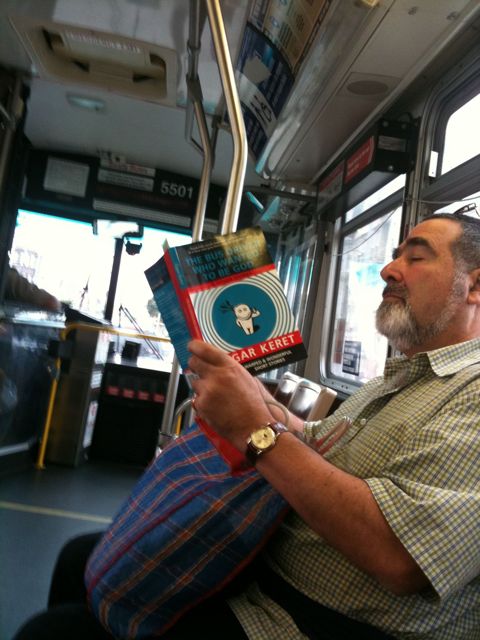
The man sitting in front of me on the bus was reading this collection of short stories. It’s been turned into a claymation movie – $9.99.
One story begins: there is a village in Uzbekistan that sits at the gates of hell.
Which may very well describe any village in Uzbekistan. Or any village in the world for that matter.
Just saw Departures at the neighborhood theatre. The movie is on it’s way out tomorrow, I suppose to its final resting place in the Netflix archives. If you haven’t, please see it.
Better to leave the premise a surprise because it’s not at all what one would expect. Enough to say that it’s about the care and feeding and dispensation of flesh. The story is one of those emissaries from another world that under normal circumstances remains invisible. And it could only come from Japan. Visually, it has some of the stillness and surreal of miyazaki animation. And yeah, it’s sentimental, but also possesses a memorable clarity and precision and artifice, that reminds me in a lot of ways of origami.
On the bus to the Fillmore on this overcast San Francisco evening I’m cool with anything sentient and material and that promises release.
—-
7:25 am warm foggy morning
Coda
I need to book out of here so I get to my appointment on time and don’t get berated by my rad therapist.
But I can’t stop thinking of this movie. So what the heck, it’s about a second rate cellist who moves back to his hometown and gets a job assisting with casketing – the ceremonial preparation of bodies before they are placed in coffins. I’ve never seen 6 Feet Under, so maybe this is all worked-over territory, but I’d like to think not.
What I love. I love how the practitioners express no emotion, so that the slightest gesture has titanic force. And how they unfold the burial kimonos by partially enrobing themselves, how each day they consciously reestablish their affinity with the dead. And how after the young cellist deals with his first body – an old woman who’s been rotting in her home for two weeks – he comes home to dinner and his wife and he vomits in the sink and then uncontrollably kneads her flesh and you realize as he does the wonderful plasticity of living flesh and the power of any body when life courses through it.
And I love the intimacy between the casketers and the bodies they are preparing, an intimacy and respect that the bodies may have never felt even in their lifetimes, and how the casketers engage with the most perfect sort of dispassionate love.
And the recognition of the intense sensitivity required to do anything well, and the difference between doing something well and not, and how the cellist’s wife comes to accept what her husband does and she can say proudly, he is a professional.
And I love how the boss says he does all religions – buddhist, muslim, christian – makes no difference to him and you come to understand the power of his own creed. Unless you want to die, you must eat, he says. And if you must eat, eat well. Eating is good, he says. So good that I sometimes hate myself.
7:40. Gotta run.
Just in from my friend Danny:
What strikes me first in this email is not the email but the To: list. First, it evinces that you are a collector of people. I’ve been hearing about some of these people for over 20 years. Second, I notice in the list a few curious and bold names, particularly David Eisele and Jeane Quivey. This is an interesting stratagem, to include the yanker and the zapper, in your update. They either will despise you for trivializing their life’s work (which in both cases is momentous and unachieveable by 99%+ of humanity), or bond with you for your irreverence to their acheivements.
He’s right on that. I guess I am a collector of people, in the same way that people are collectors of things. We treasure the memories that we have assigned to things (all those tchotchkes in our houses are mnemonics intended to remind us of different events we’ve experienced in our lives. Except some times we cease to see them.) And resident in people are all those shared memories.
To lose people is to lose a part of oneself.
But beyond that, people are so friggin’ cool.
Regarding the bold inclusion of my surgeon and radiation oncologist, I guess it’s symptomatic of the experiential Tourette’s that I’ve been expressing of late. Do something bold and unqualified regardless of consequence. At the same time, I feel I need to cc them in the interest of full disclosure. And I also hope it will keep me honest.
Dr. Eisele, Dr. Quivey, Dr. Shiboski, Nurse Tang – if you do choose to read this, I’m counting on you to keep me honest.
And lastly, I have only the utmost reverence for the yanker and the zapper as practitioners, but more importantly as human beings. Any trivialization of their life’s work and their persons in part reflects my own inability to communicate the immensity of it, as well as the responsibility we all have to keep one another humble. In the end I’ve chosen to place my well being in their hands. I doubt there’s any higher commendation.
I met CatsM today. For those who haven’t read below, this is the chick who had a stage IV tumor of the parotid. Two months after finishing her last cycle of chemotherapy the punks have recurred in her lymphatic system. She said she’s actually proud of how strong her cancer is – it resisted even the goddamn chemo. And unfortunately this gal is worthy of a strong opponent.
It turns out I was wrong: when I wrote my last post she wasn’t within a six mile radius. It turns out that at the time she was only two blocks away. We’re living in the same neighborhood. I’m lucky. I had a tumor. Everyone around me has cancer.
But there we are, the two of us in this coffeshop, both of us members of the Club of Scarves intended to hide our beautiful exquisitely rendered scars and protect our forever sun sensitive necks. So where we at? I’ve had two surgeries so I’ve bested her one, but she had some chemo during her rt which made the whole experience pukable. Her body is a toxic soup of chemicals and nasty things that she’s trying to kill and in the heart of it she didn’t shit for two weeks and she puked up so much of the world that eventually she was puking up just water. Hands down she’s fighting the bigger one. Bless her heart. That’s actually a request to whomever is reading this.
She offered to take me out – I’m a guest in her city afterall. I told her forget it, I’m actually on a medical vacation.
Well I am too, she said.
Really? I asked.
I am so lucky, she said. So damn lucky. Before I had this, I was so unhappy. I was burnt out. I hated my job. I was fighting with my boss. I was fighting with my boyfriend. Since my diagnosis, it’s been the happiest time in my life. I’m so happy.
I wouldn’t believe it if I didn’t know it to be true. My 53 year old Czech Chernobyl friend tomorrow boards a plane to Tahiti. Last fall she was at the base camp of anapurna. This morning she bought a bowl of soup for her lunch, walked outside and promptly gave it to someone asking for change. Whatever. She’s spreading her wings at a point in her life when most people are tucking them in.
And I whither before the clear eyed gaze of the head scarved women who walk so calmly, scared, and forthrightly into the clinic.
Each morning I bump space with an elderly Vietnamese man in the men’s waiting room. He doesn’t speak much English and he must be in his 70’s which puts him in his 30’s during the Vietnam war. That guy no doubt has a story to tell. The first couple days we sat across from one another and nodded. A few days later we started to smile. A few days after that we would look at each other and laugh. It turns out we share the same linear accelerator table. If I show up early I scoop him. If I show up late he takes my spot. A few days ago that’s just what happened. When he stepped out from the treatment area he pounded me on the shoulder and laughed long and hard from the gut. He and I have never spoken.
It’s true that you can get there. But who among us would willingly pay the price?
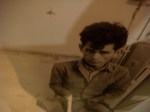
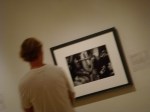
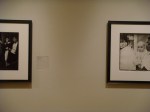
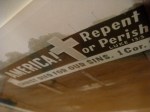
What follows Robert Frank’s The Americans?
In part it has to be the act of looking at Robert Frank. When looking at any two pictures of his, you’re looking at three. The first, the subsequent, and the third that consists only of the connection between the sense of the two other pictures. The third, the richest of all, exists entirely in your head. It does little good (certainly lesser good) to look at a Frank picture on its own – they were not meant to stand alone, though many are quite capable of doing so. I doubt that there’s a single Frank image that doesn’t reference all those that precede it, or even the ones that are to come.
So you really can’t take a picture of a Frank picture. Unless of course you do it obliquely. Or take a picture of people looking at Frank pictures. Or snap one of the throwaways. All of the dang throwaways.
That guy took a header straight into the maw of life.






Night sky in San Francisco, taken in Union Square a few days after I got here.

© Andrew Lewis
It was actually just the pavement. But sometimes it’s fun to pretend…
After my simulation my friend Danny and I sat for a while in the lobby of Mt. Zion discussing the course of treatment.
The stats:
Without radiation: 40-90% of recurrence. 100% chance of losing the facial nerve with further surgery. In addition 2-5% chance of malignancy. Using ballpark math, that equates to a 1- 4.5% chance of having a malignant tumor or and/or a 40-90% chance of eventually losing the facial nerve.
With radiation: 5% chance of recurrence. And a .001% chance of a secondary malignant tumor unrelated to the parotid. Plus the side effects. That leaves me with: .025% chance of a malignant parotid tumor, a 2 – 4.5% of losing the facial nerve from a recurrent benign parotid tumor, a .001% chance of a secondary malignant tumor, and a 100% chance of reduced blood flow to my jaw and teeth, as well as heightened sensitivity to the sun.
Of course, the stats are generated by people. And in general I don’t trust people.
Can I have a moment to think about it?
While pondering this with Danny, a crew of firemen charged into the building and anxiously began examining some piece of equipment behind us.
You never know what or when its going to blow.
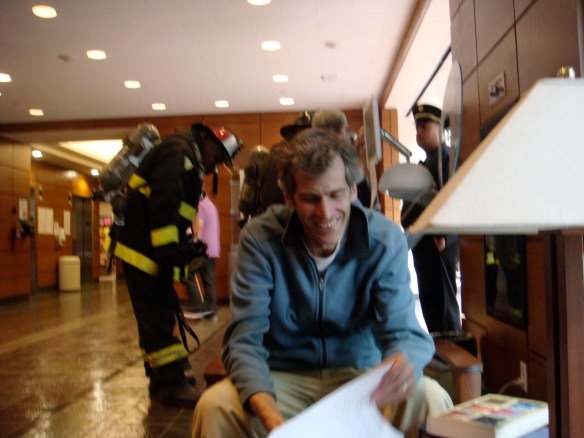
© Andrew Lewis
These pictures were taken during my simulation in which they made my mask and made some tomographic images to develop my treatment plan.
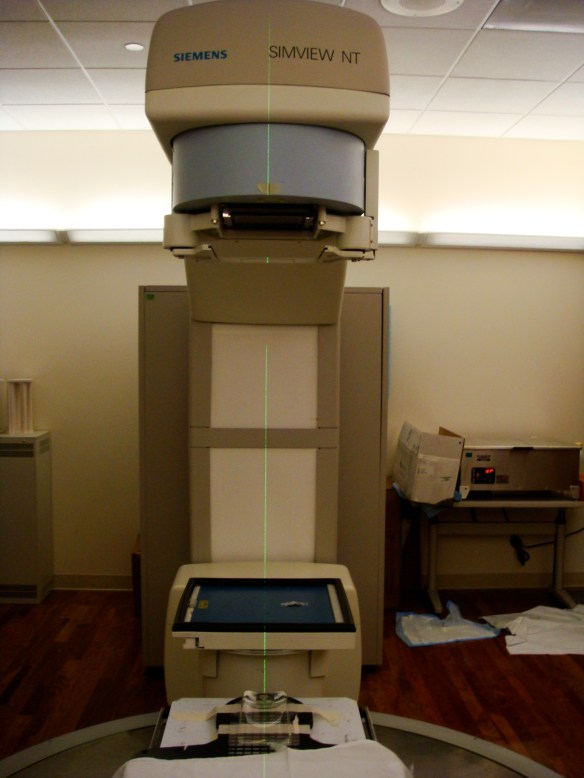
© Andrew Lewis
I’m becoming pretty intimate with this machine. The green laser beam is used to line up my body so the right areas get zapped. The lining up part still seems a little fishy to me.
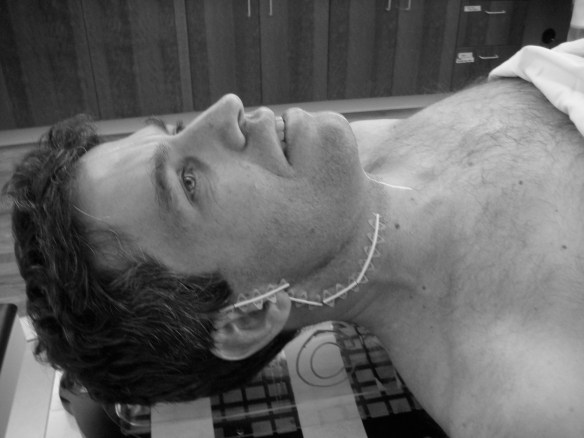
© Andrew Lewis
The radiation oncology resident taped a wire onto my neck so they could better identify the surgery field that had been dissected. I like this picture because it feels particularly corpse like. It’s always a nice reminder. Apologies to those who don’t want to be reminded.
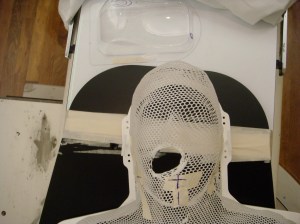
© Andrew Lewis
This is my friend. They created the mask during my simulation in a process that was similar to water boarding except without the torture. They soaked the compound-impregnated mesh cloth in warm water, draped it over my face and bolted it to the table. My hands were bound with strips of cloth, pulled down and tied to my feet (the idea being to keep my shoulders taut). I lay there for 20 minutes, waiting for the thing to harden. I like the anguished Munsch-like rictus – if ever there were an outer expression of my inner state of being.
Note the masking tape with the guidelines penned in with a felt-tipped marker. The mouth prosthesis intended to keep my tongue in place was fashioned from a popsicle stick, half a piece of cork, some masking tape, and a pack of sculpy. We’re talking Apollo 13, here.
I love these guys.
There’s a lot of concrete in this town. Some people laid this stuff. And now they’re all dead. We traipse across their handiwork, this enormous tombstone, with nary a thought of them.


I awoke this morning for the first time in San Francisco feeling a little scared. I lay for a long time in the darkness listening to the wind chimes and the dirge of the fog horns.
I dreamt last night that I was being chased by a man on a motorcycle. It was dusk. I was in a moving truck and I pulled off the road into a snowy field. I climbed out and dove head long into the snow and I buried myself many feet below except that I closed myself in entirely and then I could no longer move. I could no longer breathe.
I read last night about competing methods of rt and was reminded again that this is no child’s play. This shit is something that under normal circumstances one tries to avoid. How could I so willfully and with relatively little forethought have subjected myself to it? I’ve probably spent more time deliberating over whether to purchase a particular car.
Last night I also cruised through message board posts from people with questions who were undergoing similar treatment. Call it bad popcorn. There is so much body wreckage minor and major in this mine field – I don’t want to tread it. Except that I am. I awaken right in the middle of it.
In an Italian restaurant trying to tank up before I go to bed. The wine tastes sweet, but flat; salt taste is retreating from my palate; water tastes metallic.
An opportunity for another gratuitous post.
I just visited a board for folks with salivary gland tumors. It’s not a community that I necessarily want to be a part of (who does?), but I’ve been able to glean some useful experiential information from the folks over the last few months.
A while ago I stumbled across some posts from a gal, CatsM, who had a stage 4 malignancy of the parotid. We’d been diagnosed at about the same time except that i’m stage 0. We share the same surgeon. And I was taken by her tone: flip, irreverent, humble, and smart. I picture Hilary Swank in Million Dollar Baby. She was set to lick this thing and her course of treatment was full tilt: radical disection and removal of the gland and probable severing of the facial nerve, chemo, radiation in the basement of Zion. Come June she was all done with and things looked good. A few days ago she was readmitted with a high fever. An FNA revealed that the cancer has probably spread to her lymph nodes.
Over the last eight months I’ve probably spent 45 minutes thinking about this girl. Which is pretty disproportionate given that I don’t even know her, and whatever I know of her comes from a handful of sentences she’s posted to a message board. She’s in her 30’s. She’s engaged to be married to a pretty great guy. She rockclimbs, plays tennis, kayaks. Her parents believe in god. She probably doesn’t. But she probably believes in something. Right now she probably rests within a six mile radius of where I now sit.
How is it that people – not even people, but their voices – not even their voices, but our sense of their voices – become lodged in consciousness? And how is it that at this moment I care more for the wellbeing of this stranger than all the other strangers I pass in the street?
I’d like to believe that it has something to do with her, something that is unique to her – call it voice. But what to say, my empathetic response is probably founded in a sense that in one way or another, sooner or later, she and I share the same fate. And that she, in the most courageous way possible, is sustaining the blows before me. And if for that reason alone, out here in the ether, I’m obligated to watch her back.
On my way to dinner, talking with Mazie while standing outside an Italian restaurant on Clement.
Something about the eyes, the softness in the smile, the angle of the nose, the crack in the face.
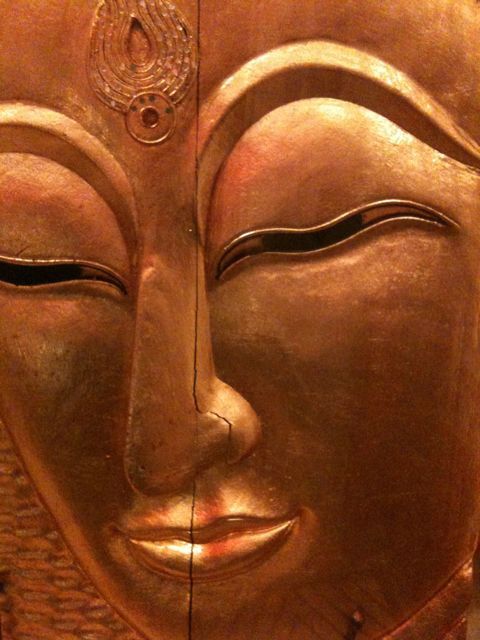
Nothing remarkable,
but at the same time fantastical.
From my perspective I can gather a little information through the white mesh of the mask. I see a trace of the green laser beam cutting across the tip of the tongue depressor. I’ve tried to check if it hits the same place each time. Sometimes I can see the face of the linear accelerator as it repositions around my head. When they shoot x-ray images I see a broad deep blue flash.


These people have quite a business. We spend our lives accumulating mountains of shit that we spend our lives keeping in motion. These folks supply all the tools and materials needed to keep it in motion. it’s a grim enerprise, really.

11 a.m. On the bus on my way to Patrick’s to help him move. All the san Franciscans are awakening and returning home from their sex parties. Brilliant light, cool air now warming. I would drive but I’m loath to give up my parking space. And besides, from the bus I have at least a few minutes to write and post from my iPhone.
What is the salient image here? The smiling woman standing with her stained comforter? The prep cook catching a smoke in the doorway of the restaurant? The unshaven Hispanic wheeling in the vegetable delivery on a dolly? Or the man in the black sweater and draping pink scarf taking it all in?
Descending into the castro, we pass the storefront that once housed Harvey Milk’s camera store. Why did he own a camera store? What was to be had in it? I doubt it was the cameras. It must have been in the film processing. In the 70’s I’m sure negatives would have passed through that shop that would have violated obscenity laws, convention, what we even desire to see. But those are the images that must be developed. Those are the images to seek.
I just finished watching Atonement, the flick based on the Ian McEwan novel. In the story, a young girl and budding writer witnesses a series of acts that she scarcely understands and tells a story that implicates those around her and changes their lives forever. For the rest of her life she tries to find a way to redress her mistake.
During the war, as a nurse she tells a dying soldier whom she doesn’t know that she loves him, that she will marry him, that all those whom he knows are fine and well, and she confesses only one truth, that her name is Briony.
Near the end of her own life, long after all the participants are dead, she finds some measure of atonement by writing a book, a true and honest account of the events – no rhymes, no embellishments, no lies – except that she restores the individuals to their original state of happiness.
She believes, we want to believe, in the gracious lie. But isn’t this the writer’s conceit? To think that we can undo what we have done simply by writing about it, by telling yet another story, yet another fabrication? That somehow our imagined understanding of people is commensurate with the people themselves? I want to tell Briony that atonement must fundamentally be not a statement, but an act.
And so why does she wait until the end of her life to write this book? This is the tragedy, I think.
The stories that we write are not necessarily those that we were meant to write. And if it takes a long time to write the stories we were meant to tell, its not for want of courage, but perhaps more due to a lack of wherewithal. She couldn’t have written it because as she advanced in life, she still didn’t understand, or only understood imperfectly what she had done. Even at an age senior to any of the participants, we may lack the clarity and prescience to understand and correctly describe and transmit experience. And we want to get it right, or perhaps even more so, we really are afraid of getting it terribly wrong. But in the end, we’re left only with our imagination and our pen, and we can only do what we can. The heartbreak of it all.
I’m midway through my second week.
This morning for the first time I decided to open my eyes and see what I could through the mask. The face of the large machine (I don’t even know what to call it) slowly circled and hovered proximate to my neck and jaw. I felt like I was staring into the mouth right at the pearly teeth of a great white.
What if someone comes up and offers you two million to do six rounds with Mike Tyson? Yeah, sure, I can do that. So first round you hop into the ring, for two minutes you dance around a bit, all is good, fun even, and then he pops you one. And then things change. This suddenly doesn’t seem like such a good idea anymore.
My side effects have begun to manifest themselves. Yesterday my morning cup of coffee tasted funny. My saliva is turning sticky. The inside of cheek feels abraded. And if sunlight strikes my neck it instantly feels like a sunburn. No one need remind me to keep it covered.
From the very beginning of this adventure I’ve wondered about the Homer Simpson factor: what happens when you put your average clod in close proximity to a nuclear reactor?
Yesterday in my weekly meeting with Dr. Quivey I asked how they knew if they were succeeding, how did they know they were actually getting the tumor cells?
She looked directly at me with a gentle clear-eyed intensity.
We don’t, she said. And it’s incredibly frustrating. We are in the position of only being able to observe and manage the negative side effects.
But how do you know you’re right? The machines for example – do they ever get out of whack?
The resident quickly piped in. The machines are calibrated every night, he said.
Quivey concurred and added that they check and calibrate the intensity every day. As for the beam vectors they regularly check the alignments.
She once again smiled at me. But they’re machines, she added. And I don’t trust machines. Machines are not to be trusted.
And the 40 variable algorithms?
The same, she said. Sometimes we need to lie in order to get the algorithm to do what we want.
She seems to find great pleasure, glee even, in this. I think of Ahab’s mad glee that drove him to the bottom of the ocean and left Ishmael floating in his coffin. But that glee somehow also tells me that my rad onc is no Homer Simpson. To revel in the risk and the uncertainty, you must first understand deeply what those risks and uncertainties are, perhaps more deeply than all those around you. And therein lies the beauty: those who profess to know are liars.
On my busride home today I spoke with my friend Patrick. He asked about my plans and I explained that I needed to unpack, move into my new place, fix the Internet connection, write a bunch, perhaps do some other stuff.
My god, you’re on fire, he said. Perhaps this radiation is turning you into some kind of super hero. Maybe you should get it on a regular basis, he said.
He’s absolutely one hundred percent right.
Perhaps everyone should, I answered.
Today I gave a doll to Dr. Quivey, the radiation oncologist managing my care. When I first told my daughter her name, she laughed and asked how I could possibly have a doctor named Quivey. Kwivi in Hopi translates to “particular” or “detail-oriented” or fussy. My Hopi friends concurred, though, that when it comes to a rad onc doc, this is probably a good thing.
The doll I gave her represents Dawa, the sun, but represents more deeply the radiant energy that not only grants us life, but has the power to take it away as well.
He looks nice. I’ve been looking at him for years now, but cannot at all profess to understand what he really means. But I do know what I see. I see rays represented by feathers – which in Hopi cosmology are also the vessel and vehicle for prayers. Eagle down is symbolically conflated with moisture and smoke and the seminal force that through intent is transmuted into life.
And I see that his mouth – the source of breath and utterance – is also represented by a prayer feather. The lower portion of his face is blue, the water world – the subterranean from which all life emerges. The upper is composed of the two halves of the celestial vault and the cyclical waxing and waning of energy and life that occurs each day and in each year and in the course of all of our lives. The beaded horizontal line appears to be where we are – the thin material and terrestrial plane in which we exist for a moment. And the vertical bead suggests the channel by which we emerge from one world to the next. It’s the birth canal and the point of exit when we die. And if we live right, it’s the gradual and wonderful process of unfolding as the world reveals itself over time.
I feel grateful to my doctor and (hopefully limited) executioner. I wouldn’t want it any other way.

© Andrew Lewis
I told my brother about the earlier posts. In a gracious gesture, he said they could stand, though I know he doesn’t necessarily want his life splayed across the Information Highway like so much roadkill.
He also cc’d me on an email which I’ll post in part:
“i can say too that a week later i have become more certain than ever that the healing power of love and music is quite profound.
now, for the the next six weeks i have a singular focus, and that is to be there for andy and for me this simply means that i be mindful in keeping him in a loving space within my thoughts and i truly believe that the more people that do this the better he will be as will we all.
so…here’s the picture…every morning…monday through friday…andy is getting these high energy radiation treatments from a machine that was conceptualized and manufactured in the heart of the imperium as a product of love by a people that care for each other enough that they have created an instrument that can bestow life in a sense upon each of us.
thus i say, that we as a community must simply think of andy being embraced by love every morning between eight and nine am as he goes through what is in essence a profoundly healing experience.”
Machinery of love. Yes.
 Snowflakes Edge