Blown breaker

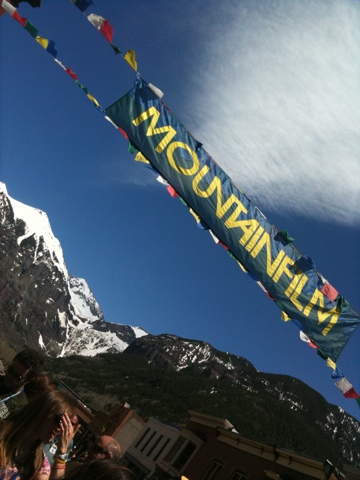
Midway through Skateistan.  Power blows.  And the screening turned into an improvised conversation about the valley floor, Mountain Film, and social action until someone broke out a fiddle.

This is the only film festival I know of that actually doesn’t need any movies.

20110528-052417.jpg

The Bowl and the Spoon

This year they’ve declared Mountain Film, a zero waste festival. That means I’m carrying a small canvas bag containing a cup, a plate, and a utensil. The initiative came directly from the screening of Bag It last year. Since then the presence of any single use disposable in my life has come to feel like a mortal rather than a venal sin.

I’m grateful to the festival for upping the ante. We’re all grownups, after all. They don’t need to give us plastic chum. They can ask us to bring our own plates and we should be able to figure it out. Stores can stop giving out bags and we’ll get it.

But their policy summons even greater questions and action. Candidate rules to live by:

1. Don’t buy anything. Ever again. In my life. Why should I? I live at the top of the food chain in the richest country in the world in the twenty-first century. What possibly could I need or want?

2. Don’t buy food unless I’m hungry. Truly hungry. Am I eating because I need to or because I want to? And if I want it, do I really want it?

3. Try to see the whole life of the food. Where did it come into being? How was it harvested? How did it come to me? Eat only those plants and creatures that I know.

4. Substitute human energy for fossil energy. This is a big one. Where can we use our hands and bodies and not rely on the grid?

5. When it gets dark let it be dark. Darkness is a gift from the universe. Why mask it with light? What a colossal waste.

6. Be where I am. Why talk with someone far away rather than the person right next to me? And why look in a device rather than the vista ahead? How much energy could we save if we weren’t trying so hard to be somewhere else?

7. Think twice before flipping a switch. Any switch. Every switch incrementally warms the world.

Anything anybody would care to add?

What I Told Them

That in some ways the world that greeted us when we first came here no longer is. And in other ways it hasn’t changed. That both make me feel equally sad.

That they will remain. That they need to look after the farmers and after the fields. That I attended the junior high promotion and felt these little lives moving into small and uncertain futures. That a boy who liked Mazie didn’t even finish the eighth grade.

How can spring feel so autumnal? I will miss this sky. This air. The landscape of people who have been part of our lives. But many of them have already gone on and I’ve mistakened my memory of them for their actual being.

But these ravens for now actually are. And I want to hang on to that.

They sat quietly. And they listened.

20110525-074224.jpg

Ravenous

Physical experience excavates language.

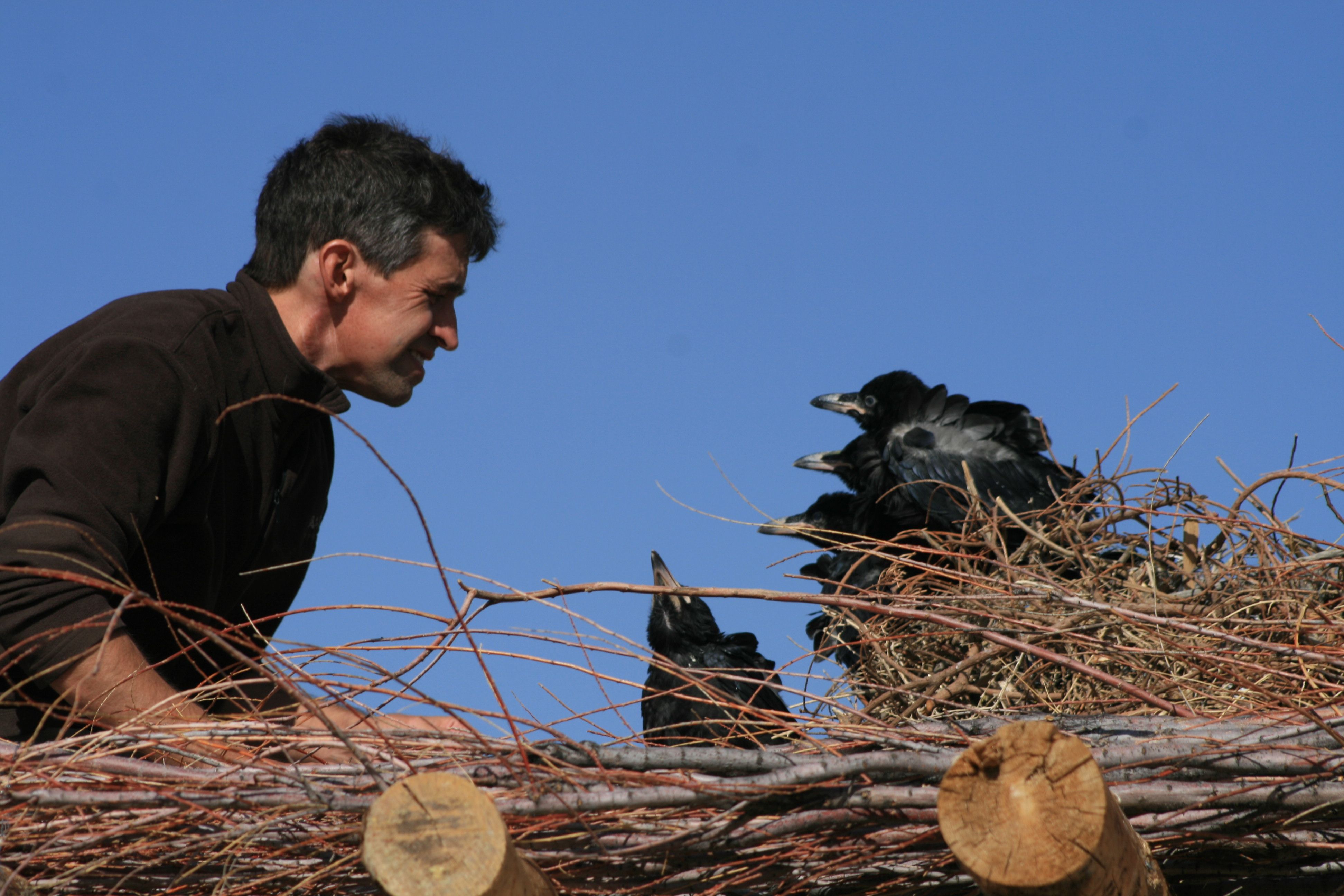
Never thought to what that word means – never could really understand what that words means until I had to keep fed a pack of starving ravens.  At dawn, their call is deafening.  I climb atop the ramada and they practically throw themselves at me to get their morning allotment of milk sodden bread and elk meat.  Once they’re sated, I climb down.  An hour later their calls are deafening.

This morning the parents fly over and call loudly when I begin feeding.  I don’t know if the fledglings cry had changed to a distress call or if the parents simply saw me.  They circle and call excitedly, but don’t appear defensive.

I’m sure they recognize that I’m feeding their young.  Are they expressing curiousity?  Or gratitude?  Or perhaps summoning the fledgelings to flight?

Last night I took the dogs to the wash roost.  What I took to be the health care parents and the wash parents were perched in the tree, looking north toward our house.  I gave my customary raven cries.  Both sets of parents circled and accompanied me nearly the entire walk back to the house.

I prefer their company to that of people.  And in that way they’re feeding me, keeping my hunger at bay.

Choices

Bernd Heinrich is right.  If you have a choice, choose the ravens over attending a meeting.

These birds have derailed my life for a week now.  Life is that stuff that happens when you’re supposed to be doing something else.

Now comes the hard part.  To the best of my abilities I have to starve them so that they’ll call out for their parents.  And as further incentive I load the ramada with dead carcasses.  A flattened rabbit from the road.  A pair of rotting rattle snakes killed by Health Care.  Some elk meat from my friend Kerry.

No luck. We leave to Flagstaff for the weekend, leaving the birds to their own devices with no people around.  When we return they’re famished.  And no signs of the parents.

Each morning they caw loudly, looking skyward.  By late morning I relent and give them food.  They recognize my voice now.  Nice for me.  Not good for the ravens.

But I love them.  And I’m glad they’re in our lives.  They’re perhaps the only things keeping me sane at the moment.

Feeding time

Nesting Instincts

They can’t live in a box forever.

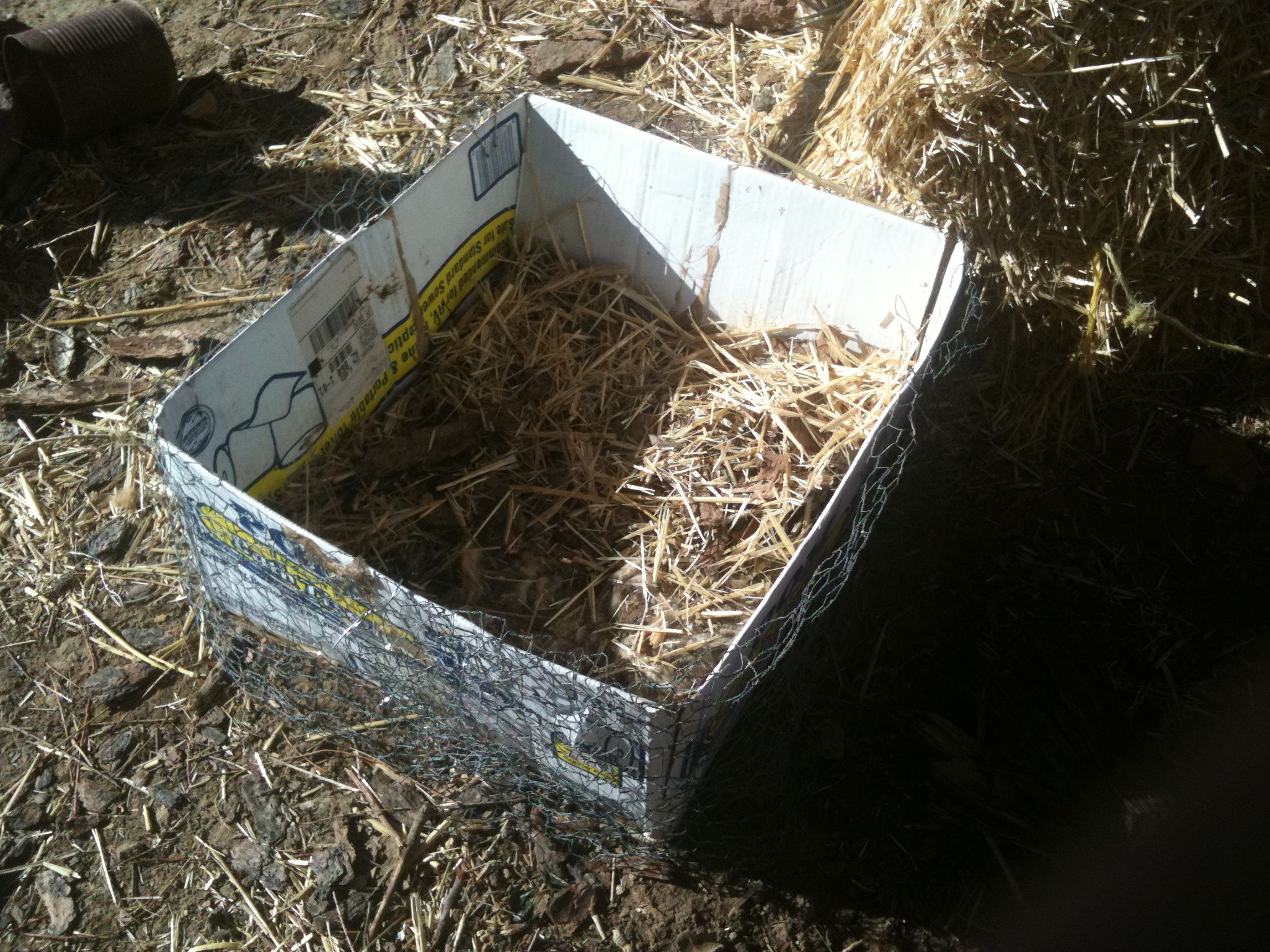
But how do you build a raven’s nest?  I don’t speak raven, so I can’t ask them.  I start with their homely toilet paper box.  I wrap it in chicken wire.  One of our chickens checks it out and gives her approval.

raven box

I walk to the wash and retrieve the remaining nesting material that had been discarded there.  The whole mass of twigs and matter smells musky and wild.  It feels true to what the raven is and should be.

One of the nesting pairs out that way follows me all the way back to housing, alighting on the ground every few feet.  I assume it’s the male.  And I assume he recognizes raven nest stuff.  And I assume he’s wondering what the heck I’m going to do with it.  He stays with me, long after we’ve passed the brood he’s protecting.

At home, I gather additional twigs and matter from the yard.  I now have to think like a raven. What stuff is pliable?  What is warm?  What is too long or too short?  Those are some of my criteria, but I have two hands, ten digits, clippers, and chicken wire.  The raven has his beak.  What does he consider?

Even with all of my tools, assembling the nest takes the better part of the day.  And I’m left in awe of my feathered friends.  All of their twigs are of near uniform length and diameter and woven together into a complex tight mass.  I have no idea how they do it.  Where we live, there is a severe housing shortage and half built homes litter the landscape.  People want houses built for them.  The damn ravens just do it themselves and their construction requires monumental effort.

Their nesting material is packed with dog hair, human hair, couch stuffing.  I recognize some of it.  A lot of it, actually.  When we clean our house we empty the vacuum cleaner in the compost pile.  And the ravens have raided it to insulate their nest.  The hair is my hair.  The fur belongs to our dog, Mango.

I’ve positioned the nest on the far edge of the ramada, as far from the house as possible.  As I weave in the last few twigs, parental instincts kick in.  This place may appear safer to the ravens, but in fact it’s not safe.  Not at all.  It’s perched adjacent to the service road.  My poor estimation of people surfaces.  Some farmer will come and kill them.  Or a Health Safety Office will deem them a hazard and remove them.  Or a housing manager will give orders to destroy the nest.

I reluctantly reassemble the nest back toward the center of the ramada, away from the road and out of line site from all the windows of the house.   The babies need protection.

Mid afternoon, I place them in their new home.  They calm down at the familiar appearance and texture.  They know this matted material.  The caked shit holding everything together is theirs.

Home.  They perch on the lip.  They appear happy.

Ravens on ramada

Reunion

Bad weather sets in so the ravens remain housebound for a day or two.  On the first clear dawn, however, I set them out on the ramada.  Out front a mating pair eyes me from a distant light pole.  A third peers surreptitiously over a parapet.  All three call to one another and take flight toward Health Care.  A half hour later a pair flies low overhead and call out wildly to the fledgelings who call back excitedly in return.

I believe they’ve been found.

Later that morning a friend comes over and climbs the ladder to take a peek.  As she gets closer, the babies call out in panic and immediately an adult pair flies over from Health Care and light upon the ramada in a defensive posture before again taking off.

But that’s it.  Later they spy me feeding the babies and circle.  And since then they’ve kept their distance.

Wild Things

What do you do with a clutch of ravens?  First order was to keep them alive.  We left a message with Bernd Heinrich in Vermont.  We called Raven Rescue only to discover that they’re a rafting company and have nothing to do with ravens.  They promised to send t-shirts.  We looked at Raven FAQ’s  online.

Folks had all sorts of questions.  Can I teach my raven to speak if I slit it’s tongue?  Can I train it?

We just wanted to know what they eat.  We settled on a mash of yeast bread and milk which they took to eagerly.  They immediately took to us as feeders.  And of course we gave them names.  Distinct personalities warrant names.  Poe is the most aloof, always sitting apart from the other three.  More is the most hungry, thrusting out his narrow head and beak long after the others have stopped feeding.  For is heavy set.  Ever is the last one left.

But it’s all nonsense.  We’re their temporary caretakers, not their parents.  Their parents are out there somewhere, undoubtedly looking for them, wondering what sort of strange alien abduction has taken place.

They’re wild.  And back to the world they must go.

Health Safety Hazards

It took a few hours to figure it out.  Why were the ravens there, at that exact spot in the desert?  They were at the end of a dirt road that began at the hospital.  So we put out a late night call to one of the facility workers.  What exactly did he know about a clutch of ravens abandoned in the wash?  He abashedly explained that they had been roosting at the entrance of the hospital.  The Health Safety Officer had deemed them a Health Safety Hazard and asked for them to be removed.  Maintenance had at first resisted, but eventually caved in.

Health Safety Hazard?  Each morning young mothers trudge past that nest, their young toddlers in tow sucking on supersize bottles of soda and someone considers the ravens a health risk?  Who’s out there tackling those young hominid mothers and dragging them out to the wash?

My misanthropy ratchets up a notch.

Ravens mate for life.  They raise their young for upwards of two years.  They possess a complex language and a fierce intelligence.  They have strong social networks and can recognize individual humans and distinguish the friendly from the hostile.  They can share this information with other ravens.

They’re beautiful.

Scared young things

Mystery

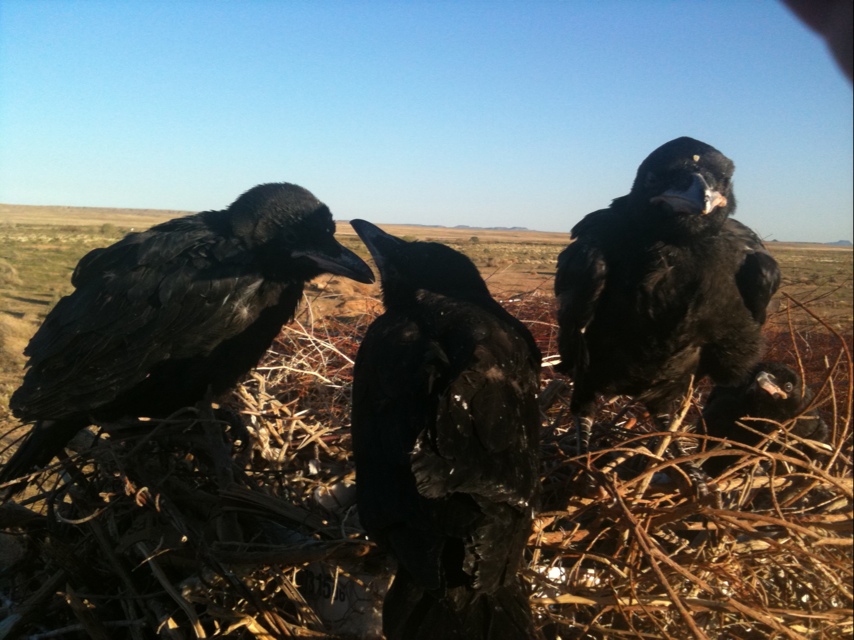
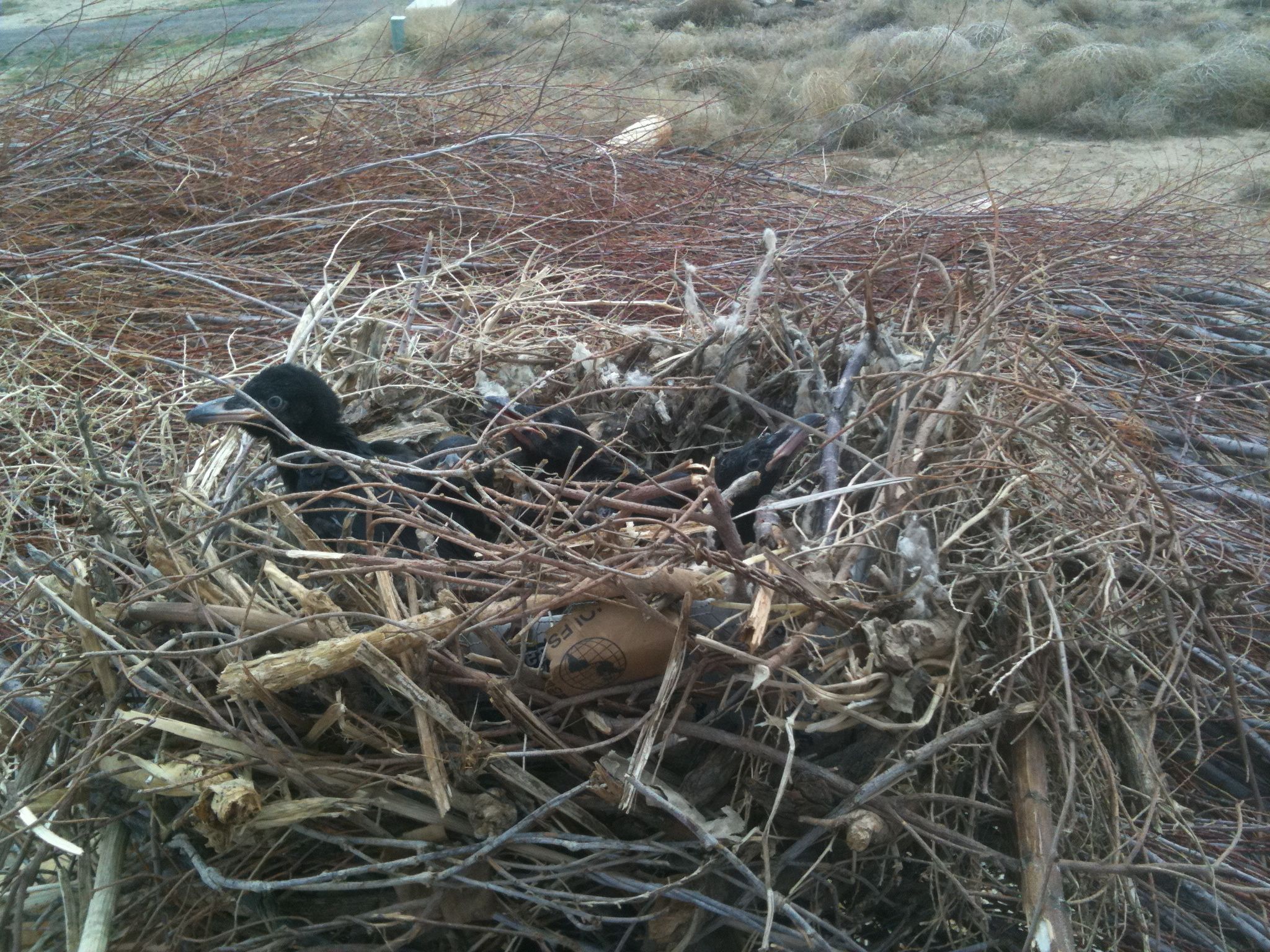
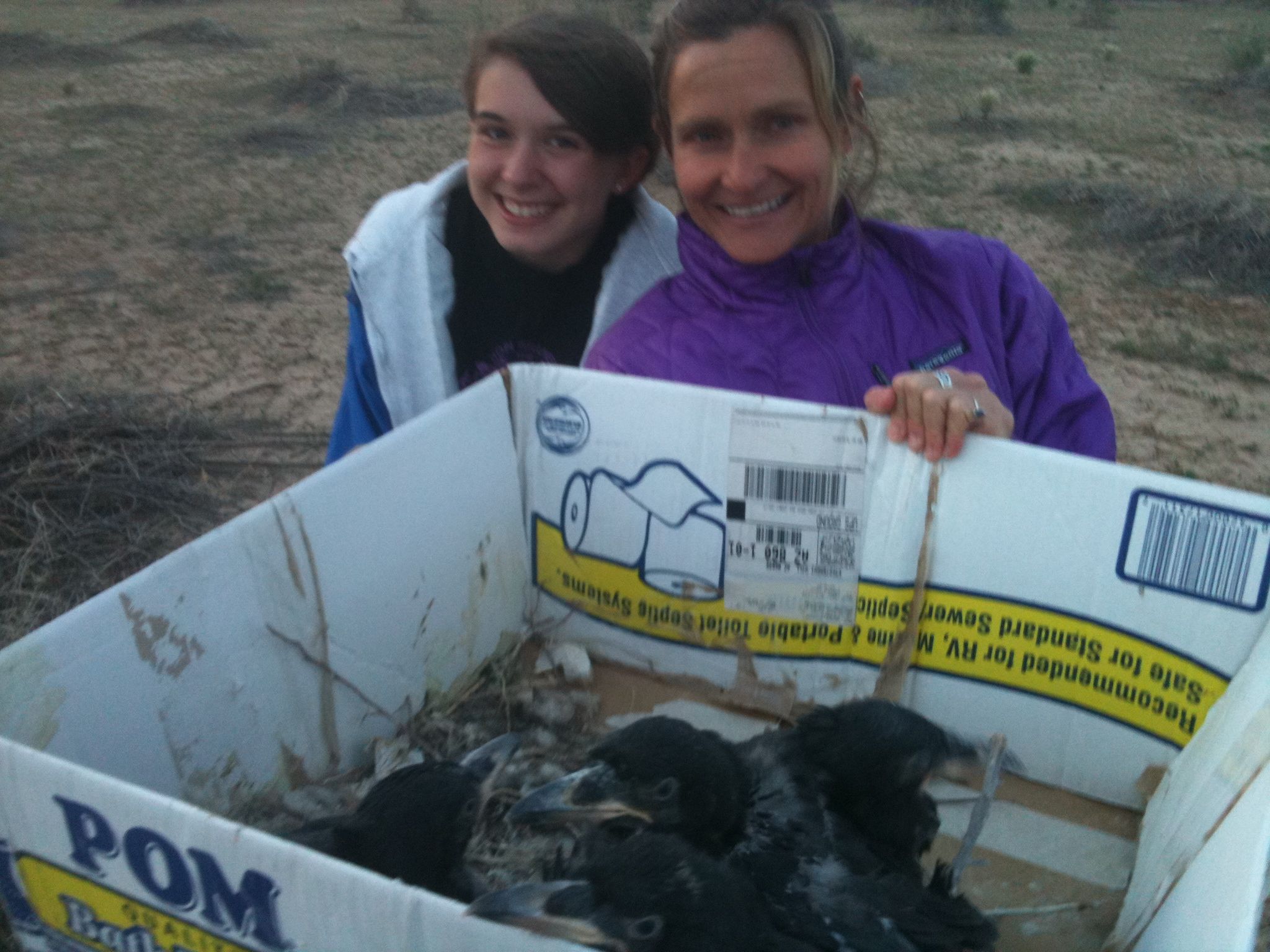
Pearish discovered them in the wash on Monday.  Four fledglings. Jet black, musty, cawing loudly.  Abandoned in an old toilet paper box with an armful of nesting materials.  We considered the possibilities.

Had they blown out of a nest?  Had a farmer collected them to remove from their fields?  Someone else who wanted the feathers?   A do-gooder trying to save them?  We found a line of ATV tracks in the wash, but no footprints from the tracks to the box.

The sun was setting and we had to move quickly or else the babies would become coyote chow.  We raced to a roost in the wash.  It appeared to have been broken.  We set up a ladder and climbed the tree, but lo, the nest was intact and already filled with four fledglings no less.

Anna recalled another roost somewhere in the wash, but if they had blown out, how had they ended up in the toilet paper box?  And it couldn’t have been a farmer. He would have dispensed with all niceties and simply killed them. And someone collecting feathers wouldn’t have left them in the wash.

Sun setting.  The babies were destined to be eaten.  And so home they come.

Ravens discovered

Is This the Way the World Ends

I’m in Hotevilla when the call comes.  There’s a propane leak at Hopi Health Care and they’ve evacuated the facility and the adjacent housing complex.  They’re afraid the whole thing is going to blow.

I drive back to First Mesa.  The hospital and housing entrances are blocked by a phalanx of squad cars.  Two fire trucks wait on the side of the road about a mile distant.  I drive past, hook a right on the airport road and park on the cracked asphalt adjacent to the air strip.  I secretly cut across the wash and desert to the rear of our house and hop the fence.

Inside, I settle down with a ham sandwich.  The neighborhood feels ghostly and empty. What do I take? I wonder. I finish my sandwich and grab my laptop and Mazie’s violin.  I load a duffle with some meat from the cow we slaughtered.  A half bottle of Hornitos.  I shoot a quick video of each room of our house (for insurance purposes).

The first editions of Stephen’s journals, the signed first editions of Cormac McCarthy books, my signed Turrells, the Heriz, my journals and family heirlooms – it’s all destined for flames, I decide.

I plop my Mennonite hat on my head and wrap my scarf around my neck.  I move the chicks outside.  I open the gate and our dog Mango steps out with me.  We’re joined by the stray pit that everyone dislikes and together – the dogs and me, violin and duffle in hand, set off across the desert. A sand storm kicks up, sending tumbleweeds skittering past.  A thunderstorm approaches.

Perhaps this is how it ends.  Behind me I’ll hear an explosion and feel the heat of an enormous fire ball.  Anna’s work and all of our worldly possessions will have blown up.  And then we’ll climb in the car with Mazie and drive west.

And that’s it.  We’ll be done with it.

Black Wind.

Blowing again.  Wind chimes newly hung have been ripped to the ground.  The one remaining from Arcosanti peals all night like a ball-peen on the skull.  The wind brings moisture but sooted with a thick cloud of orange dust.  The dust settles on everything inside, outside; it lodges in your teeth, your hair.

I’ve loved this wind because it chastens.  If it were just the wind, that alone would be enough.  But what when the whole world brings you to bow?

Last night I asked my friend Al how life was.

Full, he said.  100%.

Really? I asked.

Yeah, he said.  I mean it’s always 50-50.  Is it half empty or half full?  But when you add it all up it equals 100%.  So there you go.  Full.

Way full.

Best Friends

Morning coffee and croissant off of Grant street. The city awakening. I’m feeling sad, though. Sad at excess. A little sad at wherever I am in my life.

I look down at the pavement. And I think of the guy.
—-

Last month my friend Patrick was walking to work in San Francisco and he passed some commotion and an area cordoned off with police tape. A little bit earlier a guy had jumped from a building and his body was lying on the pavement.

He had committed the irrevocable act.

He had arrived at a moment where he felt sad / devalued / alone / ill – enough so that he no longer wanted to be alive.

Since arriving in San Francisco I’ve considered him most days. I never knew him. But by killing himself he’s given me a costly gift. Even worse, it probably pales to what he gave the world when he was alive.

What would he think to know that after his death, a complete stranger would continue to carry his shadow forward into life? And by implication, what of me is carried by him?

Sometimes we can count even a stranger as a friend.

20110503-101119.jpg

San Francisco Spring

Union Square, San Francisco

Yesterday I had my string of checkup appointments marking the two year anniversary of my initial diagnosis and recommendation.

Rounds of hugs with the receptionists as I checked in with each doctor.  Diane and Misty and Rosa have become good friends and shepherds along the way.  And embraces with my docs as well.  Dr. Eisele and Quivey and Orloff are as wonderful people as you will ever find.

And it all checked out.  The incision has healed wonderfully.  The remaining salivary glands are intact.  There’s nothing funny growing in there.  I should be cleaning my teeth more frequently.  I’ll start as soon as I get home.

So now, in whatever way, it’s time to say goodbye to it.  I still have my appointments every year or so.  Some regular imaging.  But for now I can let go of that part of my life.

It makes me a little sad.  Dr. Quivey is retiring in July.  And my trips to San Francisco have been a staple for two years.  It feels a little like graduating college or leaving home.

It should be a wonderful San Francisco morning and I hope to enjoy it as such.  And then get the hell out of here.

I won’t miss the experience.  Only some of what it summons.

Butchers

I’m sorry.  I just have to say it.

The taking of any life should not be cause to gloat.

The headline of the Chron yesterday read:  “The Butcher of 9/11 Dead.”  But what made him a butcher and us any less so?

Was it that he launched an attack against the US? He essentially was a military commander using the means available to him to achieve his military and political ends. By that measure, we are butchers.

Was it that the attack was launched at a civilian target?  In our retaliations in the Middle East, since 9/11 we have taken far more civilian lives.  We call this “collateral damage.” But by the same measure, we are butchers.

Perhaps the taking of human life amounts to butchery only when it happens to us.  That makes us narcissists.

This may be a defining moment in Obama’s presidency.  But I would hope not.  There are better things to be remembered for.  It was a necessary moment.  But not a proud one.

bin Laden’s death may diminish the chance of future attacks.  But probably not.  It certainly won’t bring back all those we’ve already lost.

Lets model good behavior and not the behavior of those we vilify.

Let it rest.

The Miller’s Tale

In Brueghel’s Procession to Calvary, the Mill perches on an implausibly high and incongruous rock in the flemish countryside. Or perhaps it’s not flemish, but the middle east, imagined by a man who could only conceive of that land as the only land he knew, Flanders.

What is the Mill and who is the Miller? The mill takes the grain, the life essence and grinds it into matter that will be transformed into bread, the holy host, the body of Christ. It takes the essence of god and renders it into the material world so that the ineffable can be partaken of by men. In the consuming of the Host, the ineffable, the Christ, becomes carnate within us.

And between the Mill (the agent of his conception) and the Cross (the instrument of his demise) dances the entire pageant of the human experience, all our sins, all our folly both venal and mortal, inattentive to the turning blades and the waiting pine.

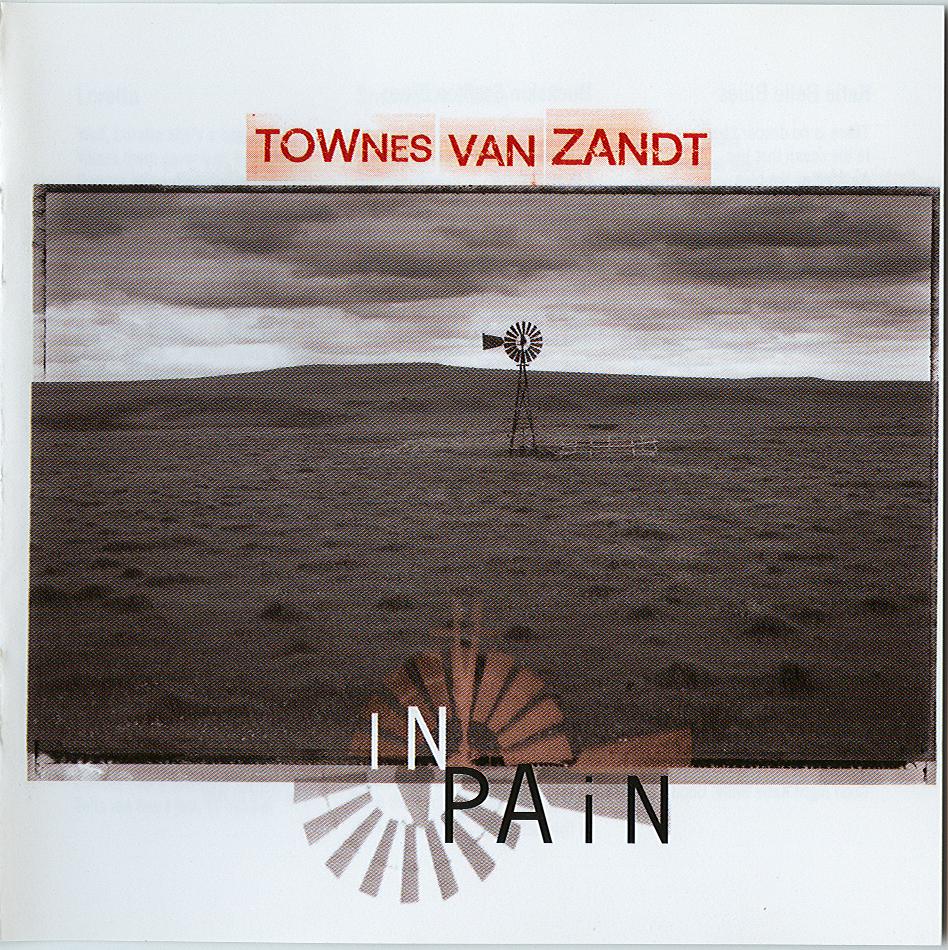
Which of course, inevitably brings us to Townes Van Zandt.

His suffering was more than any men, let alone single man should live to bear. And either because of his suffering, or because of the breadth of genius that preceded it, what remained in the end burned white hot.

Today I’ve been listening to recordings he did in his last European tour, when he was near at the end. Some of the words are so searing, they brought me to a standstill. I stood on the corner in the Mission and could do nothing but listen.

And I can’t help but think. The fruit be damned. You. The Miller. The one who would ever bestow this upon a man:

You ain’t no friend of mine.

The Garden

Running toward the Embarcadero.  On Battery, I believe.  Lost in my iTunes playlist, I cut through a swath of green.  I guess we call them parks.  But suddenly I stop, arrested.  I am in fact cutting through a Japanese Garden.  It really is just a swath of green.  A scattering of stones.  A splash of water.  But it is a Japanese garden in the truest sense.

A Japanese garden is not a swath of green.  Nor an arrangement of plants.  It’s a psychological experience.  A metaphysical state.  A state that opens up the boundary between self and the outside world.  We call this boundary “perception.”

A masterful garden will arrest, it will capture the attention in the way I have just serendipitously experienced.

A park, a swath of green, has no rules.  Or rather, the chaos of the self rules.  Parks are primed for the 21st century American.  We are free to experience it in whatever way we damn well please.  Throw a frisbee.  Loll on the grass.  Kick a ball. Read a book.

In a Japanese garden, the designer rules supreme.  We become subjugated to the designers intent.  His intent becomes our experience.  And if the designer is gifted, a new layer of reality becomes our experience.

In this garden, the path turns and breaks.  A runner must slow down to a trot.  And then a walk.  And as you walk, you see the stones.  The swath of grass is home to the stones.  A pool of water is laced with moonlike stepping stones.  The stones invite you to enter the pond.  But not on our terms.  Instead on the terms of the stones.  The stones suggest where we should walk.  We have some measure of choice.  But the stones dictate the range of choice.

We have to pay attention.  If we misstep, we fall in the water.  And when we reach the last stone, what do we find? Nothing.

But it’s not nothing.  It’s the oval of rock upon which we stand.  It’s our vantage.  And it’s enough.  From this perch we see a small tree ungainly enough to be unworthy of attention.  So we look down.  And our attention is drawn to the reflection of the tree shimmering in the water.

We return.  But this time we see the fallen cherry blossom petals speckling the ground.  The death that arrives in hand with incipient birth.

The asphalt walkway turns to rock turns to a grass path, turns once again the rock.  This part of the garden privileges our feet.  Not our eyes or other senses.  Instead it says, you oh lowly feet.  You the ones that carry.  This spot has been created just for you.

Sound of san Francisco morning

Morning. San Francisco. Disconnected. Ran to the embarcadero. Sound of the lapping of the bay and joggers and light morning traffic. And a guy. In a wheelchair. Playing the softest sweetest guitar.

If only for him, I’m glad i’m alive today.

20110430-082559.jpg

Roadtrip to Cavalry

Yesterday morning.

I race for two hours through the desert at 80-95 mph to make a flight in Flagstaff, only to learn it was cancelled due to maintenance; and then to learn that the connecting flight was leaving from Phoenix, (140 miles away) in three hours so I race at 90-100 mph to southern Arizona, throw my car in long term parking, hoof through TSA and to the gate to board with ten minutes to spare; land in San Francisco several hours later, make my way into town on BART, walk up California Street because no street cars or buses are in sight, attempted to check into my hotel only to learn my reservation had not gone through and they were fully booked; rebook another hotel across town, travelled there by bus, dropped off my bags, racd to the San Francisco International Film Festival offices 10 minutes before closing to grab my badge; eat a bowl of soba noodles; walk 100 feet to the Kabuki theatre to learn that the film they were showing was sold out and I had to wait in rush; but so many people showed they couldn’t let anyone in from the rush line; a fellow approaches and sells a spare ticket to the guy in front of me, but his friend fails to show, so two minutes before the curtain goes up, he turns and hands me his ticket to

The Mill and the Cross.

Some ponderings:

I may like the painting better than the movie.  But I like the movie because it gives us cause to consider the painting.

Which makes me consider that procession and mesh of life and intervening forces in which we’re embedded as we fulfill that life into which we’ve been born, or trace that road which we’ve chosen.

I wonder with whom of all those 500 characters in the procession we each choose to align.  Are we the miller, the horseman, the weeping mother, the man shouldering the fallen tree?

And I found it pleasant to be thrust into the stillness of Brueghel time.  Especially after a harrowing day of travel to arrive in this harrowing city.  I want that stillness, that repose from which to witness that tragedy we call being human.

This morning I feel disconnected in this most connected city.  I wonder a little about what the hell I’m doing here.  

I eat more soba.

I decide that I will just move through the day and try to be kind.  That’s all I will do today.  Just be kind.  

I’ve kind of failed at it.  But I’m still trying.  I have eight more hours to go.  And again tomorrow. Perhaps I will try.

Social Marketing

SXSW.  First day.  Or second.  Just after the premiere of Dish and a Spoon, drifting into some free boozy brunch sponsored by

Groupon.

They are an absolutely fantastic way to get local deals in towns you live in or are visiting.  I’ve never used them, but they’re super great.  Along with the free food we got cool shades that said “Groupon” on the side.  I really liked the food and the sunglasses.

That day I probably said “Groupon” five or six times.  More times than I’ve ever said “Groupon” in my life.

In fact, later at the still hip outside patio terrace at the

Stephen F. Austin Intercontinental Hotel

my friends and I talked about Groupon for a while, everyone except my friend

Brett Baer (not this guy) who just laughed and listened.

We even told some folks passing by about Groupon and our free sunglasses and they were so impressed, they said, “Damn. That deserves a t-shirt.”

And they gave me a t-shirt promoting an online social marketing service!  It’s called

Socialtoaster,

a totally awesome way to increase traffic to your website using electronic word of mouth referrals, and is up to ten times more effective than search engine marketing or other traditional forms of digital advertising.

I haven’t really used it yet, but it sounds great.

And at the very least they have a pretty good t-shirt.

The thing I can’t figure out is why they are using an old school social marketing tool (t-shirts) to advertise their new online social marketing tool?

And what about all the online tool and app and widget developers handing out free piddle-paddle noise makers and free gum and free candy and free beer and…free t-shirts?

And why do they call it sxsw interactive, when most people are sitting in the lobby staring alone into their devices?

I’m still pondering.

No answer yet.

Maybe I’ll ask my new best friend, Jane, the hots designer of the WordPress backend.  She’s super nice and seems to know a lot. She said I might even win an iPad.

Another day at SXSW.

The Windmill and the Whale

I wish we’d bought a map, Anna says.

Don’t worry, I mutter. Look on the phone. We have Google maps.

Dawn. Driving through west Texas. Somewhere southeast of Lubbock. This entire corridor is given over to energy production.

It once was energy for people, energy in the form of cattle. Solar energy harvested by grasses, concentrated into bovine fat and flesh by the gut of a steer, then rendered for our consumption.

Then the land was given over to extracting energy for things: factories, cars, lightbulbs, plastic juice bottles. And the energy came mainly in the form of oil. Ancient solar energy harvested by cycads, velociraptors, all manner of antediluvian life, then rendered by heat and pressure and time into thick black goo.

Biological life condensed into energy to give life to mechanical things.

West Texas wafts with the acrid smell of crude. this morning we drive for miles and can’t escape it.

Until we hit the turbines.

Sixty. One hundred. One hundred and twenty miles of horizon to horizon wind turbines. Solar energy heating the air that then moves in currents and drafts around the planet, to be harvested by windmills to once again feed…things.

There ain’t no farms here. And not much in the way of people. Farmsteads or ranches that once held purchase on thousand acre spreads are now abandoned, crumbling at the ankles of these Cervantian giants.

Those homes that still remain resemble more minuscule bacteria cultures lodged in the creases of the flesh of some great beast.

Any advocate for (or future victim of) wind energy should check this place out.

But it’s clean energy, Anna counters. I think it’s beautiful.

But I think of an unadulterated horizon. Of ranch hands dead and buried. Of migratory birds and raptors, of insects. Of virgin life. Of consequences of which we have no foreknowledge.

And clean energy for what? For things. For this rough beast. For Google server farms. And Google maps.

What, I wonder, would happen if we chose to have no energy? Those turbines power some Leviathan that evades our comprehension, though it is in part of our own making. What if we chose to abandon our devices and starve this thing?

Abilene. Where do we turn next? Anna asks.

Look on the phone, I say. But too late, we’ve missed our exit. I wish we had a map, she says.

It’s going to be a bit longer to Austin today.

Posted from my iPhone
1 California

I’m not sure I have the heart to write. 10 pm. House of Nanking. delicately sauteed pea shoots. an enormous onion cake. Today largely filled with appointments: Eisele to review once again the slicing; Quivey to survey the burn site; Jacob Kameesta on his broken down bike to hug and remind me what it is to be alive once again.

My one year anniversary tour leaves me a bit sad and forlorn. returning on MUNI to the Hotel Kabuki.

Rannie loved the 1 California. Or so she once said.

Fault line 2009-10-28: Foot. Snow. Earth.

I ran this morning toward the new fields that Philip has plowed. An inch of snow blanketed the ground. Out by his field area I noticed a cottonwood structure – not quite a ramada – that had been erected at some point. It may have been there for three years or a thousand or since yesterday. I only just noticed it. The dogs and I cut down across the wash, across the snow blanketed runnels along the bench and up to the plowed fields on the other side. The structure had no apparent use. And no apparent past or future. Much like many of the discoveries here, it seems to exist apart from time.

Philip had a good year. The monsoons did not come this summer which pretty much did in most of the farmers. But not Philip. His vast field sported dense head high corn. But here is the secret. He had water. But it did not come this year. The rain actually fell in August, 2008. And it sat on top of the dense clay, creating a swamp of his field. He got nothing that year. And it took three months for the rain to perc into the ground. And then the ground froze. And when it thawed, the dense clay would not give up the moisture. Philip planted late and the corn was slow to start, but when the roots finally hit that year old moisture it took off.

Philip watered his field one year in advance. And now he is plowing and preparing fields further up the wash that may not be planted for another two years. And may not produce for three.

If any foundation or philanthropic people are reading this, take note. Not all environments operate on a 1 year funding cycle. Here a full cycle of rain and drought may take 10 to 30 years. A single planting cycle here may span three to five years. Time slows down. Life proceeds as it should. Not as we want it to. We must learn to let life proceed as it should. Problems arise from forcing it.

We must accommodate ourselves to it. We must slow our pulse.

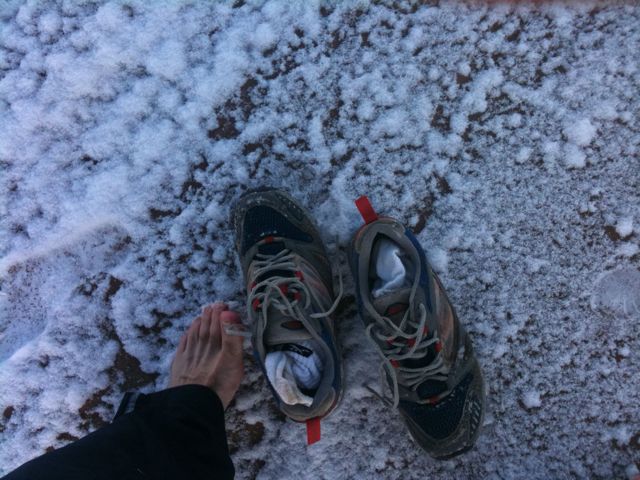
On my run, I notice footprints in the snow, the print of a human foot, complete with heel and arch and toes. I consider two possibilities. The first: at dawn a person ran before me wearing skins on their feet. The second and even more compelling: A person in fact ran barefoot in the snow.

I ponder and decide to explore the more compelling of the two. I strip off my shoes and socks. I stand on the frozen mud. I set off running barefoot across the whitened desert.

The cold instantly hardens my feet to most sensation. I feel a gentle burning pain overridden by a lightness of step. I run fast. I feel a slight bump on my heel that feels uncomfortable. I stop and find a goat head lodged in my foot up to the hilt. I cannot feel it. I pull it out and continue on for close to half a mile. Not much. Certainly not as much as some. My distant ancestors would most certainly have been ashamed.

But we do what we can. If only to feel the cold.

Faultlines

I’m airborne now, soaring above Mt. Bruno, and gazing over the dipping neckline of the Golden Gate Bridge and the gemlike buildings glinting like chiseled quartz at the tip of the Peninsula. Winds blow in from the Farallons sending whitecaps skittering across the Bay. In all, I feel sadness. I need to flee this place. I think of Rannie, of the service for her this afternoon, and the fact that she once breathed life but no longer does, shadows this whole place in illness.

And she wouldn’t have wanted that. Get the heck out and eat some good food for me, she might have said. No one should feel sad. She joked to her friends to be careful because she was going to come back and haunt them, but only in a good way. They just better keep their eyes open. I feel the haunting has only begun.

The plane arcs across the Pacific, over Mavericks. I look down trying to detect that monster wave but to my eye it is indistinguishable from the rage of other froth that embraces the shoreline. Braver folks then I, though, are even now thrusting themselves into that bracing water. We arc again, up from the Monterrey Bay and across the forested coastal hills. Somewhere in there a little Elliot happened across a charming extraterrestrial whom he would take home and secret away in his closet. And the hills give way to the Salinas valley and the slender ribbon of water that feeds this vast floodplain that each season is transmuted into millions of tons of leafing and fruiting vegetables. This water and this soil rendered into food is ingested each day by human beings all around the world. But already below us are the chock-a-block formations of the Diablo range and the Pinnacles, and in the distance to the west the gentle valley home to the Mission San Buenaventura and the Hearst hunting lodge and dry foothills that may yet become carpeted in vineyard. This is Steinbeck’s Red Pony country.

Eastward we cross yet another coastal range – but now the folding hills support grasslands and cattle until even further east when the water gives out and the land becomes laced with winding strings of road that lead to nest upon nest of oil derricks. McKittrick country. The heaving biblical tempest portrayed in There Shall Be Blood. Here you may own the surface skin of the land, but nothing underneath. The oil and mineral rights were sewed up by conglomerates decades ago. Even from the air the expanse feels like an evil infected tract, our machinery sucking the crude oozing up through the seams.

And then the grand big valley, but harvest is over. The pilot carves a wide circle around a broad patch, mile upon mile, of vineyard – undoubtedly low end grape. He essentially executes a sharp right hand turn, and I wonder why he didn’t choose a more gentle route and wonder if it has something to do with the gale winds building over the coast.

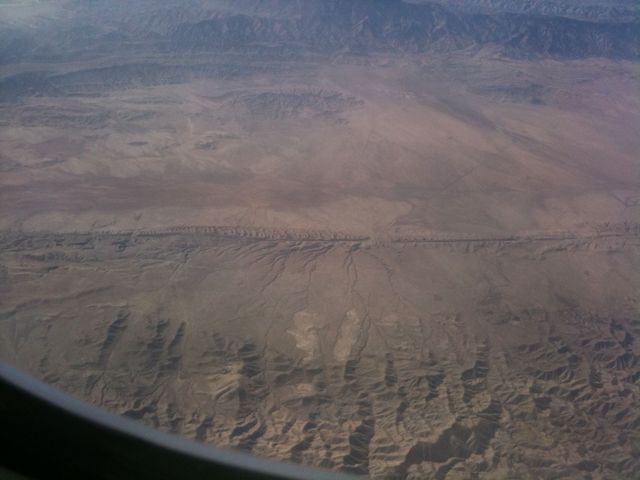
I look down and notice the San Andreas Fault, that rent in the earth signifying where California is slowing tearing away from the rest of the continent. I want to consider this formation, but I don’t know enough and I want for a companion to marvel with, someone who can appreciate the intricate delicacies of this amazing landscape. I look about in the cabin. Nearby passengers are engrossed in books or magazines or iPods. And then my own attention drifts away.

I email Danny Feikin many hours later from a motel in Flagstaff.

Rannie Yoo died on Sunday and her memorial service is today. I debated staying all the way up to when I was standing in the security line at SFO and then just decided I needed to get the hell out of that city. Flew into Flag in 60 mph winds in a prop plane. I thought that you must be use to that shit, but I’m not. And I thought I wanted to just fly around the sw with you – you’re the only other person I know who would really give a rip about flying over the san andreas fault or the pinnicles or an open pit copper mine in bagdad (I later learned from google maps because no one else on the plane knew or cared), or the colorado river, or the duststorm blowing beneath us in the mojave. Or some vast tract of subdivided desert subdivided for what? Or over the boneyard.

His reply:

The USG must not have liked what Rannie Yoo did. Barracuda web filter blocking all websites referring to her. Was she the kindred spirit you blogged about during your xrt days?

I can’t wait until life is as simple and immediate as flying over the san andreas fault as the goal and summit of one’s day.

To which I feel there is only one response.

That we can’t wait. That the future does not exist. That Rannie will never know it. That the only faultlines available to her were her final breaths.

A fact that now begs me to seek the fault lines in my own life, no matter how big or how small. I need to recognize them. I need to investigate. If only for Rannie’s sake.

Rannie Yoo 1976 – 2009

Rannie Yoo died at home late on Sunday afternoon in San Francisco. On the message boards she referred to herself as CatsM. It stood for “cats meow.” She was 33 years old.

I first came across her posts on an online forum dedicated to patients with tumors of the parotid gland. Like many I was drawn to the love and joy and humor that was so present in her voice. I would later learn that the tone and words and wisdom that I found so compelling were as well present in her person.

She and I shared the same surgeon. I had been diagnosed with a recurrent pleomorphic adenoma at about the same time that the doctors had discovered her stage IV malignancy.

When she received the diagnosis from our surgeon, she asked him what the worst outcome was. He was a little bewildered. Well you could die, he said.

She received those words and she did more than soldier on. She proceeded to live her life with a beguiling grace. She wasn’t scared of surgery, she said. It was her job to just go to sleep and wake up. It was the surgeon’s job to get rid of this thing. And so she went even as her cancer threw everything it could at her.

After my surgery I looked her up when I returned to San Francisco for my radiation treatment. We met a few times. Although by that time her cancer had spread, she was publicly upbeat and happy. Like others in her predicament, her illness had made her feel strangely alive, perhaps more so than she had ever been. She once said that she was grateful for what was happening to her, that it was helping her become who she was. She could see clearly how much her fiancée David loved her, and how devoted he was. She was grateful to him and to her sister and to her vast network of friends and coworkers. And she was deeply sympathetic to others facing similar or even lesser conditions.

At one point I had confessed to her that I was primarily a lurker on the parotid forum – that although I found the information useful, I wasn’t necessarily seeking a community of illness. There’s a lot of love on that site, she gently cautioned. They are all really good people.

She relied on them, on us, greatly for both solace and as comrades in arms. I believe we also helped her to feel of service and to provide an arena for her to express the wonderful person that she was and and will always continue to be.

Rannie and David married five nights before she died. It was a forestalled wish that she had long been harboring. I would like to think that it was one of many wishes granted her.

With her hair gone she once described herself as looking like a shaolin monk. I will always remember her as beautiful.

It is.

So it is.  I feel as if I’ve descended from second base camp to first base camp.  I’m off the summit, but I still have a ways to go yet before I’m home.

My treatment finished Monday and ended in hugs with my practitioners.  I celebrated at Swan’s sitting at the tile counter with a bowl of clam chowder and a pint of anchor at 9:30 in the morning.  I came home and slept.  I went to Spirit Rock in the evening for a meditation session and a talk.

Yesterday I did laundry and cleared my desktop and began to pack.  It’s taking longer than expected.  My face has a second round of red burns, my mucus still sticky and gaggy.  Taste buds deadened.  But overall I’ve done really really well.  Remarkably well.  I’m very happy.

This year began with a CT scan and a fine needle aspiration and a diagnosis.  And some of you grimaced and counseled me to belly up. And then I was strapped in.  And eight months later the ride (or at least this part of it) is almost over.  In that time: a half dozen consults,  a marathon along ocean cliffs, a run through a blizzard, trips to Phoenix, to San Francisco, a train journey to San Diego and back, travel to Salida and Beaver Creek, Colorado, and San Francisco, and Philly and Lancaster.  Adopted an Amish kitten.  Weddings and travel to New York and Vermont and Hopi and again to San Francisco.  Planting, and digging grubs and ants, and tending hundreds of plants.  Several deaths.  Massive teeth cleaning for the first time in 13 years – thank you Hopi Health Care.  A growing roster of brand new friends and renewed friends and a deepening group of very old friends.  A deft, protracted incision.  Healing.  And six weeks of low dose fire.  A blog.  Finishing the Border Trilogy and beginning Everything is Illuminated.  I bought a phone.  Ate a lot.  Delicious things that eventually were transformed into the absolutely undelicous.

Feeling so happy to go back to where we presently live.  I want the sky so bad.  I want our friends.  I want silence.  I want the simple.  I realize more than ever what we risk losing of we were to ever leave.  Losing something that most people never even experience.  And for what?  Most likely too much of too much.

I no longer give a darn about those hundreds of things left undone.  Instead I sleep.  I love my wife.  I love my daughter.

In cleaning up I stumbled across the note I scribbled to Mazie a few minutes before I went into surgery on June 17th.  It was scrawled on the back of my authorization form.

Dear Mazie,

  • Remember always to laugh and to make others laugh.
  • Do your best.  If you refinish a bathtub or tile a wall, do it so it will last.  If you play Pachabel or Vivaldi, play it beautifully.  Make it sing.  Do your best.
  • If you drink wine or eat cheese, eat the best.  Learn to discern the best.
  • The best pot of beans are the most simple:  beans, good water, good salt, one onion, lard.  Remember to keep ti simple.
  • Finish what you start.
  • Learn to tell a story.  Then tell them.  They make the world a better place.
  • Appreciate everything: the taxi cab, the driver, the I.V., the table cloth white and crisp, now stained with a single drop of berry juice, the smile, the names, each person’s unique story.  They all are gold.
  • Make good friends.  And do right by them.
  • Sing.  Sing.  Sing.
  • Every street corner, every barista, every vista, every shift in temperature is an adventure.
  • Breathe.  Remember to breathe.
  • At Hopi farming is a religion.  You can spend a lifetime coming to understand why.  Try.
  • We choose life because it is hard.
  • And the difficulties are what make it worth living.
  • Most things that are easy are not worth having.
  • Choose the uncommon path.
  • And if you ever have to choose between picnicking at John Boy’s house on Walton’s Mountain or eating beneath the billboard advertising the place, by all means choose the mountain.

I love you forever and ever my blood.

-Baba