23. The Ballad of Jack: The Story Without End

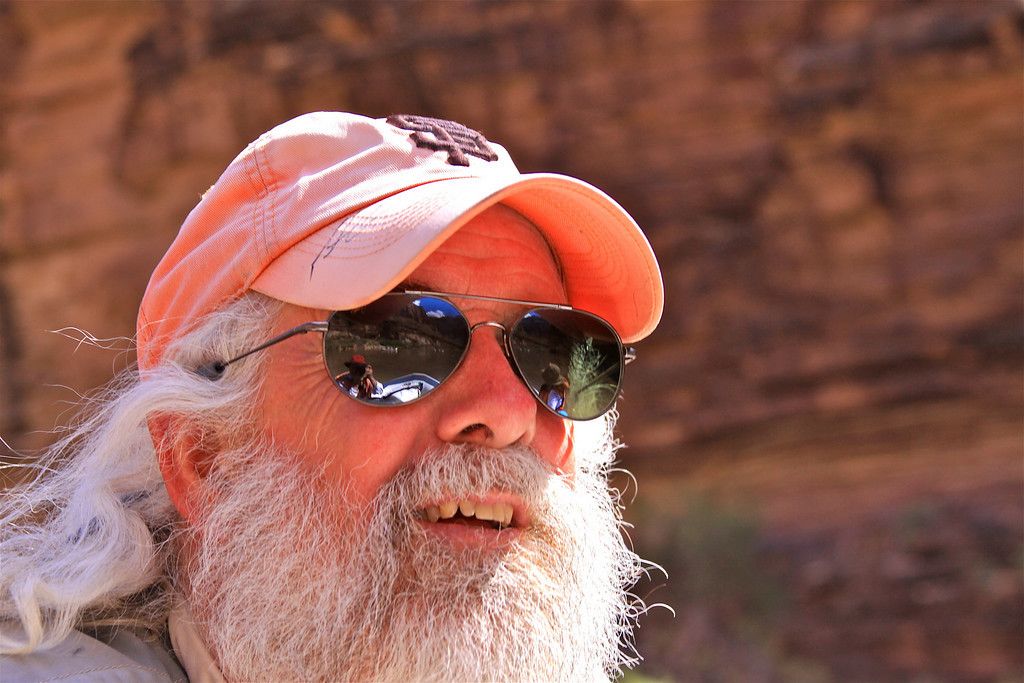
Jack sits on stage at the Bolinas Community Center, doing a fundraiser for KWMR.  It’s cold outside, late September, the ocean fog rolling in.  John Doe is coming on stage in a few minutes.

Back in the fifties, Jack was touring in England and played Brighton.  A young kid, now a resident of Bolinas, went to hear him there.  That night Jack told a long joke that rambled interminably.  It apparently wasn’t even that funny.  It was a shaggy dog story with no particular point and it ended with some punchline about goo goo.  Or something like that.  That young kid now old can no longer remember what Jack sang, but he remembers the joke to this day.

I remember playing Brighton, Jack says as he tunes his guitar.  It’s a good beach.  I guess everyone in their life at some time or other makes it to Brighton.  I remember Brighton. But I don’t remember the joke, he says.

This is a story without an end, he goes on.  It just has a beginning and a middle.  And we’re just at the beginning he says.

But don’t let it scare you none.  We’ll get there.  Soon enough, my friend.


22. The Fable of Origami

I’m twelve.  Or thirteen. Or fourteen.  My mom is chasing whatever was so important back then: yoga, eastern mysticism, organic food, the ERA.  I, like a lot of my friends, was left to my own.  We cruised around on our bikes making fun of the sailors down on Rosecrans or the Hare Krishnas who chanted in the park. I don’t know how it started, but probably inspired by Hare Krishnas, I started my own religion.

I became the sage, Origami, and I would get together with my friends the Gladkoffs and Aaron Oakes and Johnny Ford and I’d relay to them the fundamental teachings of Prefabi.  There were five powers, I would tell them.  The Power to Teach.  The Power to Learn.  The Power to Observe.  And the Power to Understand.  And then there was the Fifth Power which was unnamable and could not be known by the minds and hearts of men.  A few times my friends would talk me into preaching to their older siblings.  Dick Ford and Mike Coon, Gerry’s brother, lounged about taking hits from a bong.  I sat before them and conveyed to them the meaning of the Fifth Power.  They got high and listened until they fell into hysterics.

Junior high starts, kids get high, kids get lost.  Even more so in high school.  Dick Ford went to San Diego State and joined a fraternity.  Alpha Chi Omega.  Riders of the Night.  Mike Coon signed up for the marines and disappeared.  I wanted to get a job and get some money so I could buy a car and run away.  At fifteen I started making the rounds at every restaurant in Hillcrest asking if I could bus tables.  Everyone gave a flat no.  That is until  I walked into the the Soup Exchange and Marissa Saunders sent me to the back.  The manager Brian looked me over, desperate but not too impressed.  Can you start now? he asked.  A dishwasher had failed to show up.  Within minutes I had an apron on and was behind the line as mountains of bowls and plates piled up.  At some point the door swung open, a muscled guy set down a heaving tray, and looked up.  Ear pierced, hair short.  It was Mike Coon.  It had been years.

ORIGAMI! he shouted and pulled me out from behind the bucket of bleach and dangling scrub hose.  Listen, you need to listen to this guy, he said.  He pulled together the prep cooks and whoever else was back in the kitchen.  This is Origami, he said.  He needs to tell you about Prefabi.  Tell them about Prefabi, he said.

That summer I learned to like Molsens.  And how to hang out with adults ten years my senior.  I watched Saturday Night Live for the first time.  And took to riding my bike ever longer distances.  That autumn another dishwasher and I rode from San Diego to San Clemente, took a look at Nixon’s old house, turned around and came back.  When I rode up to my house at three in the morning, I had ridden 140 miles.  I learned that was a good way to ruin your knees.

Mike Coon eventually left for Seattle.  My future wife, Anna, once saw him spinning down Pike Street on a bike in the rain, a toddler in the basket, laughing wildly as he raced to catch the ferry.  He had built a cabin out on Vashon and that’s where he was scraping together a living with his wife and baby.  The cabin was raw and cold.  They kept themselves warm by burning wood.

21. The Fable of the Cat Killer

For those who lived it, California in the 70’s and 80’s was time run wild. It was the years of water bed shops in OB, British Invasion rockabilly revival, Dylan being booed at the Sports Arena for going Christian on the eve of Johnny Rotten.  It was the drought ridden years when people drained their swimming pools and boarders from Venice Beach learned to skate them.  Of  PSA 182 crashing in flames in our neighborhood.

PSA 182 crashing in North Park

Most of my friends were selling weed and discovering ever better ways to rip each other off.  It seemed that if you were fourteen in those years, your parents were gone or disappeared in divorce or drinking.  And so their kids pulled their own disappearing acts into weed and meth.

The only truths told were the lies to one another.  And it was all mostly bad whether it was true or not.  You might say one day that Gerry Coon’s sister worshipped the devil. You might say that she had gathered with her friends at the pentagram laid into the stone work of the old Presidio. And that they performed satanic rituals there.  That she had stolen someone’s cat.  That she killed it that night.  But it’s not true.  None of it.  She never drank the blood.  She did not kill the cat to be real cool. Despite how the stories spread.  A song was never written.  How could it have been?  We were kids.  Not the stuff of legends.

20. The Wood Shop

Best to begin with the wood shop.  Best to see how the epic is born from the banal.

Nearly a decade done with college and with little affinity for power tools, I had little business being there.  And yet there I was, in a woodshop at Mission Bay High in San Diego on a cold night in January.  A handful of adults also filled the room, all of us wanting to learn how to use woodworking equipment.  One older woman wanted to make a clock to hang in her kitchen.  A new father wanted to make a bassinet.  Someone else a cabinet.  So once a week we gathered in the fluorescent lit room smelling of sawdust and singed wood. The teacher, a blond middle aged man who surfed, had a comforting even presence of mind, which was probably key for a guy who’s job was to show people how to work with machines that could rip their arms off.

On the first night, as we were taking our first tour of the planers and table saws, drill presses and routers, I recognized someone. Up front, drawn in under a Greek fisherman’s cap, sat Gerry Coon.  We’d grown up together in Mission Hills in San Diego. I thought somehow that he should have been dead, but perhaps that was just because of his brothers.

After class we approached one another.  He asked why I was there.

I want to build a table, I said.  And a chair.  You?

His voice was so quiet I had to strain to hear him.  I want to build a boat, he answered.

19. The Message in the Bottle

Smiley’s Schooner

Where did all those marooned sailors ever find ink or a smudge of grease pencil let alone a stoppered bottle?  And how did they provision themselves?

For me, it was relatively easy.  I was living in Smiley’s Schooner Saloon, a bar on the other side of the Stinson slough that greets each foggy morning at 7 am with a fresh pot of coffee.  They have good wifi to boot which means I could toss bottle after bottle of raven writing into the sea until eventually a passing ship would find me.

The first puff of smoke came late one night in the shape of a Facebook message.  It was from Brett Baer.  Where was I living, he asked? It sounded like Northern California.  He had just moved to Bolinas from Texas, he said.

You need to work kind of hard to get to Bolinas.  But there Brett was, most likely within relative sight of where I then sat.

I guess it made sense. And the fact that it does leads to the story of Brett and the story of the Craftsman Buffet.

And those truthfully can’t be told until we first tell the story of the very first boat.  But before the very first boat, there was  the chair.  And there was the table.  And before the Chair and the Table, there was Gerry Coon.

18. The Room of Requirement: The Fifth Incarnation

A September day a year ago.

We have not even moved in, boxes still stacked, the house in chaos.

The Nichols family has come up from Davis and Sacramento and San Diego to help us inaugurate the place.

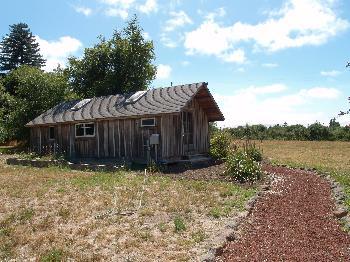
It’s our new home, but it’s not yet our home.  It will be a while yet before it becomes that.  What up with the chicken barn, Evan Nichols asks.

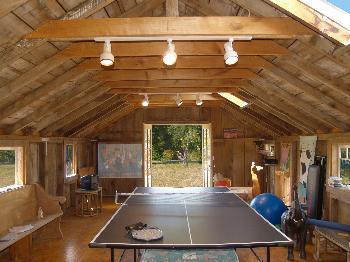
We open the french doors and step inside.  The group oohs and aahs – the unclad raw wood interior has that kind of impact.  Evan’s wife Amy announces that it would make an incredible yoga studio.  Evan considers this.  I see writing workshops, he says.  Mazie can see only the ping pong table. My friends and I are going to hang out here, she says.  I declare that I’d rather it be a beer making room.  Or perhaps cheese once we get the sheep going.  No way, says Anna.  It’s going to be my pottery studio.

Evan ponders all this.  It’s everything that anybody needs it to be.  It’s the Room of Requirement, he says.

The Room of Requirement

17. The Room of Requirement: The Fourth Incarnation

In 2000, Peter and Andrea Regan bought a home on Sparkes Road in Sebastopol California. Neighbors say the dilapidated farmhouse was not much to look at. Cramped and claustrophobic, the Regans gutted the place and tripled it in size.

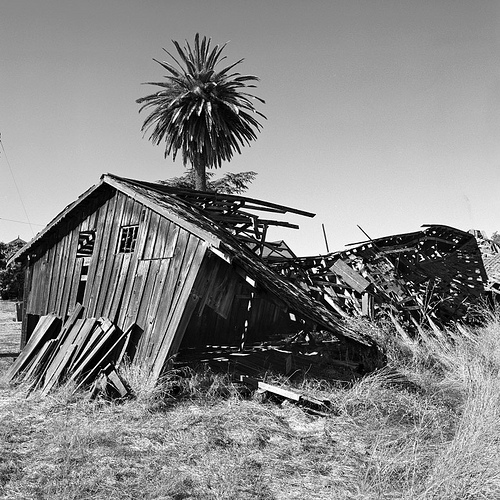
And then, there was the matter of the falling down chicken coop. Built of milled ship timbers, or perhaps from trees hauled out of the Mendocino or Stumptown woods, it hadn’t held chickens in years and was destined to be torn down.

But Peter Regan, through some infusion of resource and energy, did more than keep it alive.  He shored it up on new footings.  He had it reclad in recovered boards.  He added skylights and track lighting and a honey colored floor.  It became a playroom, a ping pong room, a secret retreat for his three growing daughters.

The natural tendency is for things to degrade until they become dust.  But what of the counterposing force?  That thing that creates and is being, well, it’s life itself.  And to foster life where there should very well be none at all – why that’s heroic.

It sounds so simple.

But what really occurs in that strange alchemy that we pass off as resurrection?

16. The Room of Requirement: The Third Incarnation

Why and how did Petaluma become the chicken capital of the world?

Kind of a weird question, but not that weird because it explains how we came to have a chicken barn on our property.

In the 1870’s the town of Petaluma 20 miles to the south of us was in economic decline.  Situated on a slough that eventually empties out into the San Pablo reach of San Francisco Bay, Petaluma and the North Bay had become a tidal eddy catching all the miners and recent emigrants washing up from the gold fields.  Some of them tried a hand at farming (grain, potatoes), and some livestock, but nothing took.

And then came Lyman Byce, a medical student and part time tinkerer from Canada, who as a boy had been intrigued in how his father had increased chick production by keeping eggs warm near the manure pile.  When he moved to the Bay Area in the 1870’s he found himself at the intersection of two interesting problems.  First, there were not enough fresh eggs to feed San Francisco.  At the time, the bulk of eggs consumed in the city were shipped in un-iced barrels from the east coast, sometimes traveling upwards of 4-6 weeks before being  consumed by some unlucky San Franciscan.

And secondly, hens get broody after their eggs hatch – they stop laying and are basically out of commission while raising chicks.  That is, until Lyman came along.  At the 1879 Sonoma-Marin fair he unveiled the first commercial egg incubator which allowed would-be chicken farmers to hatch large numbers of chicks without taking their hens out of production.

The first commercial hatchery soon opened in Twin Rocks just outside of Petaluma and by the turn of the century egg houses and chicken operations were popping up all over Sonoma county.  The fresh air, loamy soil, easy access to port (shipping was still a key line of transport) and freight lines allowed North Bay eggs to make their way across the country.  A massive civic boosterism campaign at the turn of the century proclaimed Petaluma the “Chicken Capital of the World.”  Regardless of whether it was myth or in fact, the North Bay became a locus for egg production in the United States, largely because Lyman Byce had chosen to settle there.

By 1917, Petaluma eggs were feeding WWI armies with nearly 20 million eggs shipped around the country.  With only 7000 inhabitants in the county, the area sported over 2000 chicken farms that reached peak production at the end of WWII.  Although the scale was large by historical standards, it was nothing compared to what was to come.

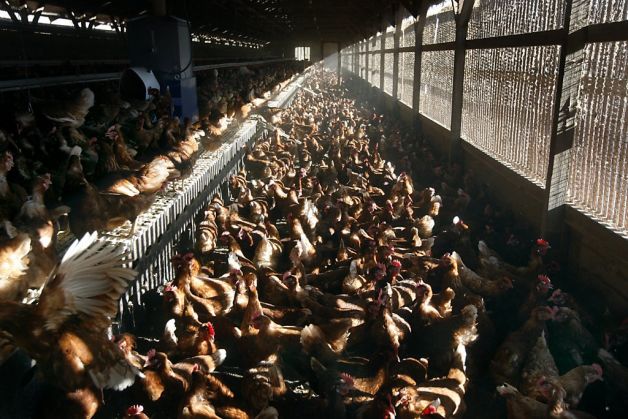
Commercial chicken farm today.

By the mid-1940’s commercial egg production shifted to industrial egg production as farmers drove in ever greater efficiencies.  Non-laying hens were culled, selective breeding introduced, and open-walled chicken houses allowed for maintenance of large numbers of chickens.  Vitamin fortified feeds and vaccinations led to greater productivity.  Eventually hens were housed in suspended cages under artificial lights to stimulate egg production, and would spend their lives in tight cubicles of 3/4 inch wire.   Indoor chicken operations could now exist anywhere, and the interstate meant that you didn’t need to be on a river or railway to ship all over the country.

Industrialization sounded the death knell for the small scale chicken farmer. They couldn’t afford the new expensive equipment.  And their kids wanted to get off the farm.

By the 1980’s there were only 300 chicken farmers left in the county. Long low roofed chicken houses everywhere were now collapsing into the ground, kept around mainly for tax reasons. To tear them down would constitute an improvement.

15. The Sailor Washes up on Shore

When the neural pathways are shaken or shattered, it can go either way.

In the case of Howie Usher, he was laid up in a hospital for a better part of too long.  And then rehab in some place in Phoenix. This is where you learn to inch your arm into a sweatshirt and shuffle with a one legged walk.  You regain your manual dexterity by counting pennies.  And you kindle whatever is in you to fend off the darkness.

Which all is what Howie has done. He’s making it, for sure, whether he feels it or not.  He’s home.  He’s walking.  Last month his confederates took him down the placid part of the Colorado from the dam to Lee’s Ferry.  And inside, that thing that can only be described as Howie Usher, is supposedly alive, and wry and strong and well.

Which is all to say, heck to the naysayers.  Leave it to a higher power to judge whether a boat or a boatman is ever done and gone.

14. Surfacing

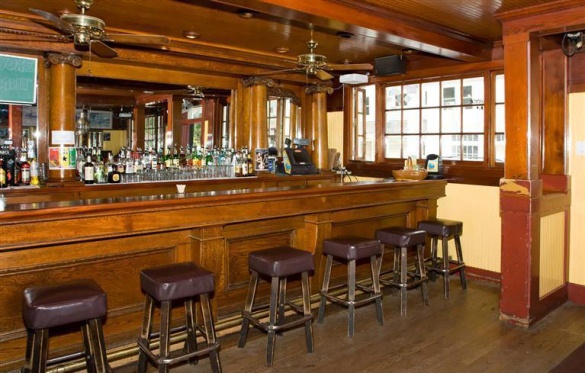
Coming to after a long summer.  And lots of ground to cover between installment #13 and #212.  So I’m holed up for the moment at the office, essentially a bar in Bolinas.

The summer: Howie had a stroke.  My daughter studied hard for her geometry test.  She wrote new songs.  And went to LA and camp.  We made an offer on a piece of land.  And finally fixed our salt chlorinator.  And started a new set of stories.  Built some garden beds.  Bought an apple press.  Pressed 30 gallons of cider.  Endured a fatal computer crash and resuscitated tens of thousands fo files.  My brother moved in with us.  And a bunch of others.  Went to a college reunion and Asheville.  Woody Guthrie celebrated his 100th birthday.  And Jack went on the road enough time to lose count.  Resolve quickened and failed and renewed itself again.  And slumbering and rising and slumbering again through it all was the boat.

Time to pick up where I left off.  Which was with an incarnation.  And a sailor.  Belly up.  And bear with.

212. The Last Day

Jack is still a bit reluctant.  Never known a boat builder to plan a launch date before the boat was actually finished, he said.  So we recast it as a christening. Today Brett Baer turns thirty.  Tomorrow he sets off toward South America.  And this boat has become his own personal right of passage.

It’s a year ago, nearly to the day since Anna arrived here and the day Poe died.  Back then the plants were dying because we didn’t know we had an irrigation system.  The pool was green.  The house stacked to the ceiling with boxes.  Yesterday?  I put in a wild flower / lavender garden in the front island.  Spread mulch in the newly reconfigured vegetable area.  Wrangled missing chickens.  Picked a basket of raspberries.  Brett layered in gunwale gray paint in the belly of the boat.  And I made a celebratory abalone dinner with three kinds of pasta in the colors of the Peruvian flag.  It was absolutely, one hundred percent, the shittiest meal I have ever made.  Completely inedible.  A great day all in all.  And so it goes.

13. The Story of the Boatman and the Serpent

Humble as he is, Howie Usher stands shaggy and tall among the sons of Sinbad.

In Mesoamerican stories, sky and sun energy embodied in the eagle sought union with the water world.  The water world is the subterranean world, the unconscious and amniotic world, – the deepest diluvian recesses from which we come.  According to the stories, the Mesoamerican people would settle in that place where the eagle seized the snake in his beak.  The eagle was eventually seen on a small island in Lake Texcoco and it was there that the great city Tenochtilan (that would one day become Mexico City) was built.

The procreative seized the generative and that’s how life came to be born.  It’s an important story that finds expression throughout Latin America:  in the serpents that guard the base of the temples in central America, in the Hopi snake dance, and even in the image of Popocatépetl and Iztaccihuatl that can be seen in practically every taqueria on the West Coast.

Some of those people from Middle America continued on, possibly following the Colorado river up into North America and the Southwest.  In Hopi stories the first person to follow the river back down to the Sea of Cortez came from Tokonave near Rainbow Bridge National Monument.  On his return he brought water knowledge and the snake people with him.

Howie Usher has spent his life riding the back of that serpent.  He’s served as one of the guides for Hopi elders, descendants of the people who emerged from there.  He knows the Canyon and the River nearly as well as anybody who comes from that place.

He knows you don’t tread lightly when you enter.  He’s in that canyon again now, deeper than ever before.  He’s still conscious, I hope.  I imagine him at the bottom of a deep pit, trying to sense the glimmer of light that will indicate which way is up.  I imagine he’s beat and hurt and tired.  He’s trying hard to find his way up. We gaze down, hardly shimmers on the surface of the water.  He’s a brother and he badly needs help.   He carried my own daughter through Lava.  I owe it to him.  If you’re near, it’s occasion to reach down hard.  And if you’re far it’s occasion for prayer.

If you can, reach for him.

12. The Story of the Boatman and the Flood

This is how I heard it.  Some may question the truth of the matter, but I know Dave Edwards and so I’ll take it as fact.

Once a group of rafters with AZRA were tied up at the drainage from Havasu Falls.  It was a clear summer day and folks were blissfully unaware of the flash flood waters until the moment that they hit.  The tributary narrows right there at the opening into a slot canyon so that the water funnels in and shoots out in a torrent.


Havasu flash flood

The folks standing and lounging on the rocks didn’t know what hit them, only that it felt like a wall of falling bricks and then that they were being swept away in the muddy maelstrom of the Colorado.

Dave was in one of the rafts and remembers the chaos of garbage and rocks, of the wall of water carrying ripped trees and flipping boats.  There in the raging torrent coming towards him he saw a woman’s face, and then the face was gone.

Dave grew up with a father, a military man, who made a career out of telling his son that he was hardly the measure of a man, that he wasn’t good enough.  In a way that only that boy now grown to be a man could do, he dove into the water without a thought.  He was swept way in the swift current and he reached down until he felt hair and he pulled the unconscious woman to the surface.  One of his fellow guides threw a float to him, but he was holding the woman with both arms, so he locked the nut in his teeth and in that way the two of them were pulled to safety.  He saved the woman’s life that day.

But he wouldn’t see it that way.  It’s just my job, he might say.

11. The Story of the Boatman and the Life in the Rapids

It was maybe the first or second night out from Lee’s Ferry and Howie told us a story.

When not running river trips Howie teaches high school biology.  I can only imagine that the experience is magical and that his students love him.  Howie knows a lot about biology and river ecologies.  On one trip he was with some muckity-muck, a CEO or terribly busy business man.  Apparently the guy had a hard time slipping into the rhythm of the trip:  He was too stressed, too worried, too preoccupied.  Whatever.  He was spending time with Howie and was humbled by Howie’s humor, his calm in the face of catastrophe, his equanimity with whatever life threw at him.  How did Howie do it? the guy asked.

They were lunching at one of the many tributaries and springs that tumble into the canyon.  Howie gave the guy a pair of swimming goggles and walked him out to a set of small cliff cataracts and asked the guy to submerge himself in the water and to look carefully toward the rock.  There, hanging on against the current were colonies of little creatures – that’s the thing about Howie – he can actually tell you what they are.  I can’t, but there they were, these nearly invisible little things with heads and fern like fans sticking up from their heads.  This species exist only here, Howie told the man.  Only here.  At this one set of rapids, on this one river, one mile deep in a three hundred mile long canyon.

Whenever I get worried about stuff, Howie said,  I just think of these guys down here, unknown to the whole world,  just calmly waving their antennae in the water.


10. Lucky Penny

Rain continues today. Sanding and prep of the boat is temporarily halted.  Which is fine.  Something else must be righted now.

1.  The story of the Boatman and the Lucky Penny

In 2009, the year she came of age, Mazie rode with Howie through Lava.
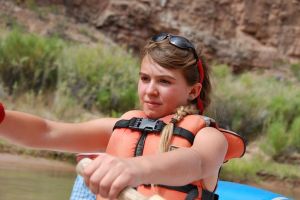
That trip for all of us was the high water mark of a magical summer.  Not even twelve, Mazie had busked in Telluride, had run in the desert, and bank to bank she had swam the Colorado.

But in this particular moment, there was little glory to be had.  The guides had nervously scouted the rapids and Mazie was well aware of their trepidation.  One by one, the rafts had set off, but when it came time for Mazie’s boat, she refused to get in.  She stood on the shore shaking with fear, and then in tears asking to be taken around some other way.

But there was no other way.

Lava sits in the depth of the Canyon, cut one mile deep in the earth.  Here the precambrian metamorphic rock is hard and ancient, dating back 1.75 billion years.  But the rock still feels fresh and scary and hot as if it was born yesterday.  And yet it came into being before there was even life on earth.  Looking at the chasm faces, you feel palpably that the world of life doesn’t belong to the ancient world that’s revealed there.  And yet life is.  The water cuts through the canyon, wearing it away until at Lava Falls water meets rock steeled by pressure and fire.  Lava is harder.  But in the end, minuscule grain by minuscule grain, the water will win.

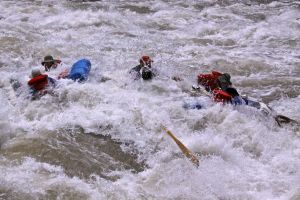
To be safe at Lava you work against instinct.  If you bull forward straight ahead, you go over the lip of the ledge and you end up in the hole which is where you don’t want to be.  There water turns into a turbo charged washing machine the size of a small building.  You get thrown around or held under, or perhaps spit out hopefully in one piece.

To avoid the ledge hole you have to bank right, straight into a chute that slams you dead against a rock face. You ride high and bank off the wall, careen around the hole into the mountain size waves that threaten to flip you back.
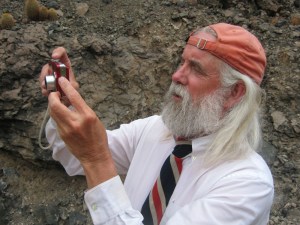
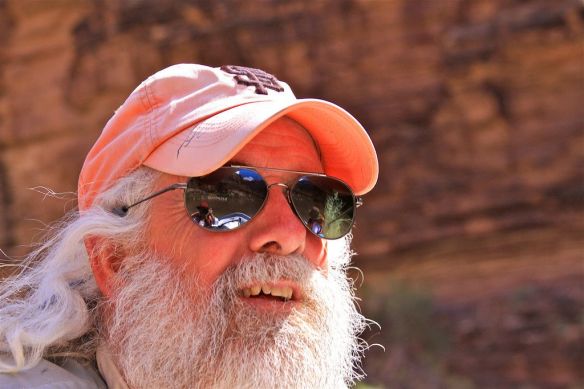
Howie has guided river trips on the Colorado for over twenty years.  He has plenty of experience.  But each time he runs Lava, Howie dons a white shirt and tie.  It’s his schtick.  You need to respect Lava he says.  You don’t own it.  That water owns you.

Mazie had chosen to ride with Howie on this run.  She loved his humor, how he told a story about ancient Puebloans, narrating it with tiny plastic figures, until folks realized he was making things up.  He had been on the river for twenty years.  But most importantly, his collected and calm manner was equal to his experience.

Mazie stood on the shore sobbing, refusing to get in the boat, begging for Howie not to leave the shore.  All the other boats, including ours had already left.  Howie was alone and at a loss.  He had no children of his own and had no experience about what to do with a terrified little girl.  So he improvised.  Before he untied the boat he knelt by Mazie and put something in her hand.  This is my lucky penny, he whispered to her.  I’ve carried it every time that I’ve gone through Lava.  Hold it tight, he told her.  Hold it tight and it will keep you safe through the rapids.  With that, Mazie climbed into the raft and she held on.

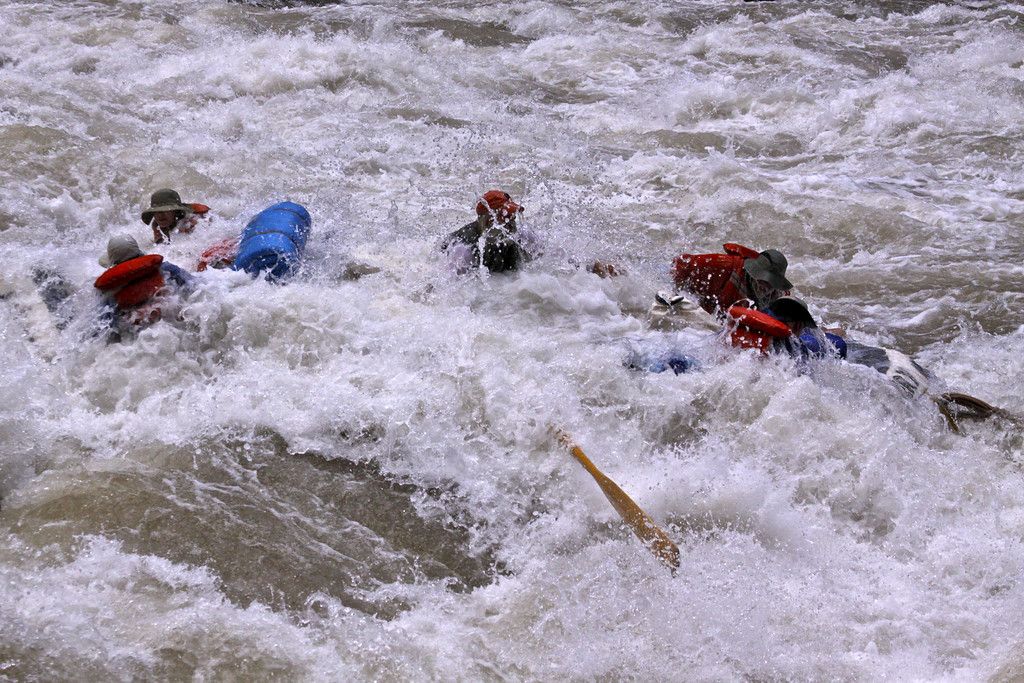
Mazie clutched that penny.  Twelve years old, not even, and she descended into that roiling water with Howie at the oars.  They struck deep, disappeared, emerged and struck deep once again, the boat fully disappearing beneath the water.  They shot out into the face of the waves that mounted again and again until they were at last carried through.

Once all the boats had safely made it, we tied up against the cliffs towering above the water.  Shaken, giddy, and fully spent, everyone had stepped onto the ledge to which we were tied.  People sat and rested, some drifting into sleep.  Mazie, though, stayed in the boat, sobbing forever it seemed, still afraid to let go of the lines.  One by one the boatmen sat with her.  Howie held her, letting her know that they were safe, that everything was okay.

A few days ago, Howie Usher suffered a severe stroke.  He was set to go down on the river this summer.  There’s little word yet on his condition, only that it’s bad and that he has a difficult road to recovery.  This time the water carried wrong.  Howie went down over the lip and he’s in there now.  Things didn’t go right.  And now Howie against his will, knowledge, and experience, has been swept into the hole.
9. Paisley

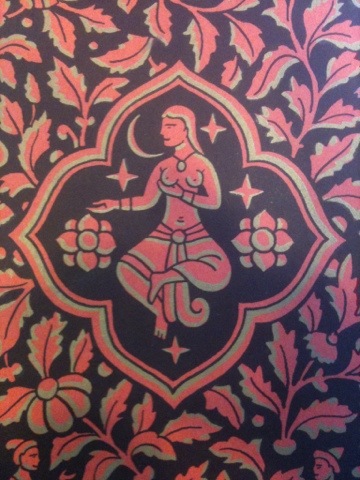
ImageStaci adds the table extensions and dresses the table with a paisley cloth.  Paisley.  How strange.  Where does it come from?

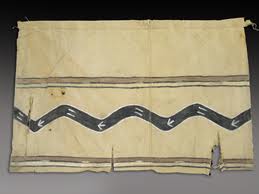
The answer is found in the densely woven tapestry hanging in the dining alcove.  The table cloth is only a slightly more abstracted version of the other.

ImageAlthough the word comes from the village in Scotland, the boteh jegheh design itself originated in Persia.  It’s a Zoroastrian symbol for the eternal and infinite as it gives expression in life.  The abstracted floral pattern decorated royal regalia and became associated with richness and opulence during the Qajar and Pahlavi Dynasties.

The boteh design eventually spread throughout Asia and eventually made it’s way to the Scottish town of Paisley by way of the East India Trading Company.  From there, the chattering looms of satan’s mills brought the design to the masses of Victorian England, and eventually Victorian San Francisco.

But if you look long enough, it might be that the boteh contains in it’s complexities the very essence of that great idea spaketh by Zarusthra.  Of the power of right thought and right word.  Of the need to keep the chaos at bay.  Of the power eminent in flame and the twisting currents of water.

8. The Sylph and the Goldfish

Rain sweeps in from the ocean and drenches coastal California. The Penguin Dinghy, however, rests safe and dry in the Room of Requirement.

With the rain and all, we go to Los Angeles  It is Persian New Year.

—-

Once upon a time there was a wisp girl who lived in the city of Los Angeles.  One evening she leapt from her bed and in doing so she ripped a toenail off. The little girl was far closer to the beginning premise of her life than we may be to our own demise. Hardly seven years old, her materiality was still fresh and barely set, hardly removed from that time in which she didn’t exist at all. What did she remember, if anything, from that world that preceded her? Maybe for this reason she couldn’t distinguish a wound from a fatal wound. Any injury might be a summons from death. She sat on the floor, cradled her toe and considered her own mortality. Baba, she wept. I don’t want to die. I am too young. I don’t want to die.

20120318-102427.jpgOnce upon a time on a living room table in Pasadena, the Nowruz goldfish swam in their small bowl. They had been brought into the house as a harbinger of the New Year. But did they know why they swam in the bowl? Or even that they were they and that they swam in a bowl at all? Did they know they had meaning? That they were living fire in a globe of water and the embodiment of spring?

20120318-102506.jpgOnce upon a time we drove to a shabby boulevard in Westwood in a heavy downpour to purchase saffron, halwa, flat bread, jordan almonds, pistachios, whole fish and tea. The rain was so heavy that the freeway traffic on the I-10 slowed to a crawl and it was as if the world had become cemented with water and we had returned to our amphibious selves.

Razieh

Razieh

Once upon a time there was a little girl in Tehran who so badly wanted a goldfish for Nowruz that she schemed with her brother and pestered her mother until the woman finally relented and handed over a 500 toman note. The little girl journeyed to the market and lost her money twice and was scared and sad and elated. She met snake charmers and merchants and a soldier who offered to help. The girl, trapped yet in her childhood felt for the first time a glimmer of the predation of men and of a looming world beyond.

But the girl never existed. And yet when the poor thing sat on the curb outside the market, staring through the sewer grate at her banknote just out of reach, future violations even further beyond her consciousness, she hardly thought to  consider our existence. In her world, none of us witnesses and sylphs existed as even a consideration. We were nothing at all.

7. The story of the third forest

Yerba Buena Harbor, 1853

Patience yet.  In due time we’ll get to the Boat.  We still need to finish with the forests.

The story of the third forest

Once upon a time, through a series of ecosystem successions, great hardwood forests emerged on the eastern seaboard. The first Europeans to experience the woods were astonished at the almost park-like feel – the result of centuries of thinning and burning of the understory by the native inhabitants who each spring would clear the woods to make it easier to track and follow game. The Europeans experienced grassy glades shaded by maples and conifers, their trunks an easy ten feet in diameter.

We all know what happened, of course. Within a couple hundred years all of New England was timbered out – by the 1800’s 98% of Vermont had been deforested and the land turned over to sheep and dairy. A chunk of that wood made its way down to the McKay Shipyards in Boston and Kennard & Williamson in Baltimore where it was refashioned into clipper ships, vessels so strongly masted and engineered that they could cut around Cape Horn with record speed.

These were the ships that carried the miners to San Francisco after 1849.  When they set port in San Francisco Bay, their crews jumped ship by the droves and headed up into the mountains to work the gold fields. With no one left to sail the ships back, and the investors and owners left holding the bag, that forest of masted clippers and schooners floated idly amouldering in Yerba Buena Harbor, a nation of hardwood that was gradually dismembered and refashioned into the parlor houses, cribs, gin joints, and Victorian filagreed domiciles that graced the city.

That was until 5:12 a.m. on Wednesday, April 18th, 1906, when the ground shook so fiercely that the city of San Francisco collapsed and the gas lines burst into flames.  Within days the Great Fire had consumed over 25,000 buildings.

In a strange arc, those wonderful ancient forests tended by the Algonquin and Abenaki, and tendered by hundreds of years Atlantic nor’easters, as well as vast stands rounding Seattle rooted in tons of salmon flesh, came to be consumed in a holocaust at the gateway to San Francisco Bay.

But not all of the wood burned.

Regardless of what forest or what ocean she came from, some of that wood fashioned of steelhead and moutain fiber made it’s way to a spot of land newly parceled out from the Blucher Rancheria in newly incorporated town of Sebastopol in Sonoma County.  The boards were stacked on the open meadow on the knoll at the crest of our ridge.

One morning in 1901 or 1902 a few sawyers and carpenters arrived and, through their hands, the Room of Requirement wrought as ocean, and then as wood, in all cases ferrying whatever was into Safe Harbor, entered it’s Third Incarnation.

6. The Story of the Wawona

The Wawona docked in Seattle

Why was timber being shipped all the way from Seattle to San Francisco?  Why not bring down wood from the Sierra Nevada which geographically was much closer?  The answer suggests what the Age of Carbon has robbed from us.

People couldn’t bring the wood from the Sierras because at the time there was no easy way to do it.  The railroad hadn’t been built yet.  Hauling timber down from the mountains by ox or cart wasn’t feasible.  And so, as it had been for thousands of years prior, the maritime ruled supreme.  For most of human time, river ways were in fact road ways.  You could cut vast territory quickly and efficiently by plying the rivers.  In the 1800’s the only way to move wood out of the Great North Woods was to float it, eventually to the mills and lumberyards of Chicago.  And in the 1850’s it was far easier to ship timber by schooner than muscle it down from the Sierras.  Even in the early years of the Gold Rush, timber was barqued 13,000 miles around Cape Horn from New England.

Which tells us something else.  You can’t cut big timber without a mill.  A mill requires blades.  And gear trains and  steam or water driven engines.  Little of that could be easily had on the West Coast of North America in the 1840’s.  So the first west coast mill built in Bodega Bay in 1843 by Stephen Smith was a big deal.  It meant that boards could be easily had.

Within a few decades nearly 800 mills lined the coast from the Bay up through the Pacific Northwest.  Their sole purpose in the early years was to mill the giant coastal timber stands and ship the cut wood to San Francisco.  Originally it was done by square riggers, but by the 1860’s special lumber vessels were being constructed, many coming out of the Bendixsen shipyard in Humboldt Bay.  The ships had simple rigging and deck arrangements to facilitate the loading of lumber.  Much like with modern container ships, the board cargo was all deck stored.

The three masted 165 foot Wawona came out of the Bendixsen yard in 1897 and ferried timber from Gray’s Harbor down to California for nearly 16 years, after which she was deployed as a cod fishing vessel in the Bering Sea.

The Wawona herself was built of Douglas Fir, fashioned from material that had once been matter parceled from the sea. So for the breadth of her lifetime, from 1897 to 1947, sea energy harvested sea energy to be consumed by humans, or bore sea energy across the ocean, so that it could be cut and planed and hammered and fastened and battened into gingerbread Victorian homes, carapaces for up and coming merchants and gold boom urbanites.  In this way ocean was borne onto the land once again.

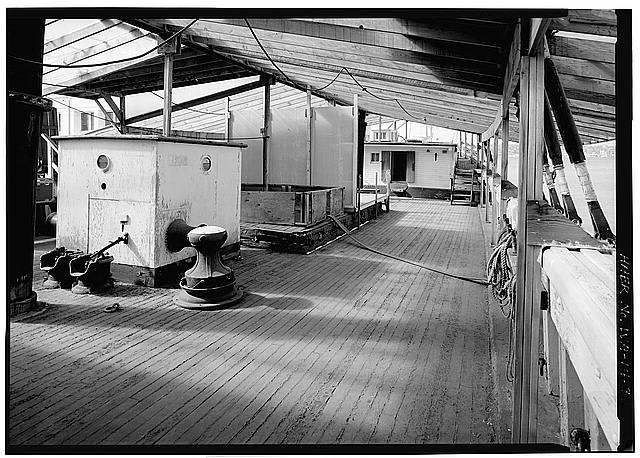
After the Wawona retired in 1964, she took harbor in Seattle’s Lake Union where she was slated for restoration at the Center for Wooden Boats.  For years it was possible to visit and walk aboard her masted carcass.  A couple years ago, though, restoration efforts were halted, she was towed to dry dock in 2009, and she was dismantled.

The Deck of the Wawona

If you’re reading this, you will never in this lifetime or any other have the chance to walk aboard the deck of Wawona.  

But picture this:  The new millennium, 1900,  and the Wawona bucks and canters in heavy surf, her hull tethered to a doghole chute.  The sharp knock of called lines and pulleys against spars and mast on a gray afternoon and more to go of an already  long day as sailors wire sweet redwood and fir onto the sheltered deck.  The winter air reeks of sea lichen, and bladderwort, and the must and rusted pine tar oakum that caulks the decking.  Picture the moist grunge, that sludgy wort that grows in the nether space between land and water, crumbling chinked mortar between port cobbles and brick, the living grease of taupe and ambergris mold that slickens the surfaces of skid rows and harbors.   It’s 1991 and the spring maritime has wet and chilled the night streets of Pioneer Square and inside the OK Hotel, mud honey, floors sticky with beer and air with sweat and smoke stink and Novoselic and Grohl and Cobain – he’s just a boy yet – drive out Smells Like Teen Spirit.


5. The Room of Requirement: The Second Incarnation

Stumptown

The Room of Requirement was built of wood, not water.  How did that come to be?

The story of the first forest

The Russian River opens out to the Pacific at Bodega Bay just northwest of here. From there it winds easterly and northerly through Monte Rio and Guerneville.  It’s fed by many small tributaries, including one, Salmon Creek, that has it’s origins near the small town of Occidental.  For thousands of years, The Chinook would run up the Russian River much as they still do today, depositing themselves in the pools and on the sandbars to spawn and to die. Bear and other predators once ate their carcasses, leaving much of the fish on the forest floor.  The fish provided nearly a quarter of the nitrogen taken up by the riparian forest.  The ocean became fish.  And the fish became trees.

The wood for the Room of Requirement could have been milled near around here in the heavy first generation forest that once layered much of West County.  The first sawmill was built in Guerneville by John Heald, William Willits, George Guerne, and John Bagley.  The first three of the men would go on to establish towns of their own.  Who knows what went south with the fourth?  Nonetheless, they worked with such intent felling the giant redwoods, that the surrounding area eventually came to be known as Stumptown.  Other mills sprung up:  six in Occidental, one in Freestone, many of them supplying timbers for the nascent narrow gauge railroads that were extending their tendrils north.  And once the railroads were in place, the wood could be shipped to the still infant metropolises to the south.  By 1901, however, that area of the Russian River watershed had been largely deforested and many of the mills shut down.  Thirty years prior, so many old growth redwood grew here that the region may have had the densest biomass on the entire earth.

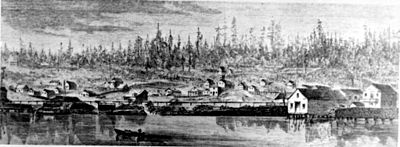
Seattle deforested

The story of the second forest

Or the wood for the Room of Requirement could have come down from the timber stands near Seattle.  Seattle was a late comer in the Anglo settlement of North America. The Denny Party didn’t land in the Puget Sound until September, 1851, but in short order, some members of the pioneer group set the saw blades spinning.  At that time the entire Sound was blanketed in 2000 year old fir standing 400 feet high.  Nothing like that exists in the world today.  Here too, the stands of trees were seasoned and nourished by the vast flow of nutrients that each year swam seasonally up from the Pacific.  Near uncountable number of Steelhead, Coho, and King had over the millennia born a treasure of maritime wealth in their bodies, coursed it up rock and rapid to lay it rest in the woods of the Pacific Northwest.  Functionally the fish were a way to transport potential energy from the ocean upstream in the system and back onto land.  Eventually much of that energy stored in timber mass, through human agency, would find it’s way back to the ocean and to new distant shores where it would one day be released in a conflagration.

Initially the wood was harvested up on the ridge lines of Capitol and Beacon Hill and then slid down on skids (in order for the logs to slide smoothly, the skids were greased by the original grease monkeys, a well-equipped and perhaps racially-tainted slur) to Henry Yesler’s harbor side mill at the base of the slope. There the logs were cut, loaded onto large timber ships that ferried the wood to San Francisco where it was devoured up by the Gold Rush building boom. The muddy timber camp, most likely the first skid row, was a sloppy mess of a place lined with bars and piled with rowdy lumbermen, windfall buckers (those logging mercenaries hired out to buck the worst of fallen trees), sailors and drunks.  Subsequent generations civilized the area into Pioneer Square, but it never really shed it’s cantankerous bearing. A hundred and forty years later on a cold spring Seattle night, Kurt Cobain stood up in a sweaty bar room in the OK Hotel in Pioneer Square and sang for the first time, Smells Like Teen Spirit.  The band was originally called Skid Row. A few years and name changes later, they had become Nirvana.

Grunge music, of course, leads us inevitably to the Story of the Wawona.


4. The Room of Requirement: The First Incarnation

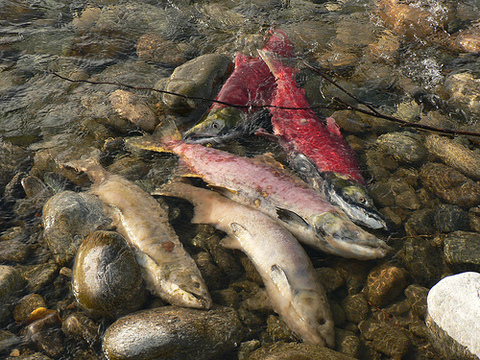
Salmon spawn

Courtesy of J. K. Rowling, is that place where you hide your fears and fashion your dreams.  It’s that place that’s exactly what you need at exactly that moment.

The house we bought in Sebastopol, it turns out, is endlessly extensible.  It even came with it’s own Room of Requirement.  In it’s first incarnation, the room was the sea.

The First Incarnation:  the story of the sea

After the flood, clam and oyster and shellfish took up calcium and salts from the ocean and from these stores the engines of their DNA fashioned shell and carapace.  Plankton and algae harvested sunlight and carbon dioxide, and in one of life’s most supreme acts created green breathing matter.  The matter was consumed by other fish, krill and invertebrates who in turn were consumed by a diminutive carnivore from the family Salmonidae.  These mighty fish hatched nearly on land, kept safe by the barest sheen of water.  They grew and molted and shimmered down the tributaries to the open sea.  Those that survived ranged the cold Pacific waters as far north as Alaska.  Much of their lives to this day remain a mystery.  What little we do know, however, concerns the laying of their spawn, and their tortured journeys back up stream in which they shed themselves of everything save the desire to reproduce.  Forsaking even their own appetite, they cast themselves repeatedly against the current, battling against the gravitational and tidal pull of the rest of nature solely so that they may live.  Once they reach gravel shoals, they lay and fertilize their own spawn.  Spent, they survive only a short while longer.  Their job is done.  And in their consequent death they return once again to join us on land.

The salmon are required to do this.  Life, their life, all life in the Pacific Northwest has pulsed for ten millennia with their return journey.  It is why, in it’s second incarnation, the Room came to be a forest.

3. Tale of the Boat

The Boat

Why, we go to sea.

The Boat arrived here in the Fall, towed up onto the property on an unplated trailer by 80 year old Jack in his one ton truck.  Brett and I pulled it by hand the last hundred feet to the  Room of Requirement.  Opening both french doors wide we ferried her in.  And for a few months now she has slumbered.  The nights long, the air chill.  The cats climbed on her and sometimes we checked in.  But mostly she just slept.  Jack has visited a few times and on each occasion he’s asked if he could visit her, just to see, just to lay his hands.

Walking about in the Room of Requirement, he’d gaze at her and touch her and he was pleased.

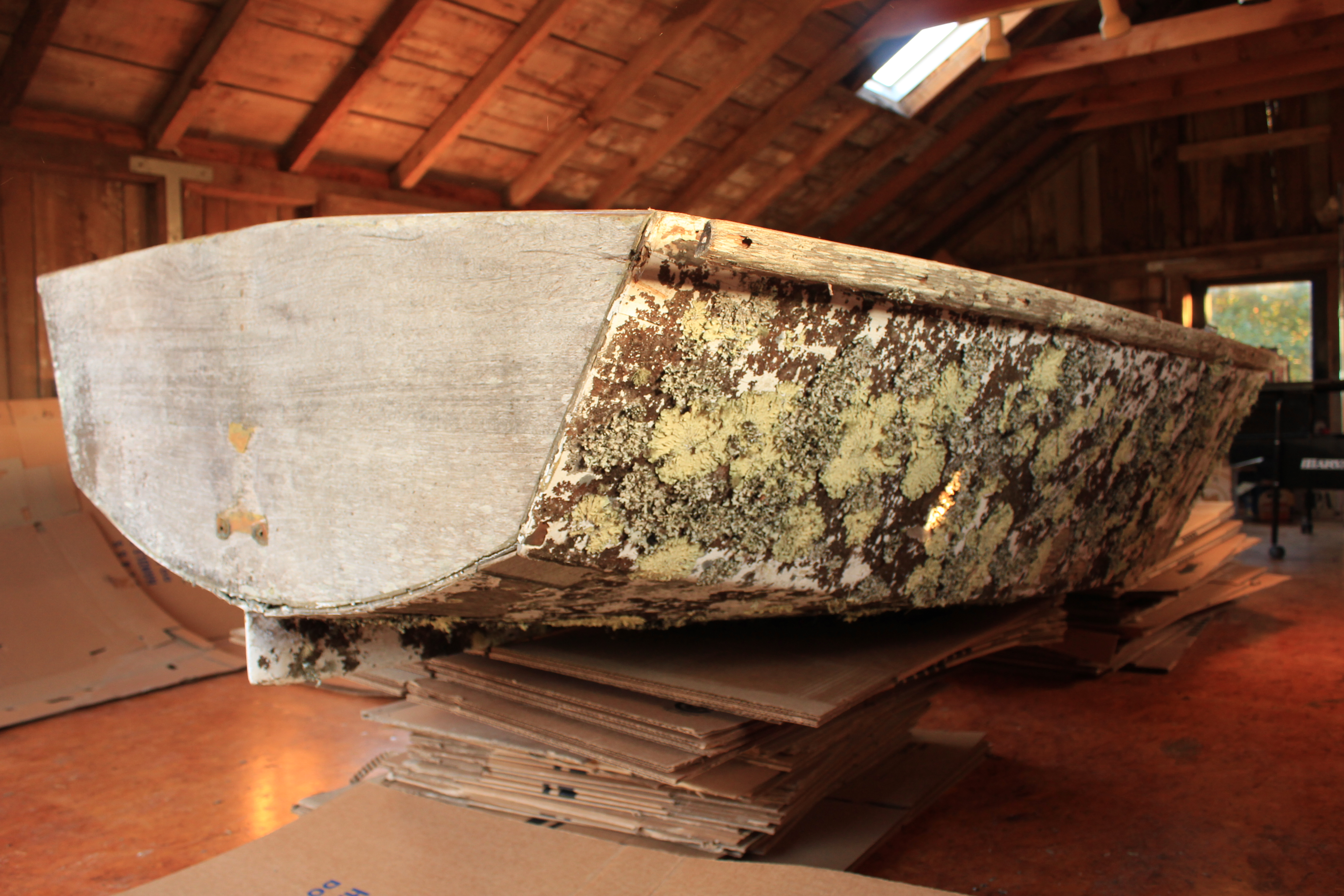
She’s just a Penguin Dinghy, if that.  She was built for placid eastern waters and can hardly withstand the gusts on San Francisco Bay.  On top of that what’s left of her is covered in lichen.  Her stern has been plowed with gashes.  What to say?  She may be more hole than anything else, but can any absences stoved in upon her negate her right to existence?

All the while Brett has been away out with the wind.  He restored a barn in Bolinas, and served at a Vipassana retreat and painted a mural and went to a movement workshop at Tamalpa.  He got a girlfriend and got a plan which shifted into another.  All good stuff.

The days have started to grow longer.  The daffodils and narcissus have come up, the locust is in full bloom along with the magnolias.  Spring appears at last to be here.  And now Brett has returned home.

Time has come for the restoration of the Boat.  The boat that came from Arlo Guthrie’s house.  The boat that rotted in Jack’s yard in Marshall for thirteen years.  The boat that harkens to an ancient childhood memory that belongs not to me.

Why do you assume any task?  Why do you refurbish or refashion anything?  Why with all the things yet to be done – rooms still to unpack, months of bookkeeping, gardens to be planted, work work work to be done, have we taken on this project?

But we don’t have an answer.  There is no why.  We do it because it’s there to be done.

And a faint trust in the belief that beauty near always arises from the foolish act.

2. O

Odysseus

Tell me, O muse, of that ingenious hero who travelled far and wide after he had sacked the famous town of Troy….

What is it with that Homeric ‘O’?  It’s all at once the hallowed ‘O’ summoning a god, the plaintive ‘O’ asking to receive the story, and the demanding ‘O’ calling for a passerby to listen, to listen now because there is something vital that must be said.  The first is filled with hubris, as if we’re even worthy to make the call.  The last, more akin to faith, underscores the belief that the story can and will be told to it’s full fruition.

I feel it most, though, as the aching cry, the lament – the Oh Christ, or the child curled in the fetal position, moaning to himself, oh…oh…oh, feeling the score of the wound behind, or the weight of the task ahead, yet unable to get the words out.

But we are not children.  And we do have allies. When resolve is lacking, we have cohorts ready to bind us to the mast so that we may stare ahead resolutely, deaf to the call of sirens.  Time to get with it.

Where do we go this morning as that once great Greece stumbles along in shambles?

1. Scheherezade

20120308-161415.jpg

Upon the betrayal of King Shahryar by his Queen and wife, the Sultan had her beheaded and vowed that, henceforth, he would each day take a new wife, he would sleep with her, and at the following dawn slay her to secure her honor as he would slay a thousand women and forever subvert the guile and perfidy of women, even though in this way lay madness.

He nonetheless set forth and the consequent wreak and ruin descended upon the Caliphate, mothers mourning, parents in flight with daughters until not a maiden fit for carnality could be had. That is until the daughter of the Sultan’s Wizir pleaded with her father to allow herself to be taken as the Sultan’s wife and, that if she were allowed to do so, she herself would end the slaughter of women and save all the virgin daughters of Islam. Unable to withstand his daughter’s will, the Wizir agreed. He delivered Scheherezade to the Sultan Shahryar, and he slept with her and he took her maidenhead, and as the dawn approached not yet making itself present, she asked the King if he would entertain a story. With that she began the tale of the Trader and the Jinni.

We know, of course, that she could not finish the tale.  The Sultan spared her life for one more night and yet another.  The stories continued on for a near infinite number of nights.

Therein lay the beauty of Scherehezade. As long as she breathed a story, she knew at least that she would breathe. For her, the story became a high wire act on which her very life or death depended. Night after night she slept with the Sultan after which she seduced him with her stories until the two acts became equated. In the end, the story became the more powerful seduction. Whole worlds and worlds within worlds were born, leaving the story as the generative act.

And it’s story telling at it’s most basic. A fairy tale and a lullaby. The story that provides solace. The story that nurses us into sleep.

The Boat

As far as this story goes, the boat’s journey began on the back porch of Arlo Guthrie’s farmhouse in Massachusetts. It had sat there for a lot of years. I don’t know how Arlo came to have it or what his plans were. Apparently he doesn’t really like the water.

His friend Jack, though, loved boats. He once took the thing out on Arlo’s pond that was hardly bigger than a small room. And I guess Arlo said Jack could have it.

So Jack drove the thing from Massachusetts to Colorado on a flatbed trailer and the boat pretty much sat upside down on someone’s property for a lot of years and then it was driven down to Palm Springs where it sat upside down for a lot more years. Jack may have floated it in a swimming pool just to see what it was like.

Eventually the boat came to Tomales Bay where it weathered untended to for more than a decade. The gunnels rotted out as well some of the sidings. It had once been a lovely Penguin Dinghy much like a boat that Jack had once owned that had been swept away in the great New York hurricane of 1953.

Just before Thanksgiving my boat building friend Brett was driving down the 1 toward Bolinas when he spied a prickly pear cactus adorned with fruit. He pulled over, got his tongs and gloves and set to gleaning a bag of fruit. He was interrupted, though, by a winsome woman, a complete stranger, who seemed to have materialized out of nowhere.

We need help, she said. We need to save Jack’s boat. She suggested that it was in some sort of imminent danger and that she needed assistance.

Well, I’ve worked on boats, Brett offered. He looked around at the neighboring docks on the bay. Where is it? he asked. I can come over and see what I can do.

The woman looked at him incredulously. The boat’s not here, she said. It’s in Sausalito.

Okay, Brett said. Give me Jack’s phone number and I can call him and I can see what I can do.

The woman became very unnerved. You can’t call Jack! she exclaimed. Everyone wants to talk with Jack. Jack calls you!

So she took Brett’s number and told him to wait ten minutes and the call would arrive.

Which it did. And by the next day Brett was in a Sausalito boat yard listening to a day full of boat yarns and traveling history and loading the boat onto a trailer hitch and towing it to Bolinas. And a few days later he was at our house standing outside the chicken house with a sack of apples in each hand, staring in reverie, wondering what our plans were for the chicken house.

Our friend Evan Nichols the writer had christened it the Room of Requirement. Everyone who stepped inside was possessed by a different overpowering vision. For Mazie, it was the ping pong hang out room. I saw a cider pressing and cheesemaking facility. Evan saw a writers retreat room. His wife Amy saw a yoga room. Anne Harley envisioned a singing studio. The vultures have found it quite useful as a dinner plate.

And Brett saw a boat restoration house.

The room is one and all of these things.

And that’s how last Monday Jack pulled up in his three quarter ton truck pulling the boat. And that’s how Arlo Guthrie’s penguin dinghy came to sit inside our chicken house. And why I will spend a better part of my winter sanding and planing and painting wood.

Because if you do things right, all of this, every bit, is required.