Unknown's avatar

About Andrew Lewis

I am alive. And well. And thinking too.

Interlude: The List

I now confess:  I’m a compulsive list maker.

My friend Danny often teases me about it.  He once said that if something ever happened to me he wanted my signed copy of The Ants and my Lists.  His point is worth honoring:  the reason I haven’t written (or for that matter, read) The Ants may in part be due to the multitude of distractions on my lists.

And mind you, they are lists.  I start one.  It gets filled to the edge.  I start another. I misplace that one so I start another.  So these lists of duplicate mutually distracting items litter my office.

Why I do dat?

It’s a good question.  I’ll take a stab at it.

1. I’m Seeking Order.  My house growing up was in absolute chaos.  I’ve told some people stories, but I think it might be hard for most folks to imagine.  Junk and trash everywhere.  At times dog shit covering the kitchen floor. No one ever cleaned up.  No one did much of anything.  I had no set bed time, no meal times, often times not even meals.  In that environment it was hard to keep even my thoughts straight and so early on I learned that a list could provide at least the illusion of structure.   I remember over spring break in 5th grade I approached my friend Leo with a schedule for everything we would do and what time we would do it.  He was baffled.  Why do we have to have  a schedule, he asked?  It’s Easter vacation.

He was right.  And yet I didn’t see it as at all weird.

2. No filter: From the very beginning the sheer number of things that would land on that list were near infinite.  In a world without structure and rules, all things are necessary.  And all things are possible.  So on any given day in 6th grade, my list might include: clean the kitchen, vacuum the house, edge the lawn with a pair of hand scissors, buy groceries, do homework, explore the canyon, ride my bike to North Park, read Les Miserables, and make a present for mom.  I had no criteria by which to differentiate between grownup stuff and kid stuff.  In 7th grade a friend once asked me what I was saving my paper route money for.  I’m going to buy a refrigerator, I answered.

And there was no distinguishing between important stuff and non-important stuff.  It was just one big soup.  Everything needed to be done.  My mom’s stuff.  My brother’s stuff.  My stuff.  And it was all possible because there was nothing or anyone to say it wasn’t.

3. Incented to be a generalist: Feral creatures are opportunists.  You don’t know where the next meal is coming from so you take what you can get.  I was too young, though, to distinguish what was truly necessary for survival.  I started reading company financial reports in 5th grade because (and I swear to god this is true), I figured I needed to know how to manage money. This information, I thought, might one day be useful.  So my floor was littered with Huck Finn, Tolkien, notes on scientific experiments I should complete, those financial reports, word searches, a half eaten omelette, recipes I might want to cook, a Scientific American issue devoted to number theory, and Readers Digests.  I grabbed whatever came in front of me. And mind you, there’s no one in my life to set boundaries, to perhaps say it’s not necessary for a nine year old to be reading financial reports or, as the case was, trying to understand periodic functions.

4. DP thinking:  Displaced Persons – folks who’ve been displaced from their homes and consequent emotional stability – tend to become packrats.  I love DP’s – In my twenties and thirties I spent a lot of time with emigres from Latvija and Russia and Germany – in part because I could identify with them.

We all were afraid of loss. And physical objects or pieces of paper become mnemonics for those things we were trying to hold on to. If I lost the piece of paper, I would in turn lose the emotion or idea that I associated with it.

That’s why I still have my record vinyl.  And certain New Yorker’s from 1992.  It’s a very interesting sickness.

And it’s also why, in part, I’ve been buried by my own lists.  If I lose the list, or even an item on the list, I stand to lose another small sliver of my self.

And that self, defined early on by loss, cannot bear it.
Priority 1: Set Priorities

That’s always the tough one.  Especially when my 2013 list is as crazy and overreaching as it is.  It can also lead to a recursive loop.

If I’m a writer, than writing should probably be at the top of the heap.  And it’s also the thing to be most avoided.  I’ll put it at the top and try to develop some strategies around it later.

As for what comes next, it might help to choose the items most onerous or requiring the most lead time and schedule those up front. Call it the inner Obama.  It’ll take 3 years to get out of Iraq, so you have to start the process on Day 1.  And if you don’t start the withdrawal that first year, you won’t see your peace dividend before year 6.  And you have to reform health care in the first half of your term because you won’t have enough political capital left in the second half.

So in my case, what long term investments should I make right out of the starting gate?  What are the most onerous things?  And which require the most lead time?

The answers are clear, though not entirely self-evident:

  1. Get organized
  2. Take care of dental work and health stuff.
  3. Help secure Natwani funding
  4. Fence train the dog and reign in the chickens.

My rationale:

I haven’t been to the dentist in years.  Some of my cavities have been cooking in my mouth since 1997.  And for me the possible ramifications are severe.  My resistance to dealing with this stuff is huge.  And the victory if I take care of it first is commensurate.

I helped start the Natwani Coalition in 2004.  They’re doing incredible work, and yet their last cycle of grants is running out and they may need to shutter their doors.  The funding will require at least a 6 month lead time.

Lastly, I spend a disproportionate amount of time chasing down our chickens and dogs as they roam the neighborhood.  I’ve learned a lot about the habits of chickens and dogs, but I really need to be using that time to do something else.

Okay.  Time to tackle them one at a time.

Faultlines: Siddhartha Gautam

Siddharta3January 25 was the birthday of a good friend, Siddhartha Gautam.  He died over 20 years ago.

And, strangely, it’s as if he’s not dead.

He’s forever young – he died in his twenties, while all of us have gone on to grow older.  He was also one of the most brilliant, and perhaps effective, people I’ve ever met.  In college would churn out a fifteen or twenty page paper in a night, leaving those of us who were less talented feeling befuddled.

But there’s something else.  Responding to a recent post, an old friend, Linda Goodman, suggested that I’m fine as I am and that there’s no need to change.  I appreciate the words.  And yet Siddhartha was better equipped than I, but he is gone and I am not.

So what responsibility do I have to do some work commensurate with the life he might have lived?

By virtue of my own pulse, what do I owe him?

The Difference Between President Obama and Me

Obama at Sasha's Dress RehearsalWell.  Actually. I think there are quite a few.  But one in particular stands out.

Between December 16 and January 21 President Obama did the following:

  • He attended a dress rehearsal of his daughter’s school play
  • While doing so he wrote some draft remarks for a talk he was to give.
  • That night he delivered those remarks at the memorial for the New Town families.
  • He celebrated the holidays
  • He engineered a compromise to avoid the fiscal cliff.
  • He initiated a sweeping effort to address gun violence.
  • He got inaugurated.
  • He attended some inaugural balls
  • He launched new efforts to reform our immigration policies
  • With great difficulty he negotiated to raise the debt ceiling
  • And he instigated new efforts to reduce gender and sexual orientation bias in the US military

I would have taken any one of those items, checked it off, and called it a year.

But instead, what did I do?

  • I made some hard cider
  • I celebrated the holidays
  • I lost a chicken to a bobcat
  • I must have done something else, but for the life of me I can’t remember what.

Now Obama, of course, is the President.  And I’m me.  And there are a whole lot of really interesting reasons why that’s the case- perhaps I’ll get to them in a later post.

But the present point is what behavior allows Obama (despite political rancor) to be a bit more effective?  Keep in mind, that in 2006, the thought that an African American named Barack Hussein Obama would soon be elected President of the United States would have been considered ludicrous.  And yet it happened.  In large part, I think, because of his personal habits.

What are some of those?

1.  Intense focus.  I carry with me the image of him the day after his 2008 election victory.  He awoke as usual at 5:30 am.  He went to his regular workout at his gym in Chicago.  And then he reported for work at the campaign headquarters and began the transition.

In hand with this, it helps to remember that Obama began as a community organizer.  To do that, you have to first know how to be organized.

2. Clear priorities.  Obama’s 2008 Campaign Blueprint for Change contains a lot of promises.  And many on the left were frustrated because he didn’t do everything he had set out to do or that he seemed too willing to compromise.  But I would counter that he actually had a much clearer understanding of the reality facing him.  In a divided nation, (and keep in mind how divided we were and still are), you only have so much political capital.  The gravity of his first Inaugural reflected, I think, the depths of the challenges facing us.  We were in economic free fall.  Banks were failing, and those on the inside feared a wholesale economic collapse.

So the priorities were bailing out the banks.  Rescuing the auto industry.  And putting forward the Affordable Health Care Act.  And none of those came easily. That’s mostly all he had capital for.  You could argue that he may have burned too much.  Gay rights, immigration reform, addressing climate change?  All those laudable efforts would have to wait for a second term.

3. Long term investments.  The 2012 campaign began in January 2011 when David Axelrod relocated back to Chicago.  The campaign team began the heavy investment in datametrics, infrastructure, and personnel that helped win the election.  They eventually assembled a distributed organization and data gathering machine of such efficiency that Obama felt at ease enough to play b-ball on election day and Nate Silverman could go to sleep on election eve with visions of sugarplum fairies dancing in his head.  Much of the heavy lifting had been done years earlier.

It also can be seen in policy decisions: In order to see a peace dividend in 2014, the draw downs in Iraq and Afghanistan would need to begin in 2009 and 2011. Or as part of the economic stimulus bill, his administration increased our investments in sustainable energy development from the hundreds of millions of dollars to over 70 billion.  We won’t see all the returns on those decisions until the tail end of his presidency.  But if the returns were ever to be felt, the infrastructure investments needed to be made early on.

So at the tail end of 2012, what dim lessons did I draw from the president?

  1. Stay focused.
  2. Get organized.
  3. Set clear priorities.
  4. Invest in tools and infrastructure early on.
  5. Hire well.

By the way, the photo is of Obama reviewing his New Town remark at the dress rehearsal at his daughter’s play.  He went to the rehearsal because he was not going to be able to attend the full performance that night.

The full raft of Pete Souza behind-the-scene photos of the Presidency are worth a look.  They give a strangely poignant sense of what it’s like for the President and staff to be working within the West Wing.

Hubris

My good friend Patrick Wilkinson recently pointed out that I may not be one of those persons for whom Resolutions work.  And now I’m essentially going for broke and doubling down on a strategy that’s proven to fail.

He’s right.

I’m basically the George Bush of New Year’s Resolutions.

But that’s the point of blind spots, isn’t it?  That you’re blind to them?  So I stand resolute.

I have my political capital and I plan to spend it!  Or as the case actually was for our former President:  I don’t have any capital and I plan to spend it.

On Habits: Why you do dat?

One of my favorite stories comes from Jeff Benjamin.

A friend of his had just gotten a new job at a lube place somewhere in New York.  One morning a guy brings his car in, the friend drains the old oil and, for whatever reason, neglects to put new oil in.  (Mind you, that’s essentially his sole responsibility – to put new oil in cars).  Car owner happily pays, drives off, and a few minutes later returns with his car, gears grinding and engine frozen up.  The car has been ruined.

The Korean owner of the lube joint comes out, a look of anguish on his face.  He walks in circles around the car, tears welling up, gesticulating at his new employee.

Why you do dat? he implores.  Why you do dat?

A very good question indeed.  Why do we do dat?

—-

We’re all guilty of doing stupid things.  Some of them we write off as mental lapses (I left the stove on when I left for work.  Or, I snapped at my kid).  But often times those things we write off as temporary lapses also form patterns (I can never find my keys when I need to leave for work and I also leave the lights on.  Or ‘mom – why do you always yell at me?’).

And then there are the chronic things that we do that we consider part of our identity.  I’m a smoker.  Or, I’ve always been fat.  Or hey, that’s too early – I’m not a morning person.  And how often do we berate ourselves for not being smart enough, or punctual, or a good parent, or good at math or science?

Are these attributes really foundational parts of who we are?  And regardless, are they changeable?

In November I picked up a couple of books that cast some cool light on the questions.  The first, The Power of Habit by Charles Duhigg has been hovering at the top of the pop charts for a while now.  Duhigg explores the idea that our being, this thing that we consider “self” or “personality” is largely a collection of “habits”, patterns of behavior that have become hardwired in our neural pathways.  These habits are actually malleable and subject to change, and that the change isn’t so much about willpower, as about choosing the correct channels by which to exercise that change.

He also goes on to look at the patterns of behavior that are encoded in institutions (to work for Google feels different than working for AT&T, for example) and even culture (racism or patriarchy, lets say). These things, too, are open to change.

The second book, Rewire Your Brain by John Arden, works from some of the same premises, but from the perspective of a clinical psychologist. He’s director of Training in Mental Health for Kaiser Northern California.  Over dinner last year, I was asking him about personality disorders and different sociopathologies and his answers were striking.  A lot of it was about how experiences and trauma can influence our neurochemistry and contribute to the development (or underdevelopment) of different parts of the brain.  We essentially learn, or fail to learn, the control mechanisms, decision making abilities, resilience, and coping skills that allow us to function in perhaps a more healthy and productive manner.  These skills and abilities are, again, encoded in the pathways and transmitters within our brains.  If you approach the challenge in the right way, to an extent the pathways are changeable.

This is big.  It gets to the heart of addictions.  And also our fundamental behaviors.

It helps to explain why we do dat.

Why does my cousin have such a hard time getting off meth?  Why do you stay in an abusive relationship?  Why do my dad and I never get along? Why do some veterans or victims of child abuse have behavioral issues? Why can’t I seem to get my act together?

The answers to why and also to how we can change lead to a lot of diverse fields:  Insight meditation, Cognitive Behavioral Therapy, neurochemistry, EMDR among others.  It’s all interesting stuff.

And what would happen if a person, lets say in they year 2013, were to conduct an uncontrolled subjective experiment and consciously apply behavior changing strategies to one’s self?

What would that look like?  And how long would it last?


New Year’s Evolution

On New Year’s Eve, I had the depressing Come to Jesus moment of looking at my 2012 Resolutions.  What were the big important things I wanted to do?    For the record, they were:

  1. Sell a script I had finished.
  2. Transcribe a letter I wrote to Mazie in the first year of her life
  3. Clear my office
  4. Build a Table

What a weird list.

And little surprise here.   Not a single item had been completed.  Not to say I didn’t do anything in the year.  I excavated our yard and built a rock wall (with a lot of help).  I cooked a lot of meals and pressed apples and made hard cider and ran regularly.  I published some editorial pieces around the election.  I submitted  a script to several places and got some good feedback.

But what about those Resolutions?  Why didn’t I fulfill any of them?  Some of the items were not the right ones (build a table).  Others were right, but not at the right time (clear office).  But there’s a deeper fault here, and it’s related, I believe, to discipline and execution.

So I’ve spent the first month of this year thinking about that 2012 list, and also thinking about what it means to make a Resolution. What have I discovered?

  1. I believe in Resolve.  But I don’t believe in Resolutions.  Resolve is the ability to commit.  Resolutions imply that a task has been brought to completion.  But are they are ever, really?  A resolution is an end.  But does the world ever end with an end?
  2. I believe in Revolving.  But I don’t believe in Revolutions. Revolving objects return to the place of beginning, except that time has passed.  You appear to be in the same place, but the world is in fact subtly different.  But a Revolution implies a large and sudden change.  It implies upheaval.   It also suggests “progress” or improvement.  But the world neither progresses nor improves (these things require criteria and criteria are subjective.)  Instead the world changes.  It fluxes.  But change is neither progressive nor regressive.  It’s simply change, and the direction of that change depends entirely on one’s vantage. (The eradication of polio is good, unless, of course, you’re polio.)  And Grand Revolutions in hindsight are sometimes not so grand.  Our own American Revolution was essentially a tax revolt (remember the Tea Party?) and assertion that we had the right to protect ourselves from overreaching power.  Which is why 2013 is shaping up to not just be about the pursuit of happiness, prosperity, and equality, but also about keeping guns and not paying taxes.True revolutions don’t result in great movement.  You just become a little older. And hopefully a little wiser.  And if you’re lucky you pass on a little of what you learned along the way.

Which ultimately explains why the one true thing I believe in is Evolution.  Evolution is not about progress (ditch that misleading image of the monkey slowly becoming erect until he is homo sapiens).  And forget that whole creationism god thing.  Evolution in the simplest terms is a model of how life adapts to occupy ever changing and ever emerging environmental niches and conditions.  Even more importantly, Evolution is a vast body of thought that explains the mechanisms of change and inheritance (more on this later) across both living and non-living things.

Perhaps we’re sowing the seeds of our own destruction if we strive to make Resolutions that are Grand, and Final, and are Revolutionary in Their Consequence.

Change (in most cases) is incremental, non-directional and without closure.  It’s closer to Evolution.  So this year I’m giving it a different approach.  This year I’m going to try and slowly jettison vestigal stuff that’s been bogging me down for years.  And I’d like to devote some attention this year to evolving some new habits.  And some of those new habits, as they take form, will hopefully have real world consequences.  In some ways it’s similar to making Resolutions.  But instead I want to slowly accrete these changes over the year.

The list should be short and finite.  One of my present habits, however, is overreaching ambition.   I sometimes try to do everything and succeed in doing nothing.  So for now, though the list is long, the underlying intent will be to accomplish just one of the things on the list.  Another intent will be to observe the process.

For the record then, here’s the abridged list of my 2013 New Years Evolutions:

Writing

  1. Revive Snowflakes Edge
    1. Boat Story – finish
    2. Creatures
    3. Habit
    4. Energy
  2. Get an Agent
  3. Dani Q – send out to folks
  4. Finish Family Photo Immigration Narrative
  5. Transcribe Mazie Letter
  6. Get Natwani funding
  7. Write Summary of Riemann’s Hypothesis that could be understood by a 14 year old.

Personal Stuff

  1. Develop new Organizational Habits
  2. Clear Office
  3. Organize computer files
  4. Organize Library
  5. Clear Room of Recapitulation

The Damn House

  1. New Electrical Panel
  2. Refinish Porches
  3. Convert Room of Requirement
  4. Plant fruit trees and olives

Well Being

  1. Wear fluoride trays every day
  2. Get fillings
  3. 2 teeth cleanings
  4. Run 1/2 marathon
  5. Learn to Swim.  Really.

A greater explanation of some of this stuff is forthcoming (Fluoride trays?  And why is teeth cleaning on my list and not on yours?)  Let’s see what change happens.  And what does not.

Wish me luck.

On your mark.

Get set.

Go.

The Last Undecided Voter in Ohio

It’s election eve and I’m working an Obama phone bank in California.  Forty five minutes before the polls close in the midwest, the autodialer beeps and on my screen appears the name of a woman in Ohio.   Continue reading

A Yip. Or a Yop.

Dr. Seuss on centrist Republicans (Horton was an elephant, after all), the Tea Party, and contemporary politics.

Happy Tuesday!

Notes From the Ground Game

Yesterday my family drove to Reno to assist with the get out the vote effort.

We all had fantasies, I think, of what it would be like, that we would be happily going door to door, sharing information with willing, perhaps marginalized voters who just needed a little reminder and they’d soon be hobbling off to the polls.

If only that were so.  In the end it was a mostly sad and dispiriting day, yet one that revealed the strange power of the process.

We arrived early at the campaign headquarters and were efficiently dispatched to a neighborhood in North Reno.  And it was no marginalized neighborhood.  Think witness protection program.  Or ground zero of the housing bubble:  cul de sac after winding cul de sac of good-sized trophy homes, largely identical except for flipped floor plans.  Each collection of houses was surrounded by that legacy of the Bush era – those carpets of housing pads for developments started, but never finished.  In other areas, the shells of half-built homes stood like bombed out structures.  Beyond that, barren desert.  I imagine that many of the people in their fancy homes were most likely under water.

It was Romney country and we were assigned to walk to select Blue houses that were few and far between.  The goal was to have a face to face contact and get a commitment from the voter in that household that they would go to the polls on Tuesday.

It became clear that this was an angry neighborhood.  And a beleaguered and fearful one as well. The streets were mostly empty. Blinds were drawn.  People refused to come to the door. The few people on the street who spoke to my wife yelled at her, telling her to get out, to go back to California where she came from.

Another man berated my daughter asking if she knew how many people Obama had killed in Libya.  Another angry father yelled because his daughter who wasn’t home had registered as a Democrat.

This wasn’t a spirited electorate gleefully stepping forward to exercise the most sacrosanct right granted to them in this country.  Instead here the ground game felt more like a ground war, an election that was pitting family member against family member.  And so we trudged through enemy territory, looking for allies, but even they were too tired or frustrated to engage. We are so tired of you people ringing our doorbell, one woman complained.

My wife eventually gave up.  We’re not helping anybody here, she said. We’re just pissing people off.

And it would seem that way.  That is until you consider why we were in that particular neighborhood on that particular day in the first place.

These were the last holdouts: the ones left after the early voting, the ones who were least committed even to the process, the ones who had steadfastly refused to come to the door, and who by elimination were the only ones left who could still make a difference. This was the reluctant and recalcitrant grit at the bottom of the barrel.  And it wasn’t going to get dislodged easily.  They hadn’t voted in the last three elections.  A simple phone call wasn’t going to do it.  It was going to take phone call after phone call, door hanger after door hanger.

And hence the power and the pain of it all.

We were going only to the doors of registered voters who because of their demographic and voting record statistically had the greatest chance of swinging the election in Nevada and possibly the entire country.

And because of that, their names had landed on our list.  And because they’re on that list, people are coming in from surrounding states, they’re knocking on their doors repeatedly, they’re deluging them with phone calls.  Nameless donors are spending boatloads of money to get them to the polls.  Unbeknownst to them, and without their conscious doing, a handful of people, those holdouts in that cul de sac in North Reno have become the most powerful in the country.  It’s not me.  It’s them. They are the ones who will decide who becomes the next President of the United States.

In part our future is up to a few lone citizens hunkered down in a half-finished housing development in Nevada.  One woman lamented that she put up an Obama sign in her front yard four years ago. Her neighbor hadn’t spoken to her since.  In such an environment it’s hard to stand by your convictions. You wonder if perhaps you might be doing the wrong thing by engaging in the electoral process at all.

And so there my family found itself on a warm November day.  We stood at the doorstep of potential voters who were literally besieged by the electoral process.  We stood there, ringing doorbells of folks who refused to answer because they didn’t want to hear one more thing about the election.

If you’re one of those people who didn’t answer the door or who hung up on the caller, I have one thing to say.

If you’re one of those people, it’s not happening to everybody. Trust me.  It’s happening to you in particular because your voice, the one that belongs specifically to you, matters a whole hell of a lot more than those in the rest of the country.  Without your asking or your doing, you have become the arbiter of the direction of this country.

How very strange.

And all you need to do is vote.

The Outer Darkness

Without a TV in the house, we’re been woefully behind in keeping up with our TV diet.  It took us five years to plow through the complete set of Sopranos DVDs.  By the time we reached the last bit of New Jersey turnpike diner pageantry and the final nihilistic scene when Tony Soprano’s consciousness, vision, pathos, tragedy – the sum total of his entire being – suddenly eclipses forever into a blank and silent screen, the series had already been over for three years.   [Disclaimer here:  I’m a sucker for the Sopranos and consider it one of the great works of American theatre, TV be damned.] Continue reading

24. The Story of the Ark

Ramblin Jack Elliott and Woody Guthrie in Washington Square, 1954

We sometimes arrive at self-definitions that really don’t mean that much.  I say I’m a writer, and I do write, every day, but just writing doesn’t fulfill all the requirements of the definition.  I also clean our pool, work in our garden, clean our house, cook our dinners, do work for non-profits, and have lots of ideas. But I would never call myself a pool boy, gardener, house cleaner, chef, community organizer, or thinker.  It leaves me kind of stuck.

In Jack’s case, when pushed into uncomfortable territory (asking to be interviewed, setting up his iCloud service), or when he just wants to say “bug off”, he’ll say, I don’t care about that.  I care about Trucks.  And I care about Boats.  That’s what I care about.

That, of course, is not his only self-definition but it’s one he’ll tactically rely on.  It shuts down the high fallutin people because they mostly don’t care too much about trucks.  And it’ll shut down all the others, because few people can talk boats the way that Jack can talk boats.

Today Jack boards a plane for a five week string of gigs on the east coast.  He’ll be playing in the Library of Congress and the Kennedy Center with Jackson Browne, the Dropkick Murphys, Ry Cooder, Rob Wasserman, Old Crow Medicine Show, Lucinda Williams and a crowd of other people the Grammy Museum was able to round up in honor of the centennial of Woody Guthrie’s birth.

What’s Jack doing there?

No matter how you cut it, the true answer can be kind of complicated.  Like the Boat, Jack absorbs near everything that he comes into contact with.  His photographic memory allows him to take in and then carry all manner of information near indefinitely:  boat lengths, dates, events, conversations, engine sizes, distances, you name it.  It also includes not just a body of music, but a manner of playing it.  And in this case, the manner of one particular person.

To talk about Woody Guthrie and Jack would be to layer myth upon myth upon myth.  I don’t want to muddy things.  But here’s one more layer of varnish.

Woody’s fate was spelled from the moment of his conception, sometime in October of 1911.  In a moment of passion his maternal and paternal DNA split and recombined, and the fetal being that we now know as Woody Guthrie, inherited a mutation of his IT15 gene that governs the Huntingtin protein.  Without his knowing, before even the moment of his birth, Woodrow Wilson Guthrie was fated to die from Huntington’s chorea.

In the intervening years, though, between conception and death, something very important happened.  The vessel called Woody Guthrie, while plying the American waters, essentially fashioned and helped save a body of American folk culture.  He played with Lead Belly and chronicled the plight of Dust Bowl refugees.   He wrote protest songs and songs glamorizing the WPA and Columbia River projects.  He captured songs and materials from his travels and recorded them with Alan Lomax for the Library of Congress.

By the time Woody had moved to Mermaid Avenue in Brooklyn in the late 1940’s, he had penned ‘This Land is Your Land’ and ‘Roll on Columbia’.  In New York he began to experience erratic mood swings.  Within a few years he would begin his descent into dementia.

It was at about this time that a young Jewish kid from Connecticut showed up and moved in with the Guthrie family.  The boy wanted to learn folk music and he decided to learn the music and playing style that Guthrie carried within him.  I wouldn’t hazard to guess yet what those years in Brooklyn were like or how they even came to be.  But I can imagine the feeling of a photographic mind coming into contact with Guthrie’s deep well of experience and intelligence.

The waters were rising and the situation required an Ark.  And that Ark came in the form of Ramblin Jack Elliott.

23. The Ballad of Jack: The Story Without End

Jack sits on stage at the Bolinas Community Center, doing a fundraiser for KWMR.  It’s cold outside, late September, the ocean fog rolling in.  John Doe is coming on stage in a few minutes.

Back in the fifties, Jack was touring in England and played Brighton.  A young kid, now a resident of Bolinas, went to hear him there.  That night Jack told a long joke that rambled interminably.  It apparently wasn’t even that funny.  It was a shaggy dog story with no particular point and it ended with some punchline about goo goo.  Or something like that.  That young kid now old can no longer remember what Jack sang, but he remembers the joke to this day.

I remember playing Brighton, Jack says as he tunes his guitar.  It’s a good beach.  I guess everyone in their life at some time or other makes it to Brighton.  I remember Brighton. But I don’t remember the joke, he says.

This is a story without an end, he goes on.  It just has a beginning and a middle.  And we’re just at the beginning he says.

But don’t let it scare you none.  We’ll get there.  Soon enough, my friend.


22. The Fable of Origami

I’m twelve.  Or thirteen. Or fourteen.  My mom is chasing whatever was so important back then: yoga, eastern mysticism, organic food, the ERA.  I, like a lot of my friends, was left to my own.  We cruised around on our bikes making fun of the sailors down on Rosecrans or the Hare Krishnas who chanted in the park. I don’t know how it started, but probably inspired by Hare Krishnas, I started my own religion.

I became the sage, Origami, and I would get together with my friends the Gladkoffs and Aaron Oakes and Johnny Ford and I’d relay to them the fundamental teachings of Prefabi.  There were five powers, I would tell them.  The Power to Teach.  The Power to Learn.  The Power to Observe.  And the Power to Understand.  And then there was the Fifth Power which was unnamable and could not be known by the minds and hearts of men.  A few times my friends would talk me into preaching to their older siblings.  Dick Ford and Mike Coon, Gerry’s brother, lounged about taking hits from a bong.  I sat before them and conveyed to them the meaning of the Fifth Power.  They got high and listened until they fell into hysterics.

Junior high starts, kids get high, kids get lost.  Even more so in high school.  Dick Ford went to San Diego State and joined a fraternity.  Alpha Chi Omega.  Riders of the Night.  Mike Coon signed up for the marines and disappeared.  I wanted to get a job and get some money so I could buy a car and run away.  At fifteen I started making the rounds at every restaurant in Hillcrest asking if I could bus tables.  Everyone gave a flat no.  That is until  I walked into the the Soup Exchange and Marissa Saunders sent me to the back.  The manager Brian looked me over, desperate but not too impressed.  Can you start now? he asked.  A dishwasher had failed to show up.  Within minutes I had an apron on and was behind the line as mountains of bowls and plates piled up.  At some point the door swung open, a muscled guy set down a heaving tray, and looked up.  Ear pierced, hair short.  It was Mike Coon.  It had been years.

ORIGAMI! he shouted and pulled me out from behind the bucket of bleach and dangling scrub hose.  Listen, you need to listen to this guy, he said.  He pulled together the prep cooks and whoever else was back in the kitchen.  This is Origami, he said.  He needs to tell you about Prefabi.  Tell them about Prefabi, he said.

That summer I learned to like Molsens.  And how to hang out with adults ten years my senior.  I watched Saturday Night Live for the first time.  And took to riding my bike ever longer distances.  That autumn another dishwasher and I rode from San Diego to San Clemente, took a look at Nixon’s old house, turned around and came back.  When I rode up to my house at three in the morning, I had ridden 140 miles.  I learned that was a good way to ruin your knees.

Mike Coon eventually left for Seattle.  My future wife, Anna, once saw him spinning down Pike Street on a bike in the rain, a toddler in the basket, laughing wildly as he raced to catch the ferry.  He had built a cabin out on Vashon and that’s where he was scraping together a living with his wife and baby.  The cabin was raw and cold.  They kept themselves warm by burning wood.

21. The Fable of the Cat Killer

For those who lived it, California in the 70’s and 80’s was time run wild. It was the years of water bed shops in OB, British Invasion rockabilly revival, Dylan being booed at the Sports Arena for going Christian on the eve of Johnny Rotten.  It was the drought ridden years when people drained their swimming pools and boarders from Venice Beach learned to skate them.  Of  PSA 182 crashing in flames in our neighborhood.

PSA 182 crashing in North Park

Most of my friends were selling weed and discovering ever better ways to rip each other off.  It seemed that if you were fourteen in those years, your parents were gone or disappeared in divorce or drinking.  And so their kids pulled their own disappearing acts into weed and meth.

The only truths told were the lies to one another.  And it was all mostly bad whether it was true or not.  You might say one day that Gerry Coon’s sister worshipped the devil. You might say that she had gathered with her friends at the pentagram laid into the stone work of the old Presidio. And that they performed satanic rituals there.  That she had stolen someone’s cat.  That she killed it that night.  But it’s not true.  None of it.  She never drank the blood.  She did not kill the cat to be real cool. Despite how the stories spread.  A song was never written.  How could it have been?  We were kids.  Not the stuff of legends.

20. The Wood Shop

Best to begin with the wood shop.  Best to see how the epic is born from the banal.

Nearly a decade done with college and with little affinity for power tools, I had little business being there.  And yet there I was, in a woodshop at Mission Bay High in San Diego on a cold night in January.  A handful of adults also filled the room, all of us wanting to learn how to use woodworking equipment.  One older woman wanted to make a clock to hang in her kitchen.  A new father wanted to make a bassinet.  Someone else a cabinet.  So once a week we gathered in the fluorescent lit room smelling of sawdust and singed wood. The teacher, a blond middle aged man who surfed, had a comforting even presence of mind, which was probably key for a guy who’s job was to show people how to work with machines that could rip their arms off.

On the first night, as we were taking our first tour of the planers and table saws, drill presses and routers, I recognized someone. Up front, drawn in under a Greek fisherman’s cap, sat Gerry Coon.  We’d grown up together in Mission Hills in San Diego. I thought somehow that he should have been dead, but perhaps that was just because of his brothers.

After class we approached one another.  He asked why I was there.

I want to build a table, I said.  And a chair.  You?

His voice was so quiet I had to strain to hear him.  I want to build a boat, he answered.

19. The Message in the Bottle

Smiley’s Schooner

Where did all those marooned sailors ever find ink or a smudge of grease pencil let alone a stoppered bottle?  And how did they provision themselves?

For me, it was relatively easy.  I was living in Smiley’s Schooner Saloon, a bar on the other side of the Stinson slough that greets each foggy morning at 7 am with a fresh pot of coffee.  They have good wifi to boot which means I could toss bottle after bottle of raven writing into the sea until eventually a passing ship would find me.

The first puff of smoke came late one night in the shape of a Facebook message.  It was from Brett Baer.  Where was I living, he asked? It sounded like Northern California.  He had just moved to Bolinas from Texas, he said.

You need to work kind of hard to get to Bolinas.  But there Brett was, most likely within relative sight of where I then sat.

I guess it made sense. And the fact that it does leads to the story of Brett and the story of the Craftsman Buffet.

And those truthfully can’t be told until we first tell the story of the very first boat.  But before the very first boat, there was  the chair.  And there was the table.  And before the Chair and the Table, there was Gerry Coon.

18. The Room of Requirement: The Fifth Incarnation

A September day a year ago.

We have not even moved in, boxes still stacked, the house in chaos.

The Nichols family has come up from Davis and Sacramento and San Diego to help us inaugurate the place.

It’s our new home, but it’s not yet our home.  It will be a while yet before it becomes that.  What up with the chicken barn, Evan Nichols asks.

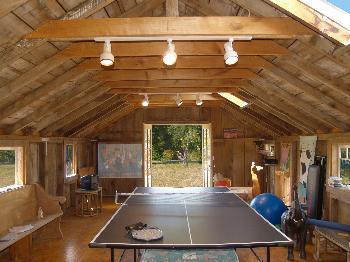
We open the french doors and step inside.  The group oohs and aahs – the unclad raw wood interior has that kind of impact.  Evan’s wife Amy announces that it would make an incredible yoga studio.  Evan considers this.  I see writing workshops, he says.  Mazie can see only the ping pong table. My friends and I are going to hang out here, she says.  I declare that I’d rather it be a beer making room.  Or perhaps cheese once we get the sheep going.  No way, says Anna.  It’s going to be my pottery studio.

Evan ponders all this.  It’s everything that anybody needs it to be.  It’s the Room of Requirement, he says.

The Room of Requirement

17. The Room of Requirement: The Fourth Incarnation

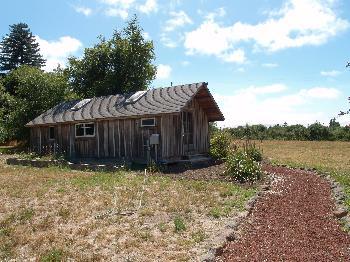
In 2000, Peter and Andrea Regan bought a home on Sparkes Road in Sebastopol California. Neighbors say the dilapidated farmhouse was not much to look at. Cramped and claustrophobic, the Regans gutted the place and tripled it in size.

And then, there was the matter of the falling down chicken coop. Built of milled ship timbers, or perhaps from trees hauled out of the Mendocino or Stumptown woods, it hadn’t held chickens in years and was destined to be torn down.

But Peter Regan, through some infusion of resource and energy, did more than keep it alive.  He shored it up on new footings.  He had it reclad in recovered boards.  He added skylights and track lighting and a honey colored floor.  It became a playroom, a ping pong room, a secret retreat for his three growing daughters.

The natural tendency is for things to degrade until they become dust.  But what of the counterposing force?  That thing that creates and is being, well, it’s life itself.  And to foster life where there should very well be none at all – why that’s heroic.

It sounds so simple.

But what really occurs in that strange alchemy that we pass off as resurrection?

16. The Room of Requirement: The Third Incarnation

Why and how did Petaluma become the chicken capital of the world?

Kind of a weird question, but not that weird because it explains how we came to have a chicken barn on our property.

In the 1870’s the town of Petaluma 20 miles to the south of us was in economic decline.  Situated on a slough that eventually empties out into the San Pablo reach of San Francisco Bay, Petaluma and the North Bay had become a tidal eddy catching all the miners and recent emigrants washing up from the gold fields.  Some of them tried a hand at farming (grain, potatoes), and some livestock, but nothing took.

And then came Lyman Byce, a medical student and part time tinkerer from Canada, who as a boy had been intrigued in how his father had increased chick production by keeping eggs warm near the manure pile.  When he moved to the Bay Area in the 1870’s he found himself at the intersection of two interesting problems.  First, there were not enough fresh eggs to feed San Francisco.  At the time, the bulk of eggs consumed in the city were shipped in un-iced barrels from the east coast, sometimes traveling upwards of 4-6 weeks before being  consumed by some unlucky San Franciscan.

And secondly, hens get broody after their eggs hatch – they stop laying and are basically out of commission while raising chicks.  That is, until Lyman came along.  At the 1879 Sonoma-Marin fair he unveiled the first commercial egg incubator which allowed would-be chicken farmers to hatch large numbers of chicks without taking their hens out of production.

The first commercial hatchery soon opened in Twin Rocks just outside of Petaluma and by the turn of the century egg houses and chicken operations were popping up all over Sonoma county.  The fresh air, loamy soil, easy access to port (shipping was still a key line of transport) and freight lines allowed North Bay eggs to make their way across the country.  A massive civic boosterism campaign at the turn of the century proclaimed Petaluma the “Chicken Capital of the World.”  Regardless of whether it was myth or in fact, the North Bay became a locus for egg production in the United States, largely because Lyman Byce had chosen to settle there.

By 1917, Petaluma eggs were feeding WWI armies with nearly 20 million eggs shipped around the country.  With only 7000 inhabitants in the county, the area sported over 2000 chicken farms that reached peak production at the end of WWII.  Although the scale was large by historical standards, it was nothing compared to what was to come.

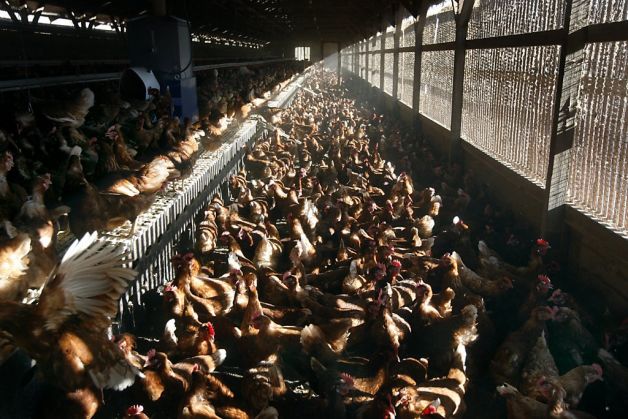
Commercial chicken farm today.

By the mid-1940’s commercial egg production shifted to industrial egg production as farmers drove in ever greater efficiencies.  Non-laying hens were culled, selective breeding introduced, and open-walled chicken houses allowed for maintenance of large numbers of chickens.  Vitamin fortified feeds and vaccinations led to greater productivity.  Eventually hens were housed in suspended cages under artificial lights to stimulate egg production, and would spend their lives in tight cubicles of 3/4 inch wire.   Indoor chicken operations could now exist anywhere, and the interstate meant that you didn’t need to be on a river or railway to ship all over the country.

Industrialization sounded the death knell for the small scale chicken farmer. They couldn’t afford the new expensive equipment.  And their kids wanted to get off the farm.

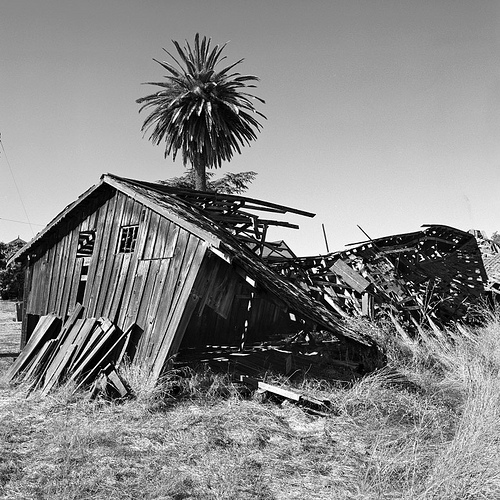
By the 1980’s there were only 300 chicken farmers left in the county. Long low roofed chicken houses everywhere were now collapsing into the ground, kept around mainly for tax reasons. To tear them down would constitute an improvement.

15. The Sailor Washes up on Shore

When the neural pathways are shaken or shattered, it can go either way.

In the case of Howie Usher, he was laid up in a hospital for a better part of too long.  And then rehab in some place in Phoenix. This is where you learn to inch your arm into a sweatshirt and shuffle with a one legged walk.  You regain your manual dexterity by counting pennies.  And you kindle whatever is in you to fend off the darkness.

Which all is what Howie has done. He’s making it, for sure, whether he feels it or not.  He’s home.  He’s walking.  Last month his confederates took him down the placid part of the Colorado from the dam to Lee’s Ferry.  And inside, that thing that can only be described as Howie Usher, is supposedly alive, and wry and strong and well.

Which is all to say, heck to the naysayers.  Leave it to a higher power to judge whether a boat or a boatman is ever done and gone.

14. Surfacing

Coming to after a long summer.  And lots of ground to cover between installment #13 and #212.  So I’m holed up for the moment at the office, essentially a bar in Bolinas.

The summer: Howie had a stroke.  My daughter studied hard for her geometry test.  She wrote new songs.  And went to LA and camp.  We made an offer on a piece of land.  And finally fixed our salt chlorinator.  And started a new set of stories.  Built some garden beds.  Bought an apple press.  Pressed 30 gallons of cider.  Endured a fatal computer crash and resuscitated tens of thousands fo files.  My brother moved in with us.  And a bunch of others.  Went to a college reunion and Asheville.  Woody Guthrie celebrated his 100th birthday.  And Jack went on the road enough time to lose count.  Resolve quickened and failed and renewed itself again.  And slumbering and rising and slumbering again through it all was the boat.

Time to pick up where I left off.  Which was with an incarnation.  And a sailor.  Belly up.  And bear with.

212. The Last Day

Jack is still a bit reluctant.  Never known a boat builder to plan a launch date before the boat was actually finished, he said.  So we recast it as a christening. Today Brett Baer turns thirty.  Tomorrow he sets off toward South America.  And this boat has become his own personal right of passage.

It’s a year ago, nearly to the day since Anna arrived here and the day Poe died.  Back then the plants were dying because we didn’t know we had an irrigation system.  The pool was green.  The house stacked to the ceiling with boxes.  Yesterday?  I put in a wild flower / lavender garden in the front island.  Spread mulch in the newly reconfigured vegetable area.  Wrangled missing chickens.  Picked a basket of raspberries.  Brett layered in gunwale gray paint in the belly of the boat.  And I made a celebratory abalone dinner with three kinds of pasta in the colors of the Peruvian flag.  It was absolutely, one hundred percent, the shittiest meal I have ever made.  Completely inedible.  A great day all in all.  And so it goes.

Mitt Romney on the Middle East

Video

http://www.youtube.com/watch?v=ukhFBJgrZxM&feature=youtu.be

Oh boy.

I’m not sure this is the most nuanced way to discuss one of the most volatile conflicts in the world today.

The 47%

Wow.

I was just personally insulted by a candidate for the presidency of the United States.

I’m planning on voting for Obama which ranks me as part of the so-called “47 percent” that Mitt Romney labeled as “people who don’t pay income tax,” takers “dependent upon government, who believe that they are victims, who believe the government has a responsibility to care for them” and who feel entitled to free food, housing, and healthcare.

He said further that it was not his job “to worry about those people, that you’ll  never convince them they should take personal responsibility and care for their lives.”

On behalf of the 47%, I’d like to clear my name, Mr. Romney.

For the last ten years my effective tax rate has been been between 21 and 25%.  For the one year of tax returns that you’ve shared with us, you paid 13.9%.  My tax burden is at least 50% higher than yours.  And you refuse to let us know how little you’ve paid in previous years.

For the last eight years my wife and I worked on an Indian reservation in a place where residents in some cases live without running water or electricity or basic social services.  My wife served as a doctor.  I started and worked for a variety of non-profits supporting local community development.

And you call me a taker?

I am a tax paying, law abiding citizen who believes in the values of this country.

Yet you basically said that because I presently support Obama you’re not going to try and speak to me or my interests.

So whom do you represent?

Your 2010 income of 20 million dollars puts you in the top 1/10th of 1 percent of American households.  In that year you earned 400 times more than the median American income.

Bain Capital shuttered at least some American companies and sent jobs overseas.  Americans lost jobs and you as the sole shareholder of Bain Capital at the time, profited.

And when the financial industry, of which you were a part, deep sixed this country through what have been recognized as deliberate, criminal activities, your colleagues were bailed out and got a free pass.  To date no one has been convicted for the crimes that contributed to the greatest economic downturn since the Great Depression.

Tax-shirkers?  Takers? People who want free everything?

Okay. So you were trying to speak about voter segmentation.  You say you spoke loosely and off the cuff.  But your job, as President, would be to speak and act with care and nuance.

When you travelled to London this summer, you insulted the Brits  by saying they were not adequately prepared for the Olympic Games.  You then travelled to the Middle East and insulted the Arab world by saying  Palestinians had not built an industrialized economy for cultural reasons and that Israel had done so because of their “providence at having selected this place.”

Now you’ve written off half the people in this country, including myself, as deadbeats.  Last night in Costa Mesa you said that you would still stand by your words.

Tell me about it, Mr. Romney.

Who are you?  Really?  And are you really ready to be President?

13. The Story of the Boatman and the Serpent

Humble as he is, Howie Usher stands shaggy and tall among the sons of Sinbad.

In Mesoamerican stories, sky and sun energy embodied in the eagle sought union with the water world.  The water world is the subterranean world, the unconscious and amniotic world, – the deepest diluvian recesses from which we come.  According to the stories, the Mesoamerican people would settle in that place where the eagle seized the snake in his beak.  The eagle was eventually seen on a small island in Lake Texcoco and it was there that the great city Tenochtilan (that would one day become Mexico City) was built.

The procreative seized the generative and that’s how life came to be born.  It’s an important story that finds expression throughout Latin America:  in the serpents that guard the base of the temples in central America, in the Hopi snake dance, and even in the image of Popocatépetl and Iztaccihuatl that can be seen in practically every taqueria on the West Coast.

Some of those people from Middle America continued on, possibly following the Colorado river up into North America and the Southwest.  In Hopi stories the first person to follow the river back down to the Sea of Cortez came from Tokonave near Rainbow Bridge National Monument.  On his return he brought water knowledge and the snake people with him.

Howie Usher has spent his life riding the back of that serpent.  He’s served as one of the guides for Hopi elders, descendants of the people who emerged from there.  He knows the Canyon and the River nearly as well as anybody who comes from that place.

He knows you don’t tread lightly when you enter.  He’s in that canyon again now, deeper than ever before.  He’s still conscious, I hope.  I imagine him at the bottom of a deep pit, trying to sense the glimmer of light that will indicate which way is up.  I imagine he’s beat and hurt and tired.  He’s trying hard to find his way up. We gaze down, hardly shimmers on the surface of the water.  He’s a brother and he badly needs help.   He carried my own daughter through Lava.  I owe it to him.  If you’re near, it’s occasion to reach down hard.  And if you’re far it’s occasion for prayer.

If you can, reach for him.

12. The Story of the Boatman and the Flood

This is how I heard it.  Some may question the truth of the matter, but I know Dave Edwards and so I’ll take it as fact.

Once a group of rafters with AZRA were tied up at the drainage from Havasu Falls.  It was a clear summer day and folks were blissfully unaware of the flash flood waters until the moment that they hit.  The tributary narrows right there at the opening into a slot canyon so that the water funnels in and shoots out in a torrent.


Havasu flash flood

The folks standing and lounging on the rocks didn’t know what hit them, only that it felt like a wall of falling bricks and then that they were being swept away in the muddy maelstrom of the Colorado.

Dave was in one of the rafts and remembers the chaos of garbage and rocks, of the wall of water carrying ripped trees and flipping boats.  There in the raging torrent coming towards him he saw a woman’s face, and then the face was gone.

Dave grew up with a father, a military man, who made a career out of telling his son that he was hardly the measure of a man, that he wasn’t good enough.  In a way that only that boy now grown to be a man could do, he dove into the water without a thought.  He was swept way in the swift current and he reached down until he felt hair and he pulled the unconscious woman to the surface.  One of his fellow guides threw a float to him, but he was holding the woman with both arms, so he locked the nut in his teeth and in that way the two of them were pulled to safety.  He saved the woman’s life that day.

But he wouldn’t see it that way.  It’s just my job, he might say.

11. The Story of the Boatman and the Life in the Rapids

It was maybe the first or second night out from Lee’s Ferry and Howie told us a story.

When not running river trips Howie teaches high school biology.  I can only imagine that the experience is magical and that his students love him.  Howie knows a lot about biology and river ecologies.  On one trip he was with some muckity-muck, a CEO or terribly busy business man.  Apparently the guy had a hard time slipping into the rhythm of the trip:  He was too stressed, too worried, too preoccupied.  Whatever.  He was spending time with Howie and was humbled by Howie’s humor, his calm in the face of catastrophe, his equanimity with whatever life threw at him.  How did Howie do it? the guy asked.

They were lunching at one of the many tributaries and springs that tumble into the canyon.  Howie gave the guy a pair of swimming goggles and walked him out to a set of small cliff cataracts and asked the guy to submerge himself in the water and to look carefully toward the rock.  There, hanging on against the current were colonies of little creatures – that’s the thing about Howie – he can actually tell you what they are.  I can’t, but there they were, these nearly invisible little things with heads and fern like fans sticking up from their heads.  This species exist only here, Howie told the man.  Only here.  At this one set of rapids, on this one river, one mile deep in a three hundred mile long canyon.

Whenever I get worried about stuff, Howie said,  I just think of these guys down here, unknown to the whole world,  just calmly waving their antennae in the water.


10. Lucky Penny

Rain continues today. Sanding and prep of the boat is temporarily halted.  Which is fine.  Something else must be righted now.

1.  The story of the Boatman and the Lucky Penny

In 2009, the year she came of age, Mazie rode with Howie through Lava.
That trip for all of us was the high water mark of a magical summer.  Not even twelve, Mazie had busked in Telluride, had run in the desert, and bank to bank she had swam the Colorado.

But in this particular moment, there was little glory to be had.  The guides had nervously scouted the rapids and Mazie was well aware of their trepidation.  One by one, the rafts had set off, but when it came time for Mazie’s boat, she refused to get in.  She stood on the shore shaking with fear, and then in tears asking to be taken around some other way.

But there was no other way.

Lava sits in the depth of the Canyon, cut one mile deep in the earth.  Here the precambrian metamorphic rock is hard and ancient, dating back 1.75 billion years.  But the rock still feels fresh and scary and hot as if it was born yesterday.  And yet it came into being before there was even life on earth.  Looking at the chasm faces, you feel palpably that the world of life doesn’t belong to the ancient world that’s revealed there.  And yet life is.  The water cuts through the canyon, wearing it away until at Lava Falls water meets rock steeled by pressure and fire.  Lava is harder.  But in the end, minuscule grain by minuscule grain, the water will win.

To be safe at Lava you work against instinct.  If you bull forward straight ahead, you go over the lip of the ledge and you end up in the hole which is where you don’t want to be.  There water turns into a turbo charged washing machine the size of a small building.  You get thrown around or held under, or perhaps spit out hopefully in one piece.

To avoid the ledge hole you have to bank right, straight into a chute that slams you dead against a rock face. You ride high and bank off the wall, careen around the hole into the mountain size waves that threaten to flip you back.

Howie has guided river trips on the Colorado for over twenty years.  He has plenty of experience.  But each time he runs Lava, Howie dons a white shirt and tie.  It’s his schtick.  You need to respect Lava he says.  You don’t own it.  That water owns you.

Mazie had chosen to ride with Howie on this run.  She loved his humor, how he told a story about ancient Puebloans, narrating it with tiny plastic figures, until folks realized he was making things up.  He had been on the river for twenty years.  But most importantly, his collected and calm manner was equal to his experience.

Mazie stood on the shore sobbing, refusing to get in the boat, begging for Howie not to leave the shore.  All the other boats, including ours had already left.  Howie was alone and at a loss.  He had no children of his own and had no experience about what to do with a terrified little girl.  So he improvised.  Before he untied the boat he knelt by Mazie and put something in her hand.  This is my lucky penny, he whispered to her.  I’ve carried it every time that I’ve gone through Lava.  Hold it tight, he told her.  Hold it tight and it will keep you safe through the rapids.  With that, Mazie climbed into the raft and she held on.

Mazie clutched that penny.  Twelve years old, not even, and she descended into that roiling water with Howie at the oars.  They struck deep, disappeared, emerged and struck deep once again, the boat fully disappearing beneath the water.  They shot out into the face of the waves that mounted again and again until they were at last carried through.

Once all the boats had safely made it, we tied up against the cliffs towering above the water.  Shaken, giddy, and fully spent, everyone had stepped onto the ledge to which we were tied.  People sat and rested, some drifting into sleep.  Mazie, though, stayed in the boat, sobbing forever it seemed, still afraid to let go of the lines.  One by one the boatmen sat with her.  Howie held her, letting her know that they were safe, that everything was okay.

A few days ago, Howie Usher suffered a severe stroke.  He was set to go down on the river this summer.  There’s little word yet on his condition, only that it’s bad and that he has a difficult road to recovery.  This time the water carried wrong.  Howie went down over the lip and he’s in there now.  Things didn’t go right.  And now Howie against his will, knowledge, and experience, has been swept into the hole.

9. Paisley

ImageStaci adds the table extensions and dresses the table with a paisley cloth.  Paisley.  How strange.  Where does it come from?

The answer is found in the densely woven tapestry hanging in the dining alcove.  The table cloth is only a slightly more abstracted version of the other.

ImageAlthough the word comes from the village in Scotland, the boteh jegheh design itself originated in Persia.  It’s a Zoroastrian symbol for the eternal and infinite as it gives expression in life.  The abstracted floral pattern decorated royal regalia and became associated with richness and opulence during the Qajar and Pahlavi Dynasties.

The boteh design eventually spread throughout Asia and eventually made it’s way to the Scottish town of Paisley by way of the East India Trading Company.  From there, the chattering looms of satan’s mills brought the design to the masses of Victorian England, and eventually Victorian San Francisco.

But if you look long enough, it might be that the boteh contains in it’s complexities the very essence of that great idea spaketh by Zarusthra.  Of the power of right thought and right word.  Of the need to keep the chaos at bay.  Of the power eminent in flame and the twisting currents of water.