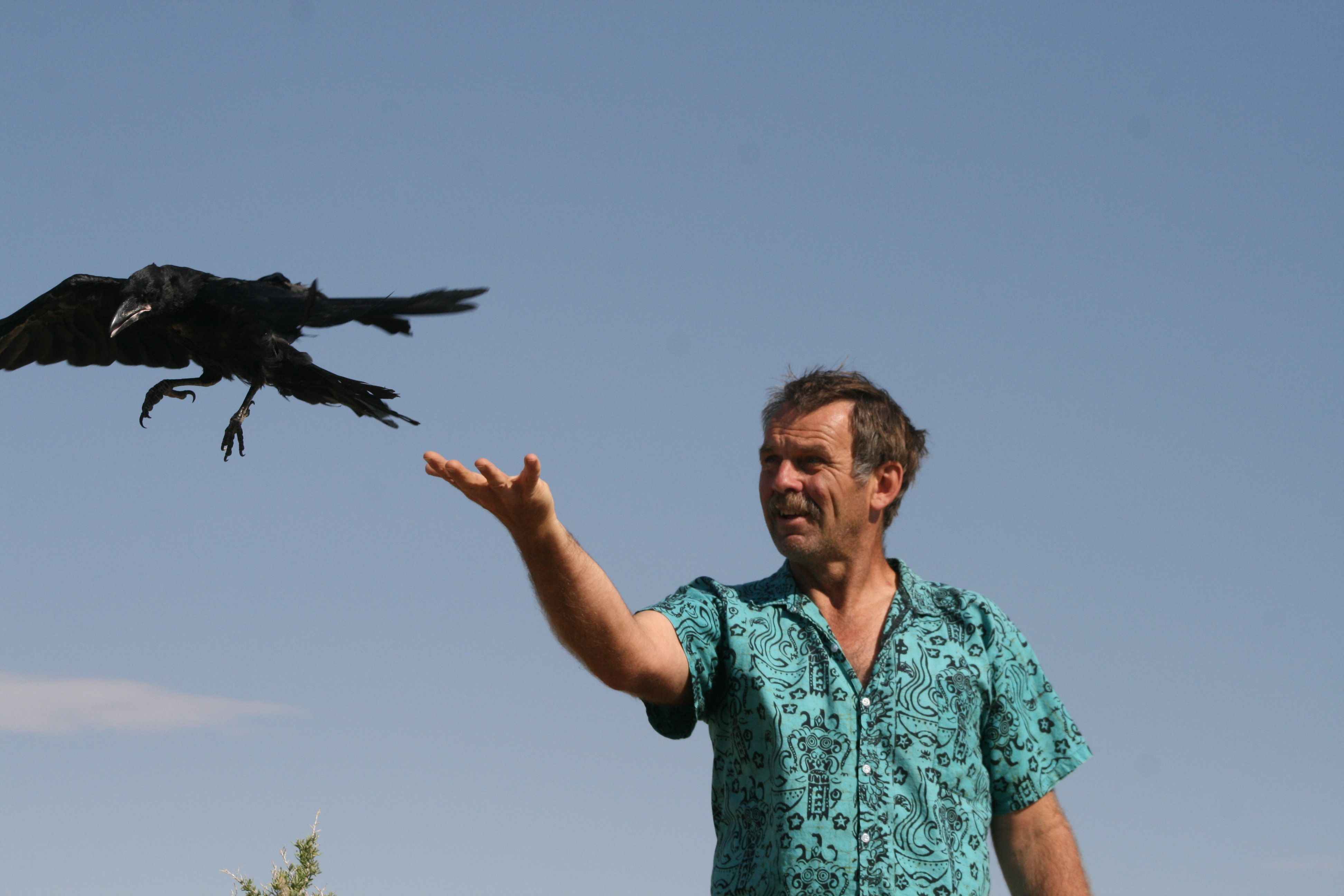
The Transaction

Fuck it.

The details are boring enough to be spared.

Mazie and I first visited the house alone.  Anna had already returned to Arizona.

It was more house than we had ever lived in.

It was rambling and grand and a combination of all that we had ever lived in and anything in a house that we had desired.  It had a pool and a sauna and orchard land and acres for vegetables and a dilapidated chicken barn in which any human would care to thrive.  It had a treehouse room for Mazie with windows that looked out over an orchard.  It was the room that she had always wanted.

It was surrounded by dozens of acres of open land and forest and orchard.  Perhaps as time passed, we could purchase some of it, and if we did that, nothing could touch us.  We would be protected.

Walking the house, I heard the ravens call out in the trees.  Again, I called out to them, Mazie hushing me to be silent.  I’m here, I wanted to tell them.  I would like to be welcome.

My family and I, we could all live here happily.  I could talk to birds here.  And no one would hear or judge.

To the extent that Poe, a small black bird, could ever be an auger and guardian-protector, I felt that he had in his own strange way led us to this house.  He knew what I wanted and he had made himself present for it to be.

But that is yet again a human construction.  The bird himself wants only to leave well enough alone, to communicate with his own kind and bear witness to folly and to live and to feed.

We found the house in the middle of the summer.  Anna was home alone with the other animals.  Mazie remained with me, but after a few days she decamped to LA to be with friends.  I stayed behind in Sebastopol, days filled with inspections and talking with mortgage brokers and moving money around as the world economy markets teetered, slipped and precipitously began to fall. A couple of men covered by umbrellas decided to occupy Wall Street.  Nothing new in this story.  It’s what the last ten years of this country’s history have been built on.  Our nation possessed by feverish desire, digging a foundation pit straight to the very bottom.  And at the bottom we would find only sadness and dissolution and rage.

I did everything I could to make it happen.

The House

There’s another part that I’m not telling you.

It’s about the little boy who a long time ago lost his father and his mother grew away from him into her new boyfriend or her own sleep and he grew up in a crumbling house with a shitty carpet filled with fleas and stinking of cat spray.  Dishes would pile in the sink because no one would care to wash them until no dishes were left and even then it would move no one to lift a finger so they turned to paper bowls and plates.  On those days, it would be the boy who would stand on a chair to reach the sink and he would do the dishes, scraping rotting peanut butter from the knife, skimming flies and sheets of mold from the pots filled with putrid water.  It would take a full twelve hours for an eight year old boy to clean that kitchen.

There was a brother and once he wanted dog and it came into the house.  But no one would take care of it or feed it and it got sick and was kept penned up in the kitchen until the floor became a seething sea of shit and piss and diarrhea.  A neighbor visited and put a call out to CPS.

There’s more.  I could go on and on with more.  I could fill the remainder of my life and a catastrophe of pages with more.  But this will be sufficient.

Imagine what happened, how it was, when the boy first read Gatsby and how Fitzgerald seized him with a vision.  Just get the hell away.  Get as far and fast away as you possibly can.  Build a mansion.  Populate it with people.  Fill it with parties and surround yourself with campfires.  Night after night.  Go to that place, make that place, with your own majesty and desire will it in to being.  Matter not that the story ends in tragedy.  That all can be worked out in the details.

How stupid for a boy to be driven by such a silly story.

But he was.

I imagined one day arriving at a house.  It would be a grand place and it would be protected from anything bad or sullied that would want to intercede from the world.  It would have it’s own water, and good soil and could grow food.  It would be surrounded by protected space that would never in anyone’s lifetime ever be developed.

A family could grow and could grow old here.  And that’s the way it would be.

A New Life

The coming days were flush with the banal.

Mazie and I, waiting for school to begin, shifted our ways to a local hotel.  They had a pool which Mazie was hot to swim in.  We joked about our big and fancy house. Poe, he stayed put in his hotel in Occidental.

On the last day of summer I took Mazie to the Harry Potter movie in Santa Rosa.  It was a dad daughter day and Mazie was pleased and funny and grateful, I think to have her dad’s attention.

On the first day at school, I drove Mazie from the hotel.  That first morning, nervous as heck, she asked that I walk her to the office, we check in, and then we walk out and as we did so she would peel away.  In that way, just as she dictated, I delivered her to her new school.

The kids were different, she later told me.  But she’s grown up resilient, and slowly, in her own way, she set to making friends.

Mazie and I would have breakfast each morning in the hotel lobby.  She would pack a lunch for herself from whatever she could scavenge from the hotel breakfast line: a piece of fruit, some juice, a PB&J.  I would then drive her to school.  In the evening I’d pick her up, we’d settle back into our hotel room, and Mazie would diligently sit and do her homework.

As for Poe, he became my own affair.  Some mornings and most afternoons I’d drive to Occidental and up into the meadow, where I would set with him.  I’d nap in the straw while he perched near me.  I’d feed him and talk to him.  He would sometimes mutter back.  I called Anna on the phone.  I wanted to tell her about the bird, but when we talked he would caw loudly until Anna would tell me to get out of the coop.  It was hard to talk with the bird near by, she said.

People seek solace and meaning and fire, and we each seek it in our own way.

I found it in dreaming of and fashioning for ourselves a new life.  I found it in Poe.

In the end, I think he just bugged her.

What Happens When You Believe

I took a bunch of pictures to share, but now even that seems too much of a bother.

I had hoped that Poe could settle in at the Salmon Creek school in Occidental.  The school is set on 20 acres of meadow and redwood forest and wetland.  It also has an enormous fenced garden where I fancied Poe could hang out and regain a semblance of self.  Mazie and I took him there in the afternoon and set him free.

He enjoyed digging and exploring with his beak.  He hopped about in the wood chips and tussled with the greenery.  Mazie read quietly beneath an arbor.  Other ravens cawed out from the surrounding forest. Lovely clouds piled high in the sky and that afternoon the light felt marvelous and true.  I called Kerry.  We both were hopeful.  Perhaps Poe’s rehabilitation could become part of a school science program.  He could stay in the garden and mend.  And kids at the school could learn what it meant to be in close proximity to wildlife and maybe they figure out how to engineer some structure that would meet the needs of a wounded raven.

You see, this was all going to work out, or so it seemed.

But school would not start for a few more days.  The afternoon waned.  We gathered Poe into his carrier and in the setting light we drove up the hill and out of the valley.  Penny, the co-owner of the Holy Cow had offered her house up as a refuge.  She had an enormous chicken coop – the chicken hotel, she called it.  And hotel it was.  Ten feet high, fifteen across, open chicken wire walls all around facing out into meadow and oaks.  Poe took to the space immediately.  He ate and preened and hopped about in the straw.  Families and ravens flying over head would call out as they headed home to their roost.  Poe listened and called out in return.

Michael and Penny and I and even Mazie were elated.  Poe was safe.  I was safe, we all were, in the august darkness.


.


Faith

Is Charlie Brown believing again and again that Lucy won’t pull the football away from him.

My uncle once said that faith was believing in something that you knew was not true.  In this case, though, I really believed.  I believed it would all unfold as planned.

That first morning, Mazie and I, the raven in tow, made our way back to the Holy Cow.  Mazie and I settled down with cups of coffee and hot chocolate.  We waited until Michael the owner came around.

He remembered us from the month before.  Excited, grateful to have an ally, I ushered him outside and opened the car.  He looked inside and saw Poe inside the carrier.

Holy shit, he said.

He got it.  And I was so grateful to no longer be alone.  For he felt the awe.

I set to explaining how Poe had been held captive by the rehabilitator and that it was no good, and how –

You fucking stole him, he interrupted.  He grinned.  That’s so cool, he said, adding that we’d fit in just fine here.

He looked in again at the poor bird.  You can’t keep him in there, he said.  Bring him into the coffee shop.

And that I did.  And like that the three of us set at the table, health codes and wildlife regulations be damned, with Poe the raven holding court over all and customers coming forward and stopping dead in their tracks.  My god, each one said.

For those highly social birds are of their own world and not of ours, and though parallel, they scant intersect.  To be here in a coffee house on main street sebastopol, why to come full face with his claw-like beak and opal eyes and the impenetrable sheen of his blackness.  Poe was the ineffable born into flesh, and that day in the coffee shop, customers wanted only to be near him.  They wanted to touch it.

Mazie made friends with Michael’s daughter, Loren.  They made plans to get together and hang out.  They talked about the schools they would be going to.

Strangers approached and gave us their phone numbers, they had ideas of how to help.  They offered homes where he could stay.

That is what home feels like.  We had found safe harbor.

Mooring

I could go on here forever, couldn’t I?

Although if you go on for too long,  your audience goes away.  They cease to listen.

What difference?  For most of my life, my writing has had an audience of one.  What difference does another ten or twenty make?

And in the end, who really does care about a bird and the string of betrayals exercised by and visited upon a single life?

That first night we stayed the night with our friend Hank in Santa Rosa.  We set up fencing in the backyard to protect Poe from the two dogs.  Once released, he squawked with agitation, pacing the pavement, bereft it seemed in his new environment.  I played bad father and bad guest, ignoring Mazie, feeding the bird, wanting badly to calm him, mindless to the shit he deposited all over the patio.

We slept fitfully.

Arrival

It rarely is what it seems.  And sometimes it holds everything that is.

You might as well all know. Mazie and Poe and I ended up in Northern California.

On that first night, we needed nothing more than safe harbor.  Mazie needed some emotional relief.  And Poe needed most of all to be released from his confinement.

We drove direct to the home of our friends Mary and Al.  They’re family friends and to tell the truth we had nowhere else to go.  We parked in their driveway at their small mid-century stucco home.  They weren’t home.  But they had a decent sized yard and so we took Poe straight back there and let him out beneath a towering redwood.  He hopped away distressed and set his distance.  I fed him bits of pizza and old meat and whatever I had with.  A cat appeared and I barked at Mazie to hold the cat back, but she had a hard time doing it.

I thought maybe Poe could hang out in this yard for the evening and that he would be safe.  But I was way wrong.  There was no respite to be had here.  I called Michael from Holy Cow and then Maryanne, but no one was picking up.  Spent, I rounded Poe up and put him back in the dog carrier.  Mazie was frazzled and upset herself.  She needed as much tending as the bird.  Why was the bird getting it all, she asked?

Because if he doesn’t get what he needs, he’s going to die, I said.

We piled back in the car.  Because it was now time for Mazie’s school orientation.

We drove the scant six blocks to Mazie’s middle school where, in five days, Mazie was going to settle in to where she was going to spend the next year of her life.

Mazie didn’t want people to see us with the bird.  So we left Poe in the car while we entered the school gymnasium.  It was filled with a crowd of white middle to upper income folk.  Which I guess is what we now were.  The principal, a warm and nice man, introduced the school and the various programs and what children and parents could expect.  It was going to be a wonderful year, he said.

As we exited the gym, tears welled up in Mazie’s eyes.  I don’t want to go to this school, she whispered.

Mazie and I no longer knew how to live in this world.

Berkeley

My father came here once and he camped out in the Doe library one foggy summer in the 1960’s searching the stacks for archival material about mining journalism in Nevada during the great silver rush.  He found a forlorn journal kept by a woman named Martha Galley in which she recorded her lonesomeness, the absence of her husband and the death of her children.  The last thing my dad did in this world was try to publish it, but by then it was too late and he was already out of time.

My grandmother and my aunt came to join him.  When my grandmother was a little girl in Philadelphia near the turn of the century she was run over by a carriage and it broke her back.  After that she was hunched and stooped and couldn’t play with the other kids and so she set to walking and that she did, up to ten or twenty miles a day.  Tilden Park? she once asked me.  Do you know Tilden Park?  Up in the hills?  Every day I would walk from the Rose Garden all the way up the hill to Tilden Park and back down again, she said.

My grandmother was in her sixties at the time and she would walk all the way to goddamn Tilden Park.

I went to Berkeley once.

I had completed my sophomore year in college and all I wanted to do at that time was run fast and far away.  I studied Russian during the summer and I stayed on for the fall.  I worked at Blondie’s pizza, sometimes prepping in the back, sometimes delivering on a scooter at night.  Once I didn’t strap the pizza boxes on right and they flew off the back all over the road.  I ended giving them up for free to the college kids who had ordered them.

I liked the feeling of riding that scooter fast through the night.  The scooter was red.

I found out that summer that my girlfriend was fucking some other guy.  It was my fault, she said.  I wasn’t there for her, she said.  It didn’t matter.  We didn’t have a good relationship anyway.  I’d cheated on my first girlfriend to go out with her.  None of us were any good.

I was living with a guy named Don at the time, right up there near Tilden Park, and I couldn’t stay down in town past three-thirty because that’s when the Livermore shuttle took it’s last run.  I didn’t want to walk up that hill.  My friend Kenny wondered what my problem was, why couldn’t I walk up a hill? he asked.  You walk up that hill, I told him and he tried and he scarce could do it.

Don was dating Maddie Wegner that summer.  He was madly in love and he confided in me that he loved her so much, that she was the one and he was going to propose to her.  He had it all planned out.  He bought her a ring and later in the summer when they were going to be driving through South Dakota, one sunset evening he was going to propose to her.

And that he did.  Except that she had no inkling he was in love with her.  She sat there with him somewhere in the midwest, embarrassed in the waning light, looking at the ring he held in his hand.  He was a nice boy, she said.  A sweet boy.  And that’s where she left it.

I would get out at the Livermore Center and walk the deer trail along the hillside and would hunker down by the wind organ and watch the sun make it’s way toward the horizon and at times the colors would be so profound that I would laugh and howl as if I’d lost my senses.

But now, on that afternoon, the one that matters most to us, my daughter and I and the bird arrived unclean and tired and needing food. We cut into town and found the Bread Board across from Chez Panisse.  We ordered pizza topped with goat cheese and peaches. We ate it sitting on a grassy divide in the middle of the road. The flavors were rank and disgusting and it made me such.  Mazie hardly touched it.  For Poe it was much the same.

All journeys, all races run, pass through a place of dissipation and I guess for us maybe this was it.  Mazie and I ate what we could in this place transitional and transcending as it has always been, and we piled then into the car and we headed north taking wrong turn after wrong turn after wrong turn until we found ourselves passing across the Delta, that swampland once parceled to the wanderings of Jack London and the tin boot fortunes of China camps, and rogue vagrants and bums and residents who had but fled all there was to flee from.

On this evening the light glinted flat across the misty water, posing an ephemeral halo for the yawning dilapidated penitentiary, and for Saint Quentin himself, I guess, tortured and beheaded as he was.  And now what stores of the unrepentant, lead and gold alike, were bound and locked tight within his chest, doing time for whatever crimes done unto?

Unseen, hardly a mote we were, Mazie and I and our companion bird passed across those mud flats, past chambered prisoners and flocks of crane set to taking flight.  By them all we passed.


Promised Land

Some of you want to know what all has become of Poe.  The questioning, the wondering is fair enough.  And the silence and all has been unfair.  But some’s too much to tell.  But now you can have it. We can carry on.

We – Mazie, the bird and I – we left Barstow at dawn.

But not before absconding with some boiled egg and bread and sausage from the Best Western breakfast nook.  Once on the road, Poe set to caching his food amidst the newspaper in his carrier.

We blitzed California, racing up the 99 through that industrial farming hell, past warehouses, processing plants, sprayers, herbicide distributors, and miles of enslaved trees, genes, and soil and vine, Poe the raven himself bearing witness to the near incomprehensible machination and subjugation of all life to sate a specie’s hunger.

I told Mazie that her grandmother came to California because of a book written by a man named Steinbeck.  It was East of Eden and had been made into a movie by Elia Kazan and starring James Dean in which he became movement and life and desire incarnate.  It was about old California farming communities, and rivalry and lust and inheritance and the inevitable despoiling of the world through our actions.  About the Monterrey morning mist and the fields outside of Gilroy, and about old honor establishing itself in a new land.  My mother had wanted, I think, to be part of California before it was all gone and now it mostly was, at least this part of it.

And in this moment, we, my daughter and I, came to this place to be the bad kid, to find wildness and prove it upon the world once again.

Ashley, our GPS guidance system gave us a few bum steers, out of malice I think, because we hadn’t been giving her much due.  We passed out of the Central Valley, now draped with box stores and outlets for extruded meat, potato and corn products and descended into the Bay Area. Past those quixotic wind mills, harvesting that relentless mass of air pressing itself eastward from the pacific.  Past Livermore, that cesspool of life and death, beginnings and ends, where Edward Teller, in all of his fin de siecle Mitteleurop sensitivities, gave birth to the hydrogen bomb.  Is that what this state, in so much that it’s a state of being, is good for?

Of these things, though, I couldn’t intimate to my daughter.  And lest of all the bird, fragile and innocent and all-knowing intelligence that he may be.  Mazie was cranky and tired.  The bird was cooped.  And so relentlessly we pressed on.

The Bay Area. The Area of the Bay.

Remembering Steve

Steve isn’t dead.

The most physical and perhaps most limited instantiation of him, of course, is gone.  No more will we know that unique conflation of DNA and environment that gave rise to the person we knew as Steve Jobs.

But his larger self, the ripples emanating out from him, those will continue to move people on this earth.

He rode sidecar in the lives of many people.  Or perhaps it was the other way around.  Perhaps it was his motorcycle all along.  Perhaps he gave expression to that motorcycle ride that we all dreamed for and wanted.

How have his ripples moved through me?

1979.  San Diego.  I’m an awkward fourteen year old boy.  It’s the first day of ninth grade and my math teacher Virginia Hamilton ushers me into a room that contains some new equipment which she doesn’t understand and has no idea what to do with.  She shows me a new Apple II.  It’s your’s to play with, she tells me.  Earlier that summer I had read about these two guys, Steve Wozniak and Steve Jobs who had invented the first real personal computer.  I understood instantly.  I took the manual home that night and was on the machine the next day tirelessly.  It couldn’t just move numbers and text.  It could play sound.  It had a color screen.   You could do art on it.  It could be a musical keyboard.  It could be a kind of stereo.  I learned to program in hex. I set to writing a program that was like a wordprocessor for music.  Why, a person could play and the computer would transcribe the music for you.

1981.  Reuben H Fleet Science Center.  I sit at a table with the director of their science center.  They had live location data on several satellites orbiting the earth, he explained.  Could I write a program that could visually display where in the sky the satellites would be visible?  Why yes.  The truth was I couldn’t program worth shit.  But I set to it with David Calabrese, a kid I met hanging out in an Apple store.  That was a thing then – kids who couldn’t afford computers would hang out in Apple retailers programming and pimping the machines.

David and I would get together each day and type out code.  We were nuts about Apple computers.  We also debated who was the stronger genius – Wozniak or Jobs?  Jobs was a petulant jerk. And Wozniak was brilliant.  He after all was the real inventor of the guts and OS of the first Apple.  He invented the first magnetic hard drive over a weekend.  But Jobs was the guy who saw what it all was.  He was the one to put it together.  He drove Wozniak relentlessly.  And eventually he drove Wozniak out.  David and I worked on our satellite tracking program. We kind of got it working, but a real programmer ended up finishing the work. I had a crush on David’s sister and I just wanted to make out with her.  I guess I got kind of distracted.

1982.  Biology class.  I borrowed an Apple IIe from a kid – I think his name was Eric Altman.  His family was pretty well off and they could afford the latest toys.  I didn’t have a computer of my own and I needed to do a demo of my science project – something about computer music transcription.  I plugged in the computer with the power switch on and I fried the mother board.  I stood in front of the class and felt like I was going to throw up.  Eric was heartbroken.  I took his machine to the Apple store where I hung out.  I had no money, but the technician worked on it for a week and fixed it for free.  He was so generous, but then he wanted to hang out with me more and I didn’t know what his intention was. I felt the the foreign edge of a grown up world and it scared me.

1983.  I stand in my childhood home, decrepit, filthy, largely stripped of furniture.  I’m seventeen and I no longer have parents.  I hold an acceptance letter in my hand.  Would I have gotten into Yale without all that freakish experience with those Apple computers?  Perhaps.  Perhaps not.  Does technology really make a difference?

1984.  At Yale my college roommate ended up with one of the first Macintoshes.  I could use it whenever I wanted to write papers, he told me.  He basically bribed me with his Mac so I would hang out with him.  Regardless, never again would I write a paper on a typewriter.  And the sheer terror I felt at having to write on the page began to dissipate just a little.  I could write, and erase, and cut and paste.  Back then the words, “cut and paste” still connoted glue and scissors.   How strange to think that in our minds the words now evoke the clicking of a mouse.  And what would the mouse have been without Steve Jobs?  And by extension, to think that our very vocabulary and the parts of our brain that support that vocabulary have been rewired by that one individual.

1987.  I camped out in the basement of our residential college for much of the spring, sitting at a bank of Macintoshes, writing my senior thesis on the Diggers, a counterculture anarchist group in San Francisco.  Why did history have to be constituted only of old stuff, I wondered?  What about recent history?  The 1960’s?  Cultural history?  I wanted to write about something that hadn’t been touched yet.  And so I looked at something so new and so insignificant, that real historians hadn’t gotten to it yet.  For hundreds of hours I stared at the screen of a Mac.  I thought about those machines of loving grace, of how that generation of tech pioneers, Steve in particular,  came out of the counterculture, how parts of their visions were fueled by acid.

1988.  Seattle.  I’m out of college by now.  My first years at trying to figure out what I want to do with my life. I didn’t quite realize it at the time, but I was alone in the world, and if I’d ever chanced to look down, I would have been terrified.  I read biographies of Steve Jobs, looking for guidance.

I inherited the stories:

Steve in India being pulled aside by a guru who, laughing hysterically, shorn his hair off.

Steve tracking down his birth mother.  He had little to say publicly about the matter other than that he believed in nurture over nature. I wondered over the years what that encounter must have been like.  Who was she?  What did they share in common?  What did they not?  Why should I even care?  But care I did.

Steve inviting John Scully to his Woodside home.  Over thin crusted pizza, asking if John wanted to continue selling sugar water to children, or if he wanted to change the world?

Steve being exiled to some lone building on the Apple campus.

Steve being fired from his own company and following his departure, retreating to his Woodside home where he raised a pirate flag and another sporting the logo of the NeXT computer.

Steve throwing crying fits, insisting that the robotic arms assembling NeXT be painted the proper shade, and then his eyes welling up again as he watched those arms moving in unison.  Thinking machines building other thinking machines.  This was poetry.  This was art.

Steve commenting years later that technology in the end doesn’t change the world.  People live for an instant and then they die.  What does technology really change?  All those widgets and gadgets and gizmos, they make the world different.  But do they really make it better?

1989.   I sat in an auditorium in Seattle as Steve Jobs unveiled the NeXT computer.  I saw OS X in it’s very first incarnation.  It had a Unix kernel and full sound and graphics and an amped up graphic interface.  Why did I still care about this stuff?  I wasn’t a computer guy anymore.  But I loved Jobs.  Watching that demo, I wondered why no one wanted to buy it?  None of us knew that 10 years later we all would.

1994.  I have an MFA by now.  I’m writing.  I scratch out a living with low-end desktop publishing.  Why that and not something else?  Because I have loads of experience on a Mac.   All on Mac’s.  Steve made the best tools I have ever touched.  I have a Sheffield digging fork.  And an Apple.  And in a way they are the very same thing.  They allow me to do most of the work I do.

1996.  Vermont.  My wife and I have just moved to the northeast.  I’m referred to a woman who’s having problems with her Mac and needs some tech support.  I end up helping her and afterwards we go for a walk and she asks about my life and she listens in a way that ranks that afternoon on the shores of Lake Champlain as one of the most important conversations of my life.  I tell her that I don’t sleep at night because there are too many things left undone.  Left undone, she said.  One day that will be the title of your autobiography.  We had a chance encounter because of a screwed up Mac and our deep friendship has lasted to this day.  What difference, really, does technology make?

1996.  Vermont. Driving through the snow with my wife.  I had heard about a new codec called MP3 and was thinking through the implications. The physical medium for content was now obsolete, I told my wife.  We no longer needed vinyl or CD’s or tapes.  All music could be shared digitally.  I wrote out a 2 page summary for a digital jukebox that would exist online, and you could purchase songs and play them on some device. I tried to find interested people.  I met with some guy from the Media Lab.  I got a job working for a start up telecom company, thinking it would help.  I was employee number 7.  The company took off and I dropped my idea, an idea which I now realize I was in no position to execute.

1998.  Steve returns to Apple.  It’s not the hardware.  It’s the software, he insists.  And the dictum becomes apparent.   There’s no reason to have buttons and physical widgets on our devices.  Practically all of it can be done by software.  The ideal computer wouldn’t even exist physically.  It would be pure software.  Pure instruction.  Pure energy.

2001.  Apple releases the iPod.

Why did Steve Jobs do it?  And why not me?  Well, because he was Steve Jobs.  And I am me.

2007.  The company I worked for got the contract to provision the iPhone on the AT&T network.   And the company screwed it up immeasurably.  Probably the single greatest failure of the iPhone release was AT&T’s botched turn up of the service.  A small number of former coworkers  got pretty rich off it, though.  But I had already left three years before and had moved to the Hopi reservation.

2005.  I stand in a parking lot in Flagstaff before a meeting with a prospective funder.  I’m trying to get money for a youth farming project.  I have my Mac Powerbook on the trunk of my car and I select 30 photos, choose a Hopi planting song, and within seconds have a slideshow.  I sit with the funder as luscious images materialized on the screen, showing kids planting ancient terrace gardens.  At the end of the slideshow he sits there in silence and then announces  that he’ll commit ten thousand dollars.

2009.  I have a recurrence of a tumor on my parotid gland and am undergoing radiation treatment in San Francisco.  Unbeknownst to me Steve Jobs is getting his liver transplant in Knoxville.  Late one night I hole up in a sushi bar in the Sunset district, seeking some morsel of food that won’t make me sick.  I chat with a woman next to me – an attorney specializing in real estate law. Her boyfriend is an oncologist in Palo Alto.  He’s been working with Steve.  It’s not good, she tells me.  But didn’t we all know that? Not just for him, but for all of us?  Isn’t life itself a terminal condition?  I drink my sake and eat my toro.  I don’t want him to go.

2011.  Sebastopol where l now live with my family.  I have struggled for the last few weeks to buy an apple orchard next door, but my efforts come to late.  It’s sold to a vintner.  Several days later bulldozers arrive and plow down the 80 year old trees.  Even as I write I can hear the sound of the dozers.  I take a break to watch a movie on my daughter’s Macbook Pro about the mining of blood minerals used in cellphones and wonder what Apple’s stance on the issue is.  I think of small boys mining colton deep underground with small hammers.  Of women being raped and mercenary groups demanding taxes on the minerals used in all our electronic devices.  Small drops of blood tainting perhaps even the devices popularized by Steve Jobs.  Does technology change the world?  Ask the boys in the mines.  I consider their lives and their terminal conditions.

I turn on the radio and learn that Steve Jobs has died.

1955 – 2011.  Apple could have said it so many ways.  What was the most simple?  They could have said, “2011”.  But that just tells you that he died.  It doesn’t tell you that he was. They could have displayed the exact month and the day of his birth and death.  But what really do those other pieces of information add?  Nothing really.

Steve Jobs.  1955 – 2011.  He lived.  And now he is dead.

I once wanted to be Steve Jobs.

And in the end we all will be.  Steve admonished that life is about the detours.  That we never know how those detours will add up.  But what if your life has been composed entirely of detours?

It took me too long of a time to realize that Steve Jobs was not the life I was born into.  I can have visions with the best of them.  But everything depends on execution.  And in the end, focus.


Intense, excruciating focus.
 

Insomnia

Three a.m.  Another hotel room.  Another sleepless night.

An old friend, Louie Conin “the Barbarian”,  Car Talk producer and writer, once told me about this pipe in her bedroom in Somerville.  She was a chronic insomniac.  Routinely she’d awaken to another dark night of the soul and wait, eternally it seemed, for that excruciating pitch to succumb to the light.  She’d lie in bed and stare at a floor to ceiling heating pipe in the corner.

That’s such a fucking ugly pipe, she’d think to herself.  I really need to paint it.  It’s such an ugly pipe.

She’d stare at this pipe night after night and it never got painted.

Louie grew up in Somerville across from Dr. Spock’s house.  She came from an old Boston Catholic family with all sorts of Catholic pathologies going on in her household.  She once wanted to go play over with the Spock kids and her mother flipped.

“You can’t go over there!” she screamed. ” Those kids run around naked and shit in their own yard!”

Which according to Louie was kind of true.

Which maybe also explains something about Baby Boomers and tech bubbles and housing bubbles and divorce rates in the seventies and maybe something else I can’t think of.

—-

In a few weeks we will have moved from Hopi to an undisclosed place in California.  In the place that we will have left, this twilight hour is kind of important.  Routinely people stay up all night praying for wellbeing not just in this world, but for all life everywhere in the universe.  I imagine that at times the experience can be physically excruciating, sad and lonely, and at times terrifying as one faces that great void.

Through unity of spirit and sheer will, practitioners attempt to summon goodness and life into a world threatened by it’s antithesis.  I whither to think of it.  And I whither as I imagine that three a.m. hour when your spirit claws for dawn to break, for that scarcely imagined moment when you emerge into a new world to be greeted by the new light.

Cliffhanger

Paddy Mitchell

It seems I’ve left a lot of friends and readers hanging by their fingernails on the white crumbly chalk of Dover.

But not for long.  There’ve been a lot of developments yet that need a clear moment for me to tap out.

In the meanwhile, two nights ago, 10 pm California time and Mazie and I are holed up in a bottom feeder in Petaluma.  It seems every room in the county is booked up on account of some speedway event.  So we’re relegated to this grim shoebox pinned between a mostly vacant industrial park, victim of the Great Bubble, and an indian casino wedged in by the 101.  Roar of a freeway outside, the sheets smell like pee and loud banging emanates from the room next door.

The phone rings.  It’s Poppy Davis from the USDA (more on Poppy later).  It’s one a.m. in D.C. and she’s doing her best to impersonate an official from Fish and Wildlife.

She eventually breaks.  Remember when I had to reprimand Mazie for writing about your youthful indiscretions on Facebook? she asks.

I do.

Well now I’m doing the same for you, she says.  YOUR WIFE IS A DOCTOR.  You cannot be writing about illegal activities on your blog.

Yeah.  She’s right.  Which is why I tried to password protect it, but in the end it would have required too much policing and management, and as long as our exact whereabouts are not disclosed – well heck, California’s a big state.

And who would Paddy Mitchell and the Stopwatch Gang have been without their brazenness?  It distinguishes the petty thief from legend.

I peek out the curtain and look down at the tawdry lights from the casino.  I didn’t know their were any gaming tribes down this way.  A minivan weaves erratically through the parking lot.

What would a raven do? 

The Hideout

It’s bad.

We checked into a Best Western in Barstow late at night. We snuck Poe up to the room, drew the curtains and considered our situation.

It was basically no different than that of all the other criminals holed up in Barstow that night. We’d done wrong, had a kidnap victim in our possession, and were high on junk food.

No sooner had we passed Kingman when Kerry started getting the calls. The rehabilitator, upset and frantic, had been on the phone, accusing Kerry of having stolen the bird. She didn’t even have to waterboard him, and within minutes he was already pointing the finger at me. A century of abolitionist roots and Maine tenancy down the tubes. Sorry, Kerry.

And the rehabilitator had set to calling our house. She worried that I would release him to the wild and that he wasn’t ready. And I think she was just plain ticked that we had taken him from right under her husband’s nose.

Anna insisted that I call the woman back, but Kerry and I concurred there would be little utility in doing so. She was nice enough and had done her part, but there was little point in looking back at that phase in Poe’s life.

Besides, I didn’t want her to have my cell. And if she was really hot under the collar, she could use it to trace our whereabouts.

And lastly, we had bigger fish to fry. We were camped out in the Mojave with this dang bird that we needed to keep alive. The first priority was just getting to our destination and getting him out of the dog carrier. His life had already been hell enough.

We set Poe so he could watch us sleep and shut our eyes for the night.

20110826-110420.jpg

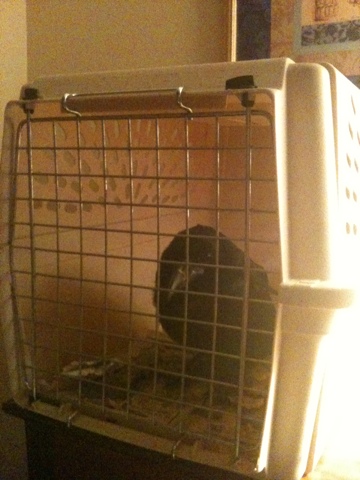
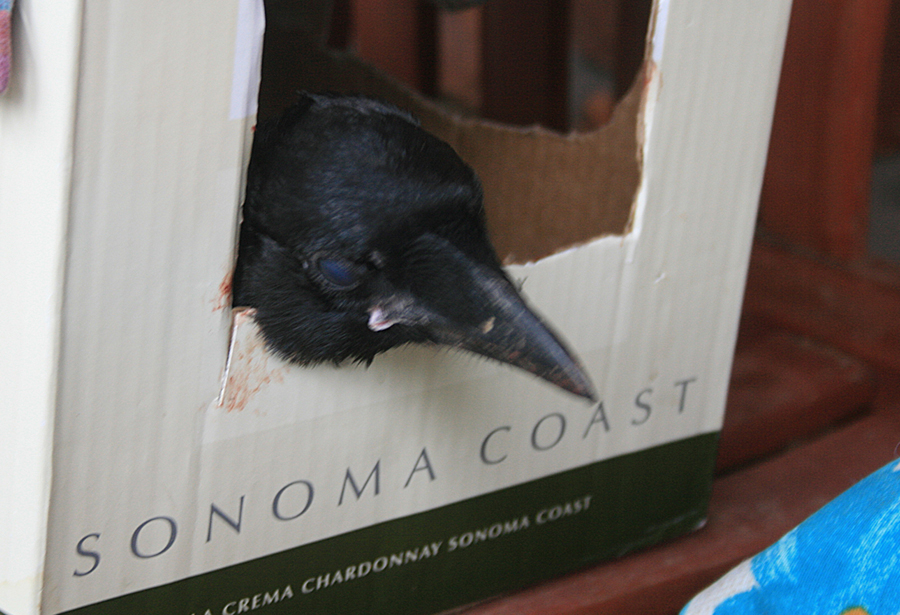
Poe hiding out in Barstow

On the Lam

So that’s how my daughter and I became fugitives.

We bolted left then right then left out of the suburban neighborhood. We got caught behind a truck trying to make a left hand turn, all the while eyeing the rear view mirror while Poe sat swaddled in Mazie’s lap.

Within minutes we were on the Interstate heading west toward California. Ten miles down the road we pulled onto a side road and released Poe into the dog carrier which we positioned again on Mazie’s lap. We got back on the highway and once we were safely past Bearizona in Williams (where I was afraid the rehabilitator might be), we pulled off once again and positioned Poe behind us, giving him a full frontal view of the road ahead.

We all felt elated – Mazie couldn’t believe we stole a raven, I was pumped that Poe had a fighting chance, and as for Poe, I think he was just glad to be free of jackhammers.

Mazie and I talked contingencies. Keep your eye out for highway patrol, I told her.  Once we crossed the border into California we’d be a measure more safe.  If we were pulled over for any reason, she would drape the sweatshirt over the carrier. If anybody asked, it was a pet animal that was easily agitated. If anyone caught sight of him and had questions, we were rehabilitators taking him to a sanctuary in California. We decided we would keep him covered when we passed through the border inspection station.

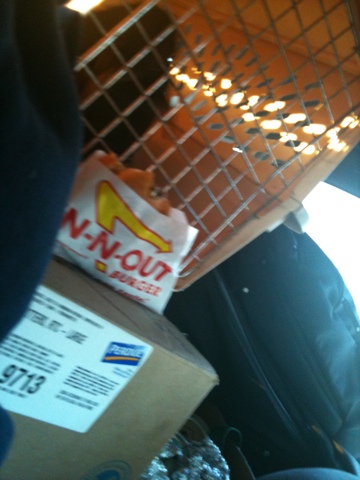
Early evening, we pulled into an In n Out and ordered Poe a cheeseburger with fries. He didn’t take to the deep fried potatoes or the bun, but he relished the cheese and beef. He paced inside the carrier, he gurgled, he peered out at the advancing road.

It was time, I decided, for Mazie to hear the talk on Huck and the Higher Law. It’s not good to steal, I told her. And it’s not good to lie. But consider Huck. He was an orphan and outcast. He habitually stole. He was profane. And given a choice between truth and the lie, he always told the lie. And what’s a lie, but a fantastical story? But as he and Jim float down river deeper and deeper into the dark soul of the country, they are increasingly surrounded by the larger lies told by all the adults around them, and the largest lie of all, that Nigger Jim was chattel, a slave unworthy of even being considered human. And as Huck’s lies and the lies of the world compound around him, the deeper truth emerges, that he and Jim, outcasts though they may be, are friends and brothers.

It’s something to think about as we fumble through our own untruths, ever into the ascending darkness.

And with that, the interstate ribbon unfolds before us. Lots of ravens drift in and out of sight, sentinels each and every one. They roost on telephone wires, pick at carrion in the road, mouths agape, cool themselves on the side of the highway. Under their watchful eyes, the three of us – my daughter and I and a fugitive raven – descend off the Plateau, past the Colorado and into the Mojave.

20110826-104326.jpg

Poe eating road food

It Takes a Thief

“Blame it, this whole thing is just as easy and awkward as it can be. And so it makes it so rotten difficult to get up a difficult plan. There ain’t no watchman to be drugged — now there oughtto be a watchman. There ain’t even a dog to give a sleeping-mixture to. And there’s Jim chained by one leg, with a ten-foot chain, to the leg of his bed: why, all you got to do is to lift up the bedstead and slip off the chain. And Uncle Silas he trusts everybody; sends the key to the punkin-headed nigger, and don’t send nobody to watch the nigger…..Why, drat it, Huck, it’s the stupidest arrangement I ever see. You got to invent all the difficulties. Well, we can’t help it; we got to do the best we can with the materials we’ve got.

Anyhow, there’s one thing — there’s more honor in getting him out through a lot of difficulties and dangers, where there warn’t one of them furnished to you by the people who it was their duty to furnish them, and you had to contrive them all out of your own head.”

And so spaketh Tom Sawyer in the 35th chapter of Huck Finn.

There’s the right way to do something and the wrong way.

In our case, Mazie imagines black face paint and ninja costumes.  Kerry dreams up fake transportation permits and forged documents from the Hopi Tribe.  I consider several furtive and superfluous transfers between waiting vehicles a la Mission Impossible.

In the end though, we just take him.

In our last moment before leaving Hopi, we disinter an old dog carrier from the garage and load it in the car.  That’s the extent of our plan.

A few hours later we find ourselves at the home of the wildlife rehabilitator.  We knock.

After a long wait, the husband shows himself.  His wife is gone.  He doesn’t know where she is, or when she’s getting back.

We came to visit Poe, we explain and he says that we are free to go to the back.

Which we do.  Mazie carries with her a Middlebury sweatshirt.  The air once again is filled with the cacophonous roar of jackhammers.  I step into the cage with Poe and he looks up with wearied eyes.  I whisper for Mazie to walk quickly to the car, retrieve a shred of burrito and bring it back.  I meanwhile sit with the stricken bird.  Mazie returns and we feed Poe with some scraps of meat that he takes eagerly.

And just like that I drop the sweatshirt over Poe and swaddle him in my arms.  I race across the yard.  Behind me I hear Mazie closing the gate so it is slightly ajar.  Goodbye Poe, she says.

We dive in the car and quick as can, we peel away.


Considerations

Walpi Housing is all in transition.

Kerry and Kristina are moving out next month as are we.  We have a bunch of folks over for dinner and most everybody, including Hopi, are heading out in the coming weeks.

A particular era is over.

But where will this leave Poe?  It’s clear he’s not coming back here.  Without mending and stewardship in the near term, he would be finished.  Kerry and I contemplate taking him to Bernd Heinrich in Maine, but we don’t know if he still has his aviary.

And Poe deserves…he deserves what?

At the very least to live large.

He’s not a beast. And I wouldn’t denigrate him with the word animal.  He’s a being.  On par with human beings.  And every effort needs to be made to make him whole and restore him to raven-ness, whenever, and wherever that may be.

One morning I make an announcement.  We’re taking Poe, I say.

Mazie wants to know how.

We’ve already been read the riot act by the rehabilitation community.  He’s a protected species.  It’s illegal for people to own them or have them in their possession.  It’s illegal to transport them across state lines without a permit. And as I’ve been reminded, I haven’t been trained in rehabilitation.

Thank god.  If I was trained in anything, it would keep me from doing half the things I do.

Being Poe © Kerry Hardy

Poe imprisoned

Mazie and I.  We’re on our way home.

I’d been in Sonoma for 4 weeks.  Mazie had joined her friend Grace in LA for the last few weeks while I was working through the house details.

After being away from Poe for over a month, we now found ourselves in Flagstaff, checking in to see how Poe was getting on with the wildlife rehabilitator.

He was not good.

On one hand the rehabilitator had given Poe antibiotics, which undoubtedly had helped.  But for 4 of the 5 weeks, she had kept him indoors in a small dog carrier.  His breast feathers were abraded and missing.  His tail feathers were a complete mess.

In the last week she had released him to a larger cage outdoors, but on the adjacent property, literally a few dozen feet away, they were literally blowing up a limestone cliff.  The air was filled with the deafening sound of jackhammers.  And on the other side of the yard several large dogs barked incessantly.

This was madness.

Mazie and I stepped into Poe’s cage and sat down with him.  Drowning the overwhelming cacophony, he looked around skittishly.  He sat in a pile of dried dogfood – basically the staple of his diet.

It has vitamins in it, the rehabilitator assured us.

Poe looked up toward us and made his customary feeding calls.  He recognized us as his feeders. But this time the calls were soft and plaintive.

The rehabilitator went to retrieve a scale so that we could weigh him (I guess this is vital to rehabilitation), but as she approached, Poe grew even more skittish and flapped his wings aggressively.

The rehabilitator said that he didn’t like her because she had been forced to tube feed him.

As she tried to step in, Poe edged out of the cage and immediately made for the open yard.  The rehabilitator herself grew agitated and she turned to get him back in.

I looked around.  The expansive yard was surrounded by an eight foot fence.  Tall ponderosas shaded the grass.

What’s the problem? I asked.  Is there a dog?  Anything that can get him?  Let’s give him some space, I said.

Well, umm. It’s just that he might try and get away, she stammered.

Get away?  First off, isn’t that the point?  And secondly, he had a busted wing.  This bird wasn’t going nowhere.

The rehabilitator acquiesced, but not before reminding me that from a rehabilitator’s perspective, it wasn’t safe and that I wasn’t trained in this.

Under the trees, Poe easily relaxed.  He began to play with twigs and branches and dig in the ground looking for grubs.  Mazie and I sat with him as quietly as we could given the roar of the jackhammers.

Perhaps I could let him out a few times during the week, she offered.

The rehabilitator made an attempt to weigh Poe, but she couldn’t tell if his weight had gone up or down.  We helped her get him back in his cage and bid farewell.

Once inside the car, Mazie turned to me.

Did you see all the other animals she had in cages? she asked.

Offerings

One morning I go out at dawn to walk the orchards.

Is this a good place? Is it safe? What life will present itself?

I walk among trees laden with apples. The coastal mist dampens my skin. I imagine Hopi plants and how they would drink this moisture up. Gopher holes riddle the loamy ash colored soil. A civilization of them. I find old walnut shells. And ancient gnarled California oaks bend exquisitely toward the ground. An oyster shell pokes up from the dirt. There’s evidence of artesian springs.

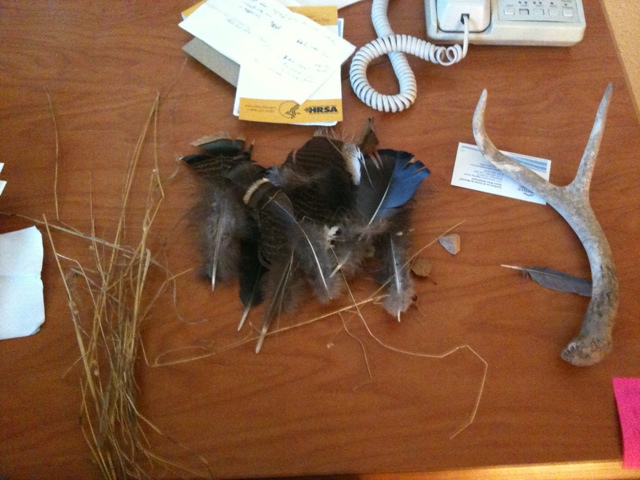
A flock of wild turkeys waddle toward the vineyard. Everywhere I find turkey feathers. And jay feathers.  And the horn of a deer. Quail dart among the trees. I see large cat prints. Rabbit pellets. Fox scat. Chickens wander in the distance. The grapes just now are coming onto the vine. A line of does steps up from the hollow. Later I learn that a mountain lion was spied coming up the Blucher creek. I see a few corn stalks volunteering among the Gravenstein apple trees.

I hear the sweet call of the crows. And then, at last, the rasp of the ravens in the fog. Two sentinel redwoods tower above one of the old farmhouses.

These are the beings that govern this place. The LaDukes. Me. My family. We’re all interlopers. We need the help of the others if we’re going to live here. And likewise we have an obligation to all of them. If nothing else, simply to let them live.

20110825-121155.jpg

The Farm

Feeling the watchful eyes of all those who protect, I pay a visit to the County Recorder’s office in downtown Santa Rosa.

I’m accompanied by our real estate agent and I want one favor from him. I want to trace back the chain of title on this house we’re buying. Eventually I want to go back to 1848 and the end of the Spanish land grants, but for now I’m just looking for one particular event.

—-

Our prospective house is old. Although it recently went through an extensive remodel, you can still see the outlines of what was once a craftsman bungalow from the 1920’s. But the current owners found in the walls a rolled up newspaper dating from 1893.

I suspect that our house was the original farmstead on what would have been a 40 acre homestead parcel.

You see, I’m the patron saint of all things lost. If you’re inhabiting a house, you’re taking on not just the house of today, but all the past lives of that house and the future ones as well. Everywhere we walk we’re surrounded by ghosts and what are we if we don’t choose to recognize and honor them?

By definition, life is a process of perpetual disintegration. Or rather, it’s persistence in the face of disintegration. Life wants to live. And in order for it to live, we must put ourselves forward as a countervailing force. Life is summoned in the face of death.

In this case, there was once a boy who lived in a sleepy seaside down in Southern California. The boy lost his parents and he watched the canyons and coastal chaparral be chewed up by a tide of development. He dreamt that one day he’d live in a place where he would be safe from loss and protected from those things that diminished life.

And once in Sonoma County there was a farm. The land supported orchards of cherries and nut trees and eventually Gravenstein apples. Over time it was divided up into ever smaller parcels, but by some miracle the orchards were never taken out and the land stayed under cultivation. And all the while an old green farmhouse and it’s inhabitants set themselves on that land and oversaw whatever life went on there.

But it only takes one change of ownership and that will cease to be.

—-

In the County Recorder’s office, I scan the yellowed maps on the wall. You can see the outlines of what were once the Blucher Rancho and the adjacent rancheria. Our parcel now exists on the border separating the two land grants. In hand I have an existing parcel map for our area, showing the house we’re looking at and two smaller adjacent parcels. One is owned by an old woman with the last name Horstmeyer. The other by an elderly lady with the last name Edmunds. Still under orchard, in all these years the land has never been visited by either of the ladies.

Before delving any deeper, I already sense the story.

The county recorder pulls up the chain of title on the computer. She can only go back to the mid-1960’s. But just from that we can see the current owners bought it 10 years ago from a fellow named Robinson. And Robinson bought it from a fellow named Percy LaDuke in 1964. to learn more, we need to go to the map ledgers.

We flip through a large book containing fragile maps until we come to one particular change of title in 1964. We see an original parcel comprised of our house and the two other plots of land. And in lavender pencil, two neat hand-drawn incisions divide the one parcel into three.

I turn to the real estate agent. The two old ladies – they were Percy LaDuke’s daughters, I tell him. When he sold the house, he deeded two portions of the land to them and their descendants. He loved the land. He had to sell the farm, but he didn’t want to lose it. He felt that there was value in land and that the land should go to his daughters.

We now turn to the microfiche. It only takes a bit of searching to find images of the change of title. And there it is. Percy LaDuke selling the farmhouse and in two separate documents he subdivides the property and conveys title to Mrs. Horstmeyer and Mrs. Edmunds.

I can hardly contain myself now.

The woman were already married. That means they were at least in their twenties.

The real estate agent is shaking his head now.

That means the two women were born in the late 40’s. It’s all so clear now. If they were born in the late 40’s, they were early boomers. They were born just after the war. If Percy were selling the house in the 60’s once his daughters were married and gone, that means he would have been young enough to serve. He’d fought overseas and once the war was over, he was discharged, he bought the farmhouse and he and his wife had settled down to raise their family. They’d all grown up here. Once his family was gone, the farm was sold off and divided.

To trace back the chain of title any further, we need to do it manually and the Recorder points us to shelves of dozens and dozens of volumes organized alphabetically and by year.

How do we find the previous transaction, I ask.

You have to go through each year, she tells me.

But there’s little need for that.

I walk directly to 1948-49, pull one book off the shelf and flip to the L’s. We turn a few pages and there we have it. Two contiguous, handwritten entries in black ink. The first registering Percy LaDuke’s discharge from the Navy in Oakland, California. He had fought in the Pacific theater. The second entry recorded his purchase of the farm.

20110825-115213.jpg

Guardians

Poe ensconced with a wildlife rehabilitator in Flagstaff. And Mazie and I are camped out in Sonoma California, trying to piece together a new life out here for our family.

We’ve found house to buy. It’s big and green and old and wonderful. But after eight years at Hopi, it’s hard to imagine a life as wild and wonderful and full of serendipity as the one we now have. Is this it? After decades of wandering, are we now settling down? Where’s the adventure in it?

On a Tuesday morning, sitting in the courtyard outside the Sebastopol Inn, I call our friends Kerry and Kristina back home. I’m worried, I tell them. How are we going to make a new life for ourselves out here?

Kristina’s answer is simple. This thing that we need to do is too big, she says. We can’t do it alone. So we need to put it out there, we need to seek out our allies and be available when they present themselves.

As for Kerry, he points out that when driving into Walpi Housing in the middle of a barren desert, would we have ever imagined that it was an ideal spot for building large wooden structures, and butchering a cow, and raising a mess of ravens? Could we have even conceived of the adventures that awaited us there?

Two hours later, Mazie and I sit in the Holy Cow coffee shop in Sebastopol. I’m despairing. Will I be able to talk to the ravens in our new home? I ask Mazie.

Daad, she says, and rolls her eyes in a way to indicate that once again I’m proving myself an embarrassment.

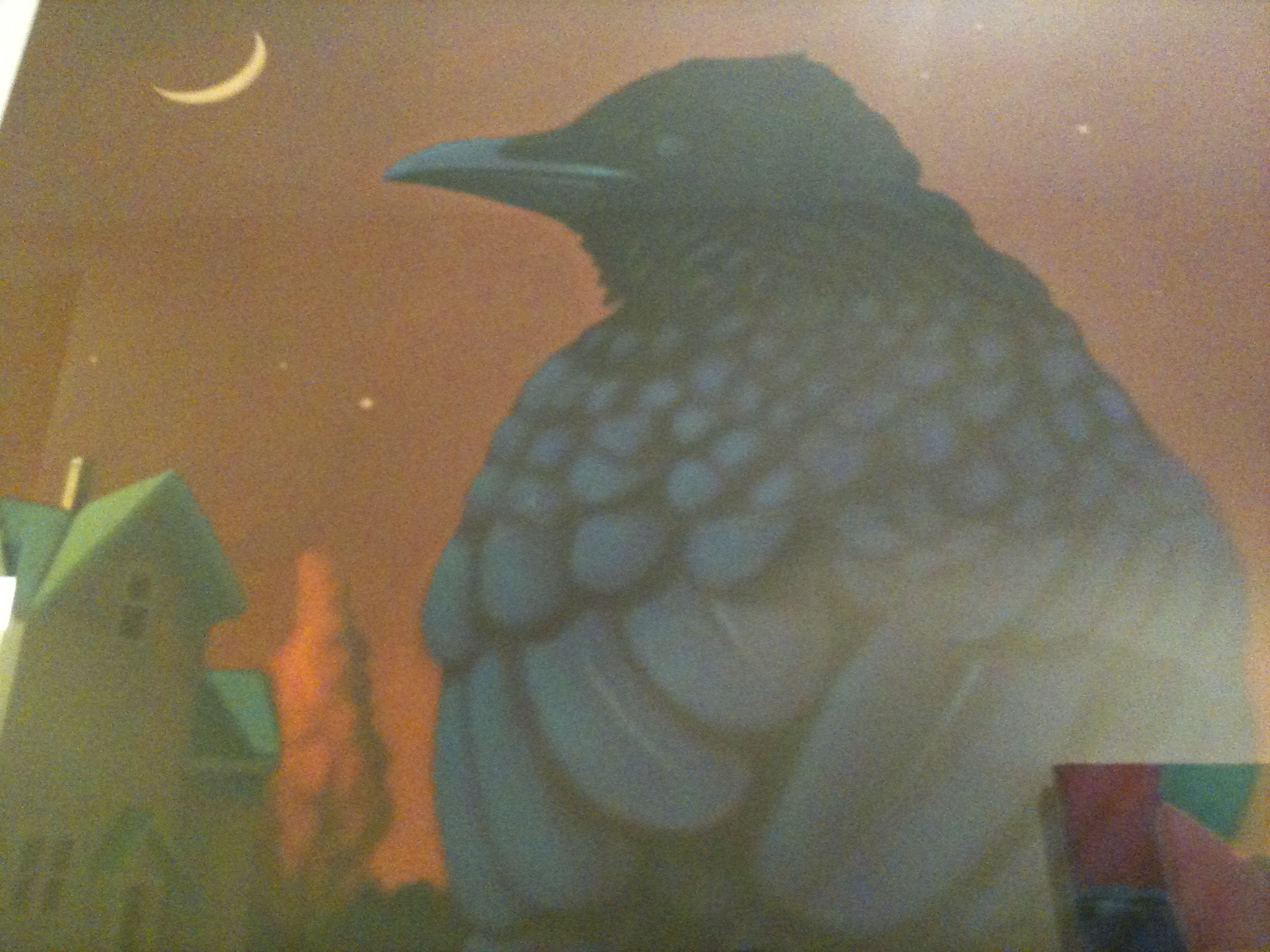
On the wall behind her hangs a large painting of a young girl cradling a crow. And further down, another canvas of an enormous raven perched on the body of a baby. I step up to take a picture of it and an older woman sitting at a nearby table asks if I’m interested in ravens.

She’s read all about them, she says.

Bernd Heinrich? I ask.

Heinrich is amazing, she says and we high five.

I tell her the story of the wash ravens and she tells me about herself. Her name is Maryann Markus. She used to teach, but she’s retired and she’s built herself a studio and she spends much of her time drawing nests. She is fascinated by ravens, she considers them her totems. There’s something I’ve never shown anybody, she says removing a velvet pouch from her purse. Inside, a hematite figurine of a raven. I squeeze it in my hand and rub it and squeeze it again. It’s heavy and has the dense sensibility of a low rumbling current.

She looks at me. It’s yours now, she says. They’re such powerful birds, guardians really. She asks if I’ve met Michael, the owner of the coffee shop and to fellow who did the paintings. She leads me to the back to introduce us.

He’s my age more or less, introspective and gentle seeming. Michael, too, says he can’t get his mind off these birds. He’s been fixated on them a while and keeps working them, making image after image. They’re deep, intense creatures, he says, and we’re afraid to let them into our lives. He says that the image of the baby and the bird scared people, but that they misinterpreted it. I see him as a protector, he says.

I tell him about the raven in our care and how our neighbor killed and maimed two of them. How I was fed up and in a weird way it was a last straw for us. I just wanted to get out of there.

But that’s all part of it, too, he says. You can’t run from that either. He says he hopes our move here works out well and that things take a good turn with the house. Before I leave, he gives me a hug.

I walk out of his office and see one more canvas.

20110825-100821.jpg

Rehabilitation

For all you ravenites out there, the saga continues.

In July, our family and Kerry’s were going to be gone for much of the month.  Never and More had joined up with the adolescents from the other family groups and were spending most of their time out in the desert.

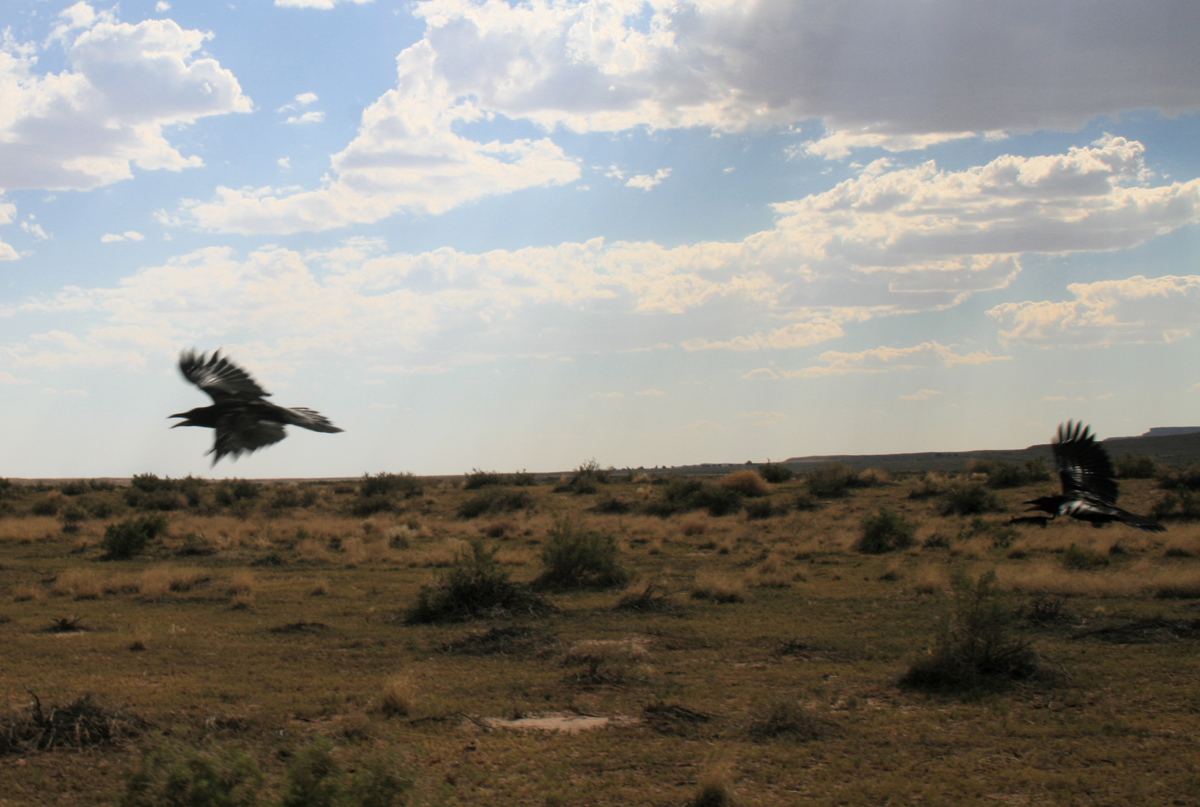
Kerry did an exemplary job meeting them in the desert, feeding them dead lizards, letting them fly off with their new found friends and capturing shots of their flying prowess.

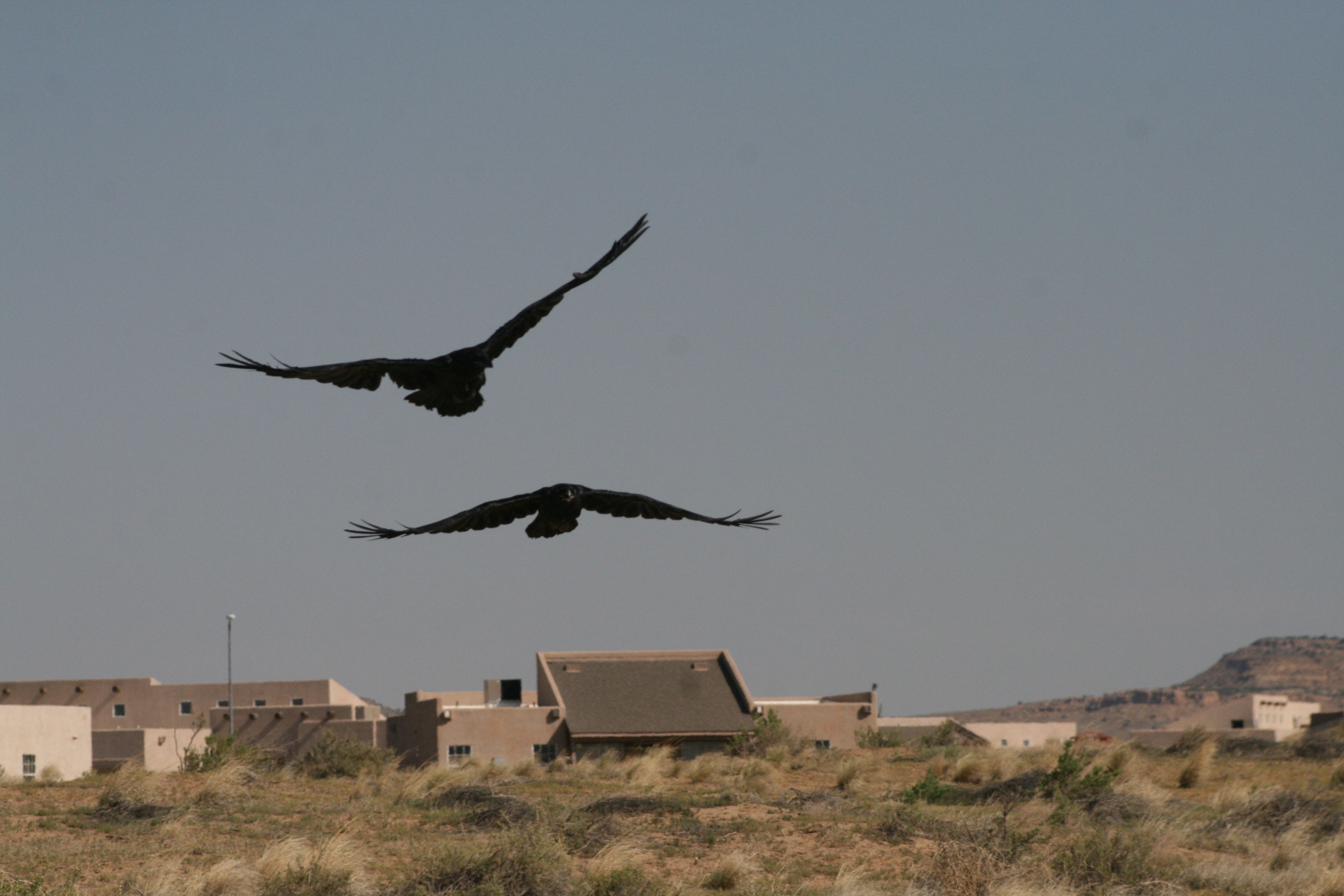
Never and More in flight © Kerry Hardy

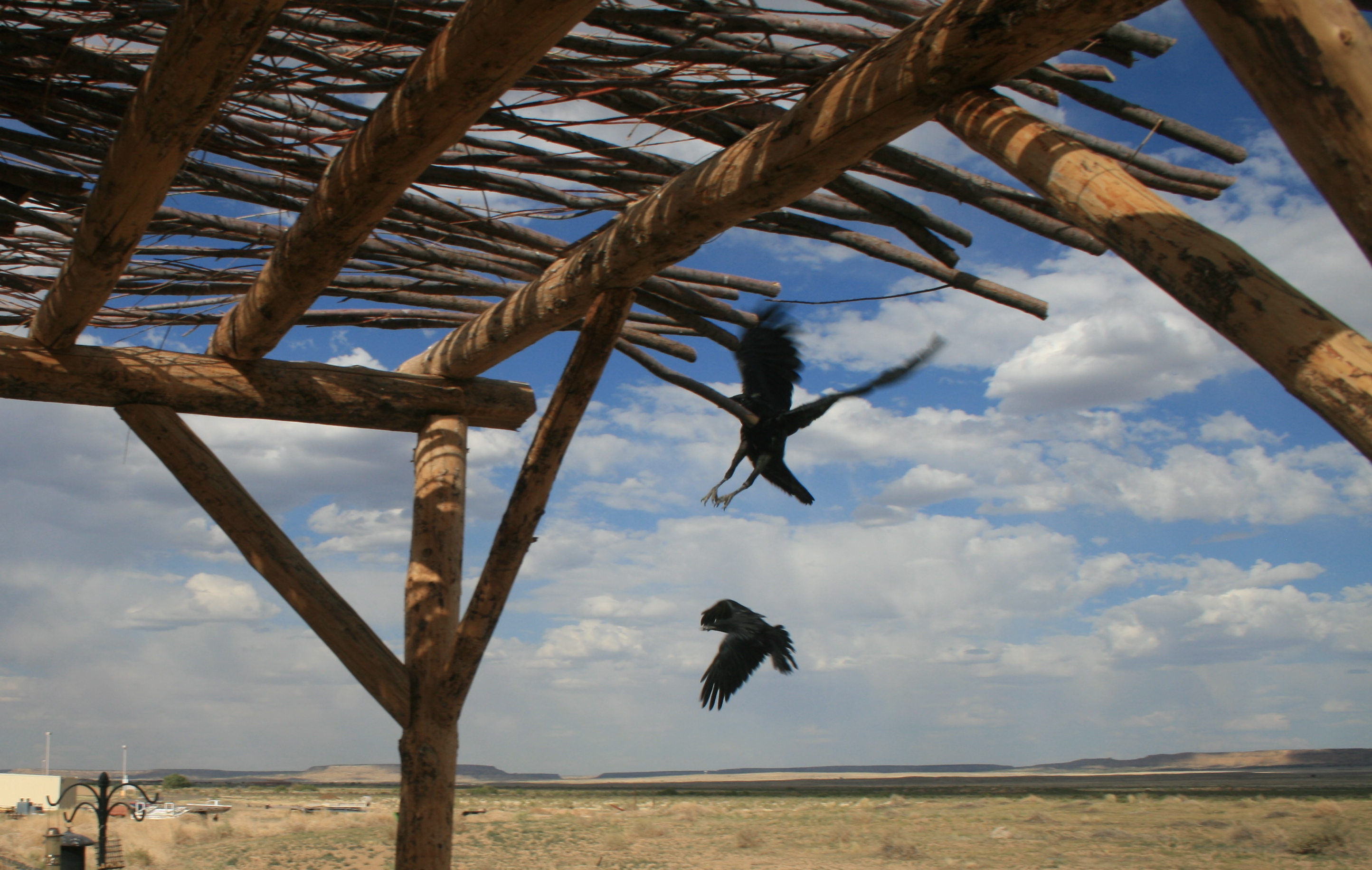
Pretty much every day, though, they would come home and hang in the shade of porch or visit with Poe who was still hobbled by his broken wing.

Never and More descend for a visit © Kerry Hardy

With each day, however, Poe seemed to be struggling.  It was tough with the heat, his appetite curbed, and with his siblings gone, he became less and less active.  Kerry and I agreed that with all of us gone, Poe’s chances of surviving the month were scant.

Injured Poe © Kerry Hardy

Resigned, we agreed that Kerry would took Poe down to Flagstaff and place him with a “wildlife rehabilitator.”  Which he did.  And all seemed good.  Poe settled in with the elderly woman.  And we were told that if he didn’t recover his flight, he could move to Bearizona, a wildlife sanctuary near Williams.  There he would be used as a “teaching tool.”  The ravens there were quite smart, we were told.  If they were handed a dollar bill, they would drop it in a piggy bank.  And if they were handed a plastic frog, they knew to put it in some water.

The thought broke my heart.

Poe being transported to Flagstaff © Kerry Hardy

15k in Therapy

Something got into our yard this morning and decimated the chicken flock.  The black hen dead, the two Plymouth’s carried away, the Yellow Leghorn freaked out.

I’m done.  Done with neglect.  Done with rabid dogs.  Done with unnecessary death.

I spoke with my friend Patrick yesterday morning.  He called me the prophet of loss – all that which has occurred and that which is yet to come.

He’s right.  I stood on the Sonoma plaza looking up at those California oaks and I realized he was absolutely right.  It’s the story of my life and my writing voice and all I really care to think about.

All of that loss.  And more to come.

Yet who are we without it?

Faultlines: James Acord

James Acord is dead.

I thought of him while sitting on the Sonoma town square.  No reason in particular, really, but I thought I’d look him up.

He committed suicide on January 8th of this year.

Acord was the subject of one of those 60 page New Yorker profiles way back a lot of years ago.  He was a sculptor who ultimately completed only a handful of works:  Monstrance for a Grey Horse, a few reliquaries, and a large portfolio of fine drawings of seedpods and nests and the like.

And yet the breadth of his mind and spirit were immense.  He was at heart an alchemist who sought to transmute base unstable material into, well, something safe and eternal, into something else.  He wanted to build a container to hold the sacrament of our age – nuclear material – and he dedicated decades of his life to the planning and carving of the Monstrance.

He spawned in me my affection for Barre granite – the hardest, most inert rock on earth.  And he gave me faith to at least contemplate the big idea – the vastness of time or the true nature of materials.  For years I’ve had a manila folder with his name on it containing information about him and his works.

I looked him up for some reason in Seattle back in 2001.  He had just returned from a teaching gig in London.  He felt gentle and doe-eyed and a bit forlorn and a bit suspicious, wondering why I wanted to talk with him.  He talked about the bus system and he needed some rides around town, I think.  Something about him felt off – he was living in Pioneer SQuare and he couldn’t quite hold his thoughts together and I realized something had happened to him between the carving of the Monstrance and now.  It was as if the power of those things he was working with was too strong, and in the face of it, unlike that Barre granite, his consciousness had begun to shatter.

Ultimately he lost the strength to carry on.  How strange to think of those hard crystals chiseled by his calloused hands, the malignant grin of the horses skull, of how it will remain yet, carrying forward for thousands of years into time a small vessel of highly radioactive uranium.  One day it will be opened by nature or by beast.  And that transformed material into this world will once again be released.


Raven Cognition. Raven Food.

I’ve been trying to feed Poe industrial hamburger meat (from Circle M).  It’s the only time I’ve ever seen one of these ravens spit food out.  And we call it fit for human consumption…

Call it the end result of what we call civilization:  Advanced Meat Recovery.  In a modern day slaughterhouse, they  blast a carcass with a high pressure hose to recover any last bit of flesh and gristle and then churn it into hamburger.   Or as Kerry said, it’s what you do after you’ve already taken the lips and asshole and served it up to some poor unsuspecting consumer.

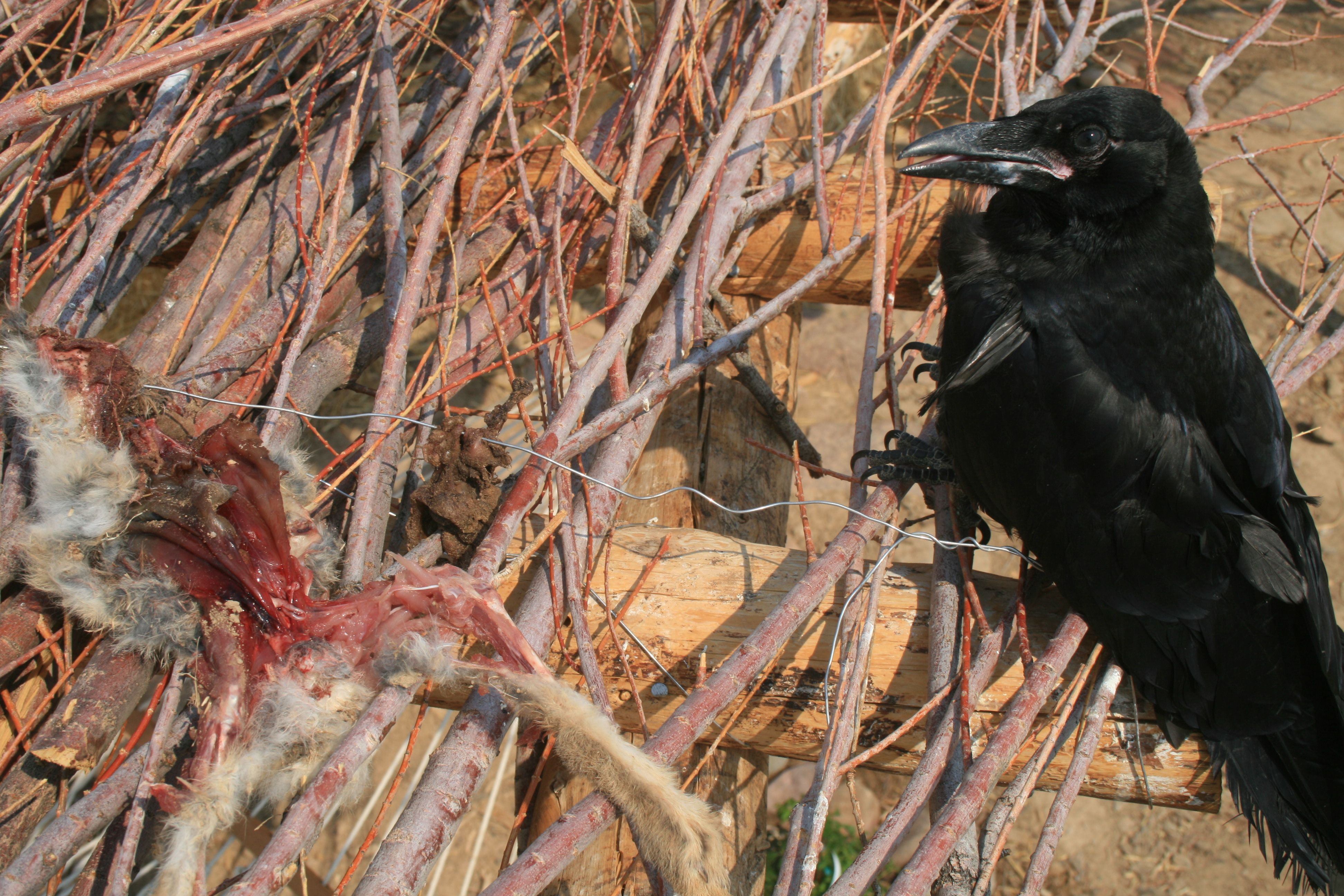
This morning Kerry brought over a dead rabbit that his dog had caught.  He fastened it to the top of the ramada and placed Poe proximate to give him a chance to pick and feed in a more raven like way.

He also set out to retrieve the other two ravens from the wash.  But as he stepped away from the yard (us conversing loudly all the while), we saw two lone figures making a swift approach in the distance.

Sure enough, it was Never and More.  They soon circled the yard and alighted on the fence near Kerry.  They kept bouncing and circling around him.  Amazing window into their cognition.

  1. Ravens recognize Kerry as a source of meat. This idea has persistence in their brains over many days.
  2. They recognize his voice as distinct from other voices.
  3. They associate his voice with him.

Not receiving food from him, they took to the ramada where Poe was, but they boosted away from him and the carcass pretty quickly.  Again:

  1. They showed a fear of a new foreign object.  A dead one at that.
  2. Death is scary.  That is, until we recognize it as food.  Then all is fare game.

Kerry brought his hand beneath the carcass.  The other ravens caught the gesture, squawked and flew back to the ramada.  He fed some rabbit entrails to Poe, they observed. He tried baiting Never and More with intestine, but they wouldn’t take it.

  1. They need to learn that a carcass is food.

How long will it take them to learn?  If the parents were present, would they teach or model behavior and would the ravens learn more quickly?

  1. Poe began pecking at the carcass.  Never and More squawked.
  2. Never and More gave their danger squawk.  We looked outside and saw Lola approaching.
  3. More grabbed rabbit entrails and took it to the ground.
  4. Poe continued feeding and Never ascended to observe.  He later flew down to join More.
  5. More, however had cached his meat on the ground.  Never found the meat and began to taste it.  I’m sure that caching is a sign that an object is of interest.  If More cached something, it must be good, it must have value.
  6. Never and More got into an intestine contest.
  7. Poe continued at his chowing up top.
  8. A lone adult perched on a lamppost facing us and called out in four short repetitive, gutteral trills.

Neighbors wonder if the ravens are hanging out at Kerry’s now, looking for food.  Folks don’t get that we have complex relations with these birds, that they come and go and fly about based on a whole set of variables.

The house sitter thought at one time taking them to the wash was too close if our goal was to make them go away.  Again, she missed it.  Our goal is not to make wild things go away.  Instead it’s to reintegrate these birds back into their environment and ecosystem.  That ecosystem includes the Wepo Wash, the other flocks, the parents, and to a limited extent, Walpi Housing.  For years the mating pairs have been doing flyovers, observing us, perching on the lamp posts, scavenging nest materials form our yards.  It’s fine that the birds come here, as long as it’s within the context of the larger environment and they’re capable of surviving on their own.

I hear the other young calling out in their playful sing song from somewhere out in the wash.  Never and More playfully follow the motions of the dancing hummingbirds.

The young flock approaches and circles and dives above our house, calling all the while, and eventually break apart and disappear to the south.

As I sign off, Poe has descended from the ramada.  Never soaks in the water.  More explores the yard.  Two hummingbirds circle.  the Plymouths rest in the shade.  The two other chickens scratch by the honeysuckle.  Two doves hang on the fence.  Lots of flies (call them pollinators).  Mango sits at my feet, watching it all.

Going Wild

More and Never didn’t roost at home last night.  But we think we know why.

While on his run yesterday, Kerry spied six ravens in the wash tributary by his house.  He displayed some raw elk meat (leave it to a downeaster to be running around with raw meat in his pocket), but none of the ravens were interested.

Later though, after he had fetched Poe from the wash, two split off from the pack and landed right next to him.  For the second day, Poe and More had been hanging with the adolescent flock!

Earlier I thought I had heard the sing song call near our house which now seems quite possible.  The new routine for Never and More now includes some house time (they like picking through the chicken feed and hanging with Poe), and lots of away time.  They’ll come and go during the day.  When they get bored at our house, they’re just as soon to take off and maybe check out Kerry’s or to go off elsewhere, presumably with the other birds.  If they can keep it up, we all will be quite happy.

More questions, though.  What’s the normal routine for the other adolescents?  Are they always in a pack?  Do they split off into singles and pairs as well for part of the day and then recongregate?  Are they roosting communally?

Do they perhaps have a set feeding period in which they all split off to find food individually (less competition for a single resource)?  More and Never know right away where there’s some good pickings – they can get free water and lots of scavengy refuse from the yard and compost.  They also like the chicken feed.  The other birds may go off in different directions and catch as catch can.  They may then recongregate in the afternoon for hang out time.  Lots yet to figure out.

As for Poe, we’ve decided that  since we’re no longer leading More and Never to the wash, he might as well stay at home in the yard to recoup his strength.  If More and Never are out and about, he’s basically alone down there and it doesn’t seem to push him to develop strength.

He’s a sitter and observer.  At least in the yard he has the stimulation of the other animals.  And the approaching dogs sometimes keep him moving, which is good.  We also have more chances to incent him to flap his wings and get a move on it.  I fear, though, that he may be settling into his crippled mode and perceiving himself as disabled.

That dang bird.  I love him so.

I’ll have to look into adaptive skiing programs.

Poe Learning © Andrew Lewis

Hay Fever (and climate change)

It’s not the hay, though.  It’s the ragweed.  Ambrosia artemesiifolia or Ambrosia psilostachya, both from the Sunflower family.

I’ve had ever-worsening allergies here at Hopi for the last five years or so.  Last summer was the pits – Kerry even had to give me a lift to Flagstaff (my eyes were swollen shut) just to escape the pollen.  Keep in mind, I’ve never had allergies until now.

The cause?  As best I can tell it’s the ragweed.  And the Russian thistle (a brush against the plant causes my arms to break out).  And also perhaps lodgepole pine (up at Vail the second week of June, I’m a runny, congested mess).

Yeah, yeah, yeah.  We’ve all heard it.  And we all have allergies.

Which is my point exactly.  In the last few years, it seems that everyone here is walking around with itchy red eyes, swollen faces, and congested sinus.  Hopi Health Care ER is full of it.  And this year I’ve done my own informal survey, asking every checkout clerk in Flag, every person in a chance conversation, etc. if they have allergies.  The answer has been uniform, 100%.  Yes.  But not like this.  Or not until now.  Or never this early.  Or it is way worse then I’ve ever experienced.  100%.  Not one person (out of perhaps 100) answered differently.

Hmm.

I asked the pharmacist in Walgreens about it.  “There’s probably some pollen or something in the air that they’re allergic to,” she said.

Now there’s a waste of eight years of education.

What’s interesting is to have a widespread allergic response at Hopi.  They’re an isolated, genetically uniform population that have been living in this environment for over two thousand years.  By now folks would have either adapted to allergens native to the environment.  Or if they had always been this severe,  I doubt people would have settled here in the first place.

So at a birds eye view, what’s going on?  Non-native invasive species (ragweed and russian thistle) have moved in.  But that happened with grazing and land disturbance at least a hundred years ago.  What’s happened in the last few years?  It could be diet or lifestyle related – think homeopathy.  Bodies were once able to cope with local allergens because folks spent most of each day out on the land and had exposure year round, as well as consuming micro quantities through the local food.  Now people are holed up inside in cubicles or watching TV at home.  But it still doesn’t quite add up.

The best answer through my lense came from Bill McKibben a few weeks ago in his book Eaarth.  It’s climate change.  According to McKibben, a recent study showed that ragweed grows 10% taller and puts out 60 percent more pollen with increasing temperatures. Ten of the hottest years on record have occurred in the last 13 years.  In addition, the pollen season has extended because the growing season is longer.  And ragweed pollen can travel hundreds of miles.  It doesn’t need to be growing here.

What holds true for ragweed may hold true for other plants.  A friend who was in Beaver Creek this last month (and is normally not prone to extreme allergies) was a mess.  She described walking through “storms of pollen raining through the air”.

Which means climate change isn’t going to just result in trivial disasters like super cell storms, class 5 hurricanes, severe flooding in the upper and lower midwest, 365 straight days of rain in Columbia, and massive tornados wiping out Joplin Missouri.

All of our eyes will be swollen and itching, too.


Quoth not the Raven

I heard a new sound from the wild ravens today.

When Never and More returned (or so it appeared) with the four wild ravens, the four adolescents called out in a delightfully sweet sing-songy call.  Even after they settled in the desert 50 yards from the house, the continued to fill the air with sound.  Never and More, however, sat mutely on the fence.

According to Heinrich, ravens may have the greatest number of vocalizations out of any other birds [Any readers who’ve gotten this far have to check out Ravens in Winter].  But he also cautions that we shouldn’t get sidetracked by this idea of “language” as a sole proof of cognition.  Animals (including humans) can have (and communicate) symbolic or visual ideas without expressing them through “language”.  What’s key here might be whether the birds can use sound and motion to communicate intent and information to influence the behavior of their peers.  Clearly they can.

Our ears here at Walpi Housing have detected at least 6 distinct vocalizations.  There’s the loud relentless hungry call.  They would do this as young, their mouths gaped open, yawning to be fed.  Then the defensive/aggressive call used to scare away an intruder.  It’s feels like a shrill growl and is sometimes accompanied by a circling and prodding forward and falling back (imagine a boxer baiting an opponent in the ring).  Third, there’s the gentle gurgle when being fed or recently sated.  Fourth, the call and response murmur. It’s like a brief purr, or the “hmmm…yes…hmmm” that you get from a good active listener.  Fifth is a conversant squawk.  I squawk, you squawk.  But it’s not aggressive and more like a loud animated conversation between friends.  Except that they know what’s being said and we don’t.  And now lastly, the playful, sing-song call.

Of course, I would bet that these birds can say a hell of a lot more than that.  I’m just slow at learning raven.  As with prairie dog speech [Also check out the great NPR/Radio Lab story on prairie dogese], their language could possibly include a range of microtones that our ear can’t detect.  Their language could also include accompanying behavior or gestures or the simple (and complex) modeling of behavior.

Our birds have largely grown up feral:  they’ve been removed from raven society and have had to grow up in a human/cat/dog/chicken society.  Although we’ve done our best to feed and care for them, any well-meaning raven equipped with a cell phone would have long ago called CPS.

We are totally unskilled at communicating the wealth of information and skills a parent raven would model and teach their young. We can’t fly, let alone fly efficiently.  We don’t know good food from very good food, from bad.  I can’t build a nest with my hands let alone a beak.  And though I can pretend, I can’t talk raven.

Of course, that’s not entirely true.  Inter-species communication revolves in part around communicating intent.  And that may or may not involve words.  It may happen through creating a “sense” in one’s mind and being, and letting that sense communicate itself (through sub-conscious behavior or telepathically or whatever).  It sounds wacky, but how many times have you walked into a room, seen someone and recognized immediately, I like that person.  I want to be with them.  It’s Malcolm Gladwell’s “first handshake” – that the majority of your impressions of a person are formed within the first five seconds.

Or take our recent time away.  A nervous house sitter stepped in and the household slipped into chaos.  The cats ran away (for 15 days!), Mango the dog was afraid to go out, the stray busted into the chicken coop, and the chickens stopped laying.  Ravens wouldn’t allow the house sitter to approach, while Kerry could just saunter up.  Then we returned.  A few minutes of meows and calls by the hospital and the emaciated cats poked their heads out from the culverts.  Chester the stray returned to his characteristic abeyance.  Mango perked up, and we’re back to two eggs a day now.  We’re back to a peaceable kingdom.  How is it that our presence can communicate “all is well, all is safe” and balance be restored?

Think also of Cesar, the Dog Whisperer.  Or better yet, the original Horse Whisperer [the recent documentary Buck is a must see].

So back to the sweet sing-song call of the ravens.  I heard it from the four wild ravens, but not from Never and More.  It could be that they were wary, or didn’t yet know the social cues that would help them fit in with the crowd.  But it made me wonder about the language instinct and language acquisition among birds.  I hazard that something like the language instinct is there; even without the influence of the parents, the ravens share information.  Hungry birds call out shrilly (imagine the nerve-rattling quality of a baby’s cry).  Or dog approaches Poe, and Never and More call out defensively.

But what of more nuanced communication?  Like humans, do ravens have a critical period in which the parents can jumpstart the language acquisition ability, and if they miss the window, the birds won’t be able to get it?

I think of the girl Genie [check out the classic New Yorker article by Russ Rymer]   who in the 1970’s was raised in far more feral conditions than our poor ravens. She spent the first 13 years of her life locked in a room tied to a potty chair.  Her father beat her and silenced her whenever she attempted to make a sound and other family members were forbidden to speak to her.

Genie grew up without language.  And despite being strikingly intelligent and communicative, she could never learn how to communicate her ideas through speech.

What of our birds, then?  We’ve spared them from grievous abuse (as far as we know), but have the poor things missed a window that would have allowed them rich communication with their fellow birds?  Why should emergent neural pathways in a highly developed and socially oriented avian brain develop any differently than that of a human?

I want their fellow birds to ask them.  And what if they can’t answer?  What if quoth not the Raven?  What if Nevermore?

Mowgli

This morning, Poe alone in the yard.  No Never.  No More.

In the west toward Floyd’s field, a mile distant, I heard a few calls.  I suspected it was More and Never, but wasn’t sure.  Two days ago on the walk back from the wash, a solitary raven did a fly over.  Poe (in my arms) was the first to catch sight of him and struggled excitedly.  One of our ravens observed where the wild one landed and flew over to join him.  The second raven soon followed.  Never and More had taken off to join one of the wild ravens.  Since it was solitary, we assumed it to be one of the parents.  And there they remained together, all three flitting about in the desert and getting acquainted.

At dusk, Never and More returned and settled in for the evening.

So now, this morning, I have little doubt that the two are off with their new found friend.  But lo, what do I see approaching?  What appear to be six adolescents, dipping, soaring, circling around one another as they approach the house, all the while calling out playfully (more on this in the next post).  I step to the back yard just as four of the ravens settle onto the rise beyond our yard.  And there are Never and More perched on the fence.  The wild ravens continue to call.  It’s not defensive, but more like a summons:  come out and play, join us, why are you sitting on the fence?  But More and Never don’t respond.

I swaddle Poe and set out toward the wash, hoping the other two will follow, (as part of the on-going experiment, I don’t overtly lead them with food this time, waiting to see if they’ll just follow Poe) but they remain where they are, tired perhaps from their morning exertions.  The four wild ravens, however, follow (and lead) us out, and eventually settle in the brush on the far bank while I put Poe in his customary place beneath the tree.  I feed him and he turns to face in the direction of the other birds.  I also leave meat out for them, hoping to attract them to Poe.

I feel like a doting parent trying to introduce my child to new friends on the first day of pre-school.  Please, I want to say, he’s a good bird.  Please, will you be friends with him?

Poe, Alone

We’re trying to help the ravens return to their kind.  But it’s hard.

They’ve all had a good number of Wepo Wash days.  We have to carry Poe, but Never and More will go back and forth between our house and the wash at will.  At dusk, though, they return home to the ramada to roost.

Yesterday was blazing hot.  We were to be gone into the evening and so didn’t take Poe out because we wouldn’t be able to retrieve him before dark.

Never and More didn’t leave either, though. Instead they chose to hang around with Poe.  It could have been that it was just too dang hot (all the birds sat around, following the shade, their mouths gaping open as a cooling response).  Or it could have been that they enjoyed being in close proximity to water.

Or perhaps they just wanted to be with Poe.  A couple times when one or the other of the dogs approached him (Poe tends to hang out on the ground), the other two alighted near by and cawed defensively.

When I returned that evening though, More and Never were nowhere in sight.  For the first time, they chose not roost at the house.  A good thing, I thought.  But that left Poe, alone, roosting on the back of one of the porch chairs.  The dogs sniffed at him and he was safe, but I thought it not good for him to become too comfortable with our house.

I carried him over to a log leaning against the ramada and he clambered up it in an ungainly way.  It wasn’t too comfortable of a roost and he had to work to stay balanced, so I brought the ladder over and he soon alighted on that.  He took to his customary habit of staring off silently into the desert, as if awaiting for someone or something.  He’s one to always look out, away from even his siblings.  I wish any of you could experience his gaze, so solitary and at once both hopeful and resigned.

I lay in the hammock, looking up at the stars.  And I talked to Poe.  And he murmured back.  I felt sad and worried for him, stuck with my meager human company.  He needs to get better.  He needs to fly.  Or soon he will be left behind, first by his siblings and then the other ravens.  And then even by us.  It felt too unjust.  Too undeserving.  And with only that, he and I continued to wait.  We stared out into space and that deluge of stars.