23. The Ballad of Jack: The Story Without End

Jack sits on stage at the Bolinas Community Center, doing a fundraiser for KWMR.  It’s cold outside, late September, the ocean fog rolling in.  John Doe is coming on stage in a few minutes.

Back in the fifties, Jack was touring in England and played Brighton.  A young kid, now a resident of Bolinas, went to hear him there.  That night Jack told a long joke that rambled interminably.  It apparently wasn’t even that funny.  It was a shaggy dog story with no particular point and it ended with some punchline about goo goo.  Or something like that.  That young kid now old can no longer remember what Jack sang, but he remembers the joke to this day.

I remember playing Brighton, Jack says as he tunes his guitar.  It’s a good beach.  I guess everyone in their life at some time or other makes it to Brighton.  I remember Brighton. But I don’t remember the joke, he says.

This is a story without an end, he goes on.  It just has a beginning and a middle.  And we’re just at the beginning he says.

But don’t let it scare you none.  We’ll get there.  Soon enough, my friend.


22. The Fable of Origami

I’m twelve.  Or thirteen. Or fourteen.  My mom is chasing whatever was so important back then: yoga, eastern mysticism, organic food, the ERA.  I, like a lot of my friends, was left to my own.  We cruised around on our bikes making fun of the sailors down on Rosecrans or the Hare Krishnas who chanted in the park. I don’t know how it started, but probably inspired by Hare Krishnas, I started my own religion.

I became the sage, Origami, and I would get together with my friends the Gladkoffs and Aaron Oakes and Johnny Ford and I’d relay to them the fundamental teachings of Prefabi.  There were five powers, I would tell them.  The Power to Teach.  The Power to Learn.  The Power to Observe.  And the Power to Understand.  And then there was the Fifth Power which was unnamable and could not be known by the minds and hearts of men.  A few times my friends would talk me into preaching to their older siblings.  Dick Ford and Mike Coon, Gerry’s brother, lounged about taking hits from a bong.  I sat before them and conveyed to them the meaning of the Fifth Power.  They got high and listened until they fell into hysterics.

Junior high starts, kids get high, kids get lost.  Even more so in high school.  Dick Ford went to San Diego State and joined a fraternity.  Alpha Chi Omega.  Riders of the Night.  Mike Coon signed up for the marines and disappeared.  I wanted to get a job and get some money so I could buy a car and run away.  At fifteen I started making the rounds at every restaurant in Hillcrest asking if I could bus tables.  Everyone gave a flat no.  That is until  I walked into the the Soup Exchange and Marissa Saunders sent me to the back.  The manager Brian looked me over, desperate but not too impressed.  Can you start now? he asked.  A dishwasher had failed to show up.  Within minutes I had an apron on and was behind the line as mountains of bowls and plates piled up.  At some point the door swung open, a muscled guy set down a heaving tray, and looked up.  Ear pierced, hair short.  It was Mike Coon.  It had been years.

ORIGAMI! he shouted and pulled me out from behind the bucket of bleach and dangling scrub hose.  Listen, you need to listen to this guy, he said.  He pulled together the prep cooks and whoever else was back in the kitchen.  This is Origami, he said.  He needs to tell you about Prefabi.  Tell them about Prefabi, he said.

That summer I learned to like Molsens.  And how to hang out with adults ten years my senior.  I watched Saturday Night Live for the first time.  And took to riding my bike ever longer distances.  That autumn another dishwasher and I rode from San Diego to San Clemente, took a look at Nixon’s old house, turned around and came back.  When I rode up to my house at three in the morning, I had ridden 140 miles.  I learned that was a good way to ruin your knees.

Mike Coon eventually left for Seattle.  My future wife, Anna, once saw him spinning down Pike Street on a bike in the rain, a toddler in the basket, laughing wildly as he raced to catch the ferry.  He had built a cabin out on Vashon and that’s where he was scraping together a living with his wife and baby.  The cabin was raw and cold.  They kept themselves warm by burning wood.

21. The Fable of the Cat Killer

For those who lived it, California in the 70’s and 80’s was time run wild. It was the years of water bed shops in OB, British Invasion rockabilly revival, Dylan being booed at the Sports Arena for going Christian on the eve of Johnny Rotten.  It was the drought ridden years when people drained their swimming pools and boarders from Venice Beach learned to skate them.  Of  PSA 182 crashing in flames in our neighborhood.

PSA 182 crashing in North Park

Most of my friends were selling weed and discovering ever better ways to rip each other off.  It seemed that if you were fourteen in those years, your parents were gone or disappeared in divorce or drinking.  And so their kids pulled their own disappearing acts into weed and meth.

The only truths told were the lies to one another.  And it was all mostly bad whether it was true or not.  You might say one day that Gerry Coon’s sister worshipped the devil. You might say that she had gathered with her friends at the pentagram laid into the stone work of the old Presidio. And that they performed satanic rituals there.  That she had stolen someone’s cat.  That she killed it that night.  But it’s not true.  None of it.  She never drank the blood.  She did not kill the cat to be real cool. Despite how the stories spread.  A song was never written.  How could it have been?  We were kids.  Not the stuff of legends.

20. The Wood Shop

Best to begin with the wood shop.  Best to see how the epic is born from the banal.

Nearly a decade done with college and with little affinity for power tools, I had little business being there.  And yet there I was, in a woodshop at Mission Bay High in San Diego on a cold night in January.  A handful of adults also filled the room, all of us wanting to learn how to use woodworking equipment.  One older woman wanted to make a clock to hang in her kitchen.  A new father wanted to make a bassinet.  Someone else a cabinet.  So once a week we gathered in the fluorescent lit room smelling of sawdust and singed wood. The teacher, a blond middle aged man who surfed, had a comforting even presence of mind, which was probably key for a guy who’s job was to show people how to work with machines that could rip their arms off.

On the first night, as we were taking our first tour of the planers and table saws, drill presses and routers, I recognized someone. Up front, drawn in under a Greek fisherman’s cap, sat Gerry Coon.  We’d grown up together in Mission Hills in San Diego. I thought somehow that he should have been dead, but perhaps that was just because of his brothers.

After class we approached one another.  He asked why I was there.

I want to build a table, I said.  And a chair.  You?

His voice was so quiet I had to strain to hear him.  I want to build a boat, he answered.

19. The Message in the Bottle

Smiley’s Schooner

Where did all those marooned sailors ever find ink or a smudge of grease pencil let alone a stoppered bottle?  And how did they provision themselves?

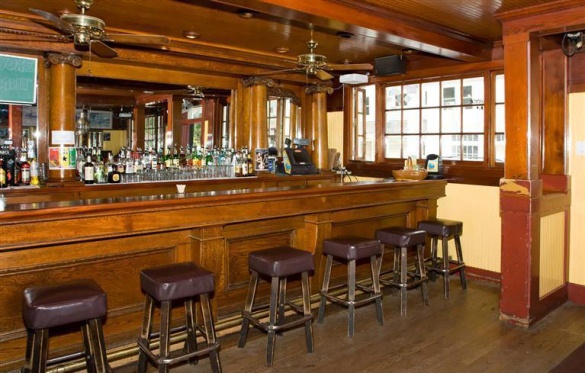
For me, it was relatively easy.  I was living in Smiley’s Schooner Saloon, a bar on the other side of the Stinson slough that greets each foggy morning at 7 am with a fresh pot of coffee.  They have good wifi to boot which means I could toss bottle after bottle of raven writing into the sea until eventually a passing ship would find me.

The first puff of smoke came late one night in the shape of a Facebook message.  It was from Brett Baer.  Where was I living, he asked? It sounded like Northern California.  He had just moved to Bolinas from Texas, he said.

You need to work kind of hard to get to Bolinas.  But there Brett was, most likely within relative sight of where I then sat.

I guess it made sense. And the fact that it does leads to the story of Brett and the story of the Craftsman Buffet.

And those truthfully can’t be told until we first tell the story of the very first boat.  But before the very first boat, there was  the chair.  And there was the table.  And before the Chair and the Table, there was Gerry Coon.

18. The Room of Requirement: The Fifth Incarnation

A September day a year ago.

We have not even moved in, boxes still stacked, the house in chaos.

The Nichols family has come up from Davis and Sacramento and San Diego to help us inaugurate the place.

It’s our new home, but it’s not yet our home.  It will be a while yet before it becomes that.  What up with the chicken barn, Evan Nichols asks.

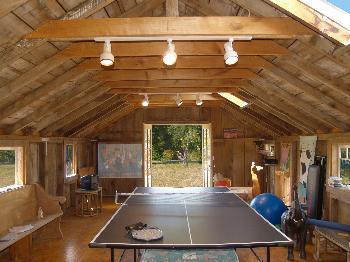
We open the french doors and step inside.  The group oohs and aahs – the unclad raw wood interior has that kind of impact.  Evan’s wife Amy announces that it would make an incredible yoga studio.  Evan considers this.  I see writing workshops, he says.  Mazie can see only the ping pong table. My friends and I are going to hang out here, she says.  I declare that I’d rather it be a beer making room.  Or perhaps cheese once we get the sheep going.  No way, says Anna.  It’s going to be my pottery studio.

Evan ponders all this.  It’s everything that anybody needs it to be.  It’s the Room of Requirement, he says.

The Room of Requirement

17. The Room of Requirement: The Fourth Incarnation

In 2000, Peter and Andrea Regan bought a home on Sparkes Road in Sebastopol California. Neighbors say the dilapidated farmhouse was not much to look at. Cramped and claustrophobic, the Regans gutted the place and tripled it in size.

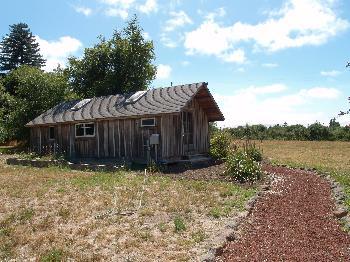
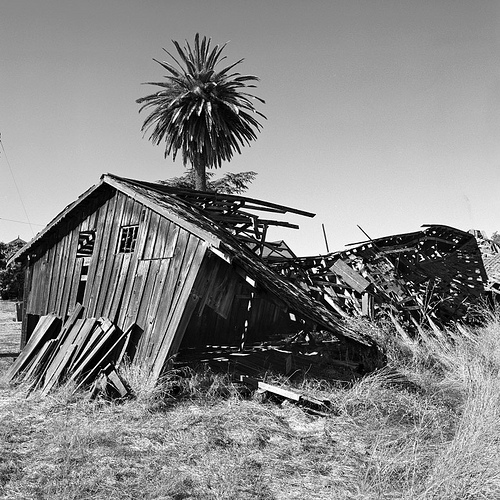
And then, there was the matter of the falling down chicken coop. Built of milled ship timbers, or perhaps from trees hauled out of the Mendocino or Stumptown woods, it hadn’t held chickens in years and was destined to be torn down.

But Peter Regan, through some infusion of resource and energy, did more than keep it alive.  He shored it up on new footings.  He had it reclad in recovered boards.  He added skylights and track lighting and a honey colored floor.  It became a playroom, a ping pong room, a secret retreat for his three growing daughters.

The natural tendency is for things to degrade until they become dust.  But what of the counterposing force?  That thing that creates and is being, well, it’s life itself.  And to foster life where there should very well be none at all – why that’s heroic.

It sounds so simple.

But what really occurs in that strange alchemy that we pass off as resurrection?

16. The Room of Requirement: The Third Incarnation

Why and how did Petaluma become the chicken capital of the world?

Kind of a weird question, but not that weird because it explains how we came to have a chicken barn on our property.

In the 1870’s the town of Petaluma 20 miles to the south of us was in economic decline.  Situated on a slough that eventually empties out into the San Pablo reach of San Francisco Bay, Petaluma and the North Bay had become a tidal eddy catching all the miners and recent emigrants washing up from the gold fields.  Some of them tried a hand at farming (grain, potatoes), and some livestock, but nothing took.

And then came Lyman Byce, a medical student and part time tinkerer from Canada, who as a boy had been intrigued in how his father had increased chick production by keeping eggs warm near the manure pile.  When he moved to the Bay Area in the 1870’s he found himself at the intersection of two interesting problems.  First, there were not enough fresh eggs to feed San Francisco.  At the time, the bulk of eggs consumed in the city were shipped in un-iced barrels from the east coast, sometimes traveling upwards of 4-6 weeks before being  consumed by some unlucky San Franciscan.

And secondly, hens get broody after their eggs hatch – they stop laying and are basically out of commission while raising chicks.  That is, until Lyman came along.  At the 1879 Sonoma-Marin fair he unveiled the first commercial egg incubator which allowed would-be chicken farmers to hatch large numbers of chicks without taking their hens out of production.

The first commercial hatchery soon opened in Twin Rocks just outside of Petaluma and by the turn of the century egg houses and chicken operations were popping up all over Sonoma county.  The fresh air, loamy soil, easy access to port (shipping was still a key line of transport) and freight lines allowed North Bay eggs to make their way across the country.  A massive civic boosterism campaign at the turn of the century proclaimed Petaluma the “Chicken Capital of the World.”  Regardless of whether it was myth or in fact, the North Bay became a locus for egg production in the United States, largely because Lyman Byce had chosen to settle there.

By 1917, Petaluma eggs were feeding WWI armies with nearly 20 million eggs shipped around the country.  With only 7000 inhabitants in the county, the area sported over 2000 chicken farms that reached peak production at the end of WWII.  Although the scale was large by historical standards, it was nothing compared to what was to come.

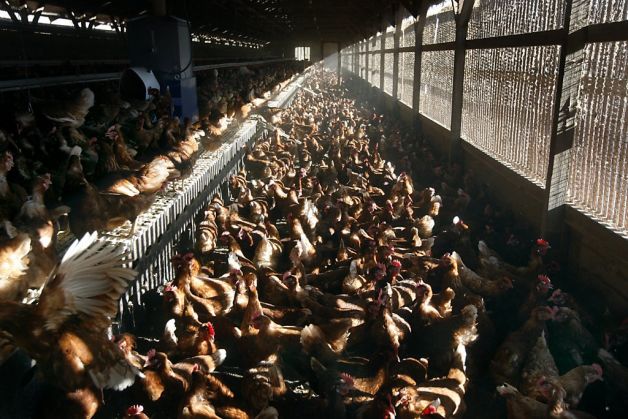
Commercial chicken farm today.

By the mid-1940’s commercial egg production shifted to industrial egg production as farmers drove in ever greater efficiencies.  Non-laying hens were culled, selective breeding introduced, and open-walled chicken houses allowed for maintenance of large numbers of chickens.  Vitamin fortified feeds and vaccinations led to greater productivity.  Eventually hens were housed in suspended cages under artificial lights to stimulate egg production, and would spend their lives in tight cubicles of 3/4 inch wire.   Indoor chicken operations could now exist anywhere, and the interstate meant that you didn’t need to be on a river or railway to ship all over the country.

Industrialization sounded the death knell for the small scale chicken farmer. They couldn’t afford the new expensive equipment.  And their kids wanted to get off the farm.

By the 1980’s there were only 300 chicken farmers left in the county. Long low roofed chicken houses everywhere were now collapsing into the ground, kept around mainly for tax reasons. To tear them down would constitute an improvement.

15. The Sailor Washes up on Shore

When the neural pathways are shaken or shattered, it can go either way.

In the case of Howie Usher, he was laid up in a hospital for a better part of too long.  And then rehab in some place in Phoenix. This is where you learn to inch your arm into a sweatshirt and shuffle with a one legged walk.  You regain your manual dexterity by counting pennies.  And you kindle whatever is in you to fend off the darkness.

Which all is what Howie has done. He’s making it, for sure, whether he feels it or not.  He’s home.  He’s walking.  Last month his confederates took him down the placid part of the Colorado from the dam to Lee’s Ferry.  And inside, that thing that can only be described as Howie Usher, is supposedly alive, and wry and strong and well.

Which is all to say, heck to the naysayers.  Leave it to a higher power to judge whether a boat or a boatman is ever done and gone.

14. Surfacing

Coming to after a long summer.  And lots of ground to cover between installment #13 and #212.  So I’m holed up for the moment at the office, essentially a bar in Bolinas.

The summer: Howie had a stroke.  My daughter studied hard for her geometry test.  She wrote new songs.  And went to LA and camp.  We made an offer on a piece of land.  And finally fixed our salt chlorinator.  And started a new set of stories.  Built some garden beds.  Bought an apple press.  Pressed 30 gallons of cider.  Endured a fatal computer crash and resuscitated tens of thousands fo files.  My brother moved in with us.  And a bunch of others.  Went to a college reunion and Asheville.  Woody Guthrie celebrated his 100th birthday.  And Jack went on the road enough time to lose count.  Resolve quickened and failed and renewed itself again.  And slumbering and rising and slumbering again through it all was the boat.

Time to pick up where I left off.  Which was with an incarnation.  And a sailor.  Belly up.  And bear with.

212. The Last Day

Jack is still a bit reluctant.  Never known a boat builder to plan a launch date before the boat was actually finished, he said.  So we recast it as a christening. Today Brett Baer turns thirty.  Tomorrow he sets off toward South America.  And this boat has become his own personal right of passage.

It’s a year ago, nearly to the day since Anna arrived here and the day Poe died.  Back then the plants were dying because we didn’t know we had an irrigation system.  The pool was green.  The house stacked to the ceiling with boxes.  Yesterday?  I put in a wild flower / lavender garden in the front island.  Spread mulch in the newly reconfigured vegetable area.  Wrangled missing chickens.  Picked a basket of raspberries.  Brett layered in gunwale gray paint in the belly of the boat.  And I made a celebratory abalone dinner with three kinds of pasta in the colors of the Peruvian flag.  It was absolutely, one hundred percent, the shittiest meal I have ever made.  Completely inedible.  A great day all in all.  And so it goes.

Mitt Romney on the Middle East

Video

http://www.youtube.com/watch?v=ukhFBJgrZxM&feature=youtu.be

Oh boy.

I’m not sure this is the most nuanced way to discuss one of the most volatile conflicts in the world today.

The 47%

Wow.

I was just personally insulted by a candidate for the presidency of the United States.

I’m planning on voting for Obama which ranks me as part of the so-called “47 percent” that Mitt Romney labeled as “people who don’t pay income tax,” takers “dependent upon government, who believe that they are victims, who believe the government has a responsibility to care for them” and who feel entitled to free food, housing, and healthcare.

He said further that it was not his job “to worry about those people, that you’ll  never convince them they should take personal responsibility and care for their lives.”

On behalf of the 47%, I’d like to clear my name, Mr. Romney.

For the last ten years my effective tax rate has been been between 21 and 25%.  For the one year of tax returns that you’ve shared with us, you paid 13.9%.  My tax burden is at least 50% higher than yours.  And you refuse to let us know how little you’ve paid in previous years.

For the last eight years my wife and I worked on an Indian reservation in a place where residents in some cases live without running water or electricity or basic social services.  My wife served as a doctor.  I started and worked for a variety of non-profits supporting local community development.

And you call me a taker?

I am a tax paying, law abiding citizen who believes in the values of this country.

Yet you basically said that because I presently support Obama you’re not going to try and speak to me or my interests.

So whom do you represent?

Your 2010 income of 20 million dollars puts you in the top 1/10th of 1 percent of American households.  In that year you earned 400 times more than the median American income.

Bain Capital shuttered at least some American companies and sent jobs overseas.  Americans lost jobs and you as the sole shareholder of Bain Capital at the time, profited.

And when the financial industry, of which you were a part, deep sixed this country through what have been recognized as deliberate, criminal activities, your colleagues were bailed out and got a free pass.  To date no one has been convicted for the crimes that contributed to the greatest economic downturn since the Great Depression.

Tax-shirkers?  Takers? People who want free everything?

Okay. So you were trying to speak about voter segmentation.  You say you spoke loosely and off the cuff.  But your job, as President, would be to speak and act with care and nuance.

When you travelled to London this summer, you insulted the Brits  by saying they were not adequately prepared for the Olympic Games.  You then travelled to the Middle East and insulted the Arab world by saying  Palestinians had not built an industrialized economy for cultural reasons and that Israel had done so because of their “providence at having selected this place.”

Now you’ve written off half the people in this country, including myself, as deadbeats.  Last night in Costa Mesa you said that you would still stand by your words.

Tell me about it, Mr. Romney.

Who are you?  Really?  And are you really ready to be President?