It Takes a Thief

“Blame it, this whole thing is just as easy and awkward as it can be. And so it makes it so rotten difficult to get up a difficult plan. There ain’t no watchman to be drugged — now there oughtto be a watchman. There ain’t even a dog to give a sleeping-mixture to. And there’s Jim chained by one leg, with a ten-foot chain, to the leg of his bed: why, all you got to do is to lift up the bedstead and slip off the chain. And Uncle Silas he trusts everybody; sends the key to the punkin-headed nigger, and don’t send nobody to watch the nigger…..Why, drat it, Huck, it’s the stupidest arrangement I ever see. You got to invent all the difficulties. Well, we can’t help it; we got to do the best we can with the materials we’ve got.

Anyhow, there’s one thing — there’s more honor in getting him out through a lot of difficulties and dangers, where there warn’t one of them furnished to you by the people who it was their duty to furnish them, and you had to contrive them all out of your own head.”

And so spaketh Tom Sawyer in the 35th chapter of Huck Finn.

There’s the right way to do something and the wrong way.

In our case, Mazie imagines black face paint and ninja costumes.  Kerry dreams up fake transportation permits and forged documents from the Hopi Tribe.  I consider several furtive and superfluous transfers between waiting vehicles a la Mission Impossible.

In the end though, we just take him.

In our last moment before leaving Hopi, we disinter an old dog carrier from the garage and load it in the car.  That’s the extent of our plan.

A few hours later we find ourselves at the home of the wildlife rehabilitator.  We knock.

After a long wait, the husband shows himself.  His wife is gone.  He doesn’t know where she is, or when she’s getting back.

We came to visit Poe, we explain and he says that we are free to go to the back.

Which we do.  Mazie carries with her a Middlebury sweatshirt.  The air once again is filled with the cacophonous roar of jackhammers.  I step into the cage with Poe and he looks up with wearied eyes.  I whisper for Mazie to walk quickly to the car, retrieve a shred of burrito and bring it back.  I meanwhile sit with the stricken bird.  Mazie returns and we feed Poe with some scraps of meat that he takes eagerly.

And just like that I drop the sweatshirt over Poe and swaddle him in my arms.  I race across the yard.  Behind me I hear Mazie closing the gate so it is slightly ajar.  Goodbye Poe, she says.

We dive in the car and quick as can, we peel away.


Considerations

Walpi Housing is all in transition.

Kerry and Kristina are moving out next month as are we.  We have a bunch of folks over for dinner and most everybody, including Hopi, are heading out in the coming weeks.

A particular era is over.

But where will this leave Poe?  It’s clear he’s not coming back here.  Without mending and stewardship in the near term, he would be finished.  Kerry and I contemplate taking him to Bernd Heinrich in Maine, but we don’t know if he still has his aviary.

And Poe deserves…he deserves what?

At the very least to live large.

He’s not a beast. And I wouldn’t denigrate him with the word animal.  He’s a being.  On par with human beings.  And every effort needs to be made to make him whole and restore him to raven-ness, whenever, and wherever that may be.

One morning I make an announcement.  We’re taking Poe, I say.

Mazie wants to know how.

We’ve already been read the riot act by the rehabilitation community.  He’s a protected species.  It’s illegal for people to own them or have them in their possession.  It’s illegal to transport them across state lines without a permit. And as I’ve been reminded, I haven’t been trained in rehabilitation.

Thank god.  If I was trained in anything, it would keep me from doing half the things I do.

Being Poe © Kerry Hardy

Poe imprisoned

Mazie and I.  We’re on our way home.

I’d been in Sonoma for 4 weeks.  Mazie had joined her friend Grace in LA for the last few weeks while I was working through the house details.

After being away from Poe for over a month, we now found ourselves in Flagstaff, checking in to see how Poe was getting on with the wildlife rehabilitator.

He was not good.

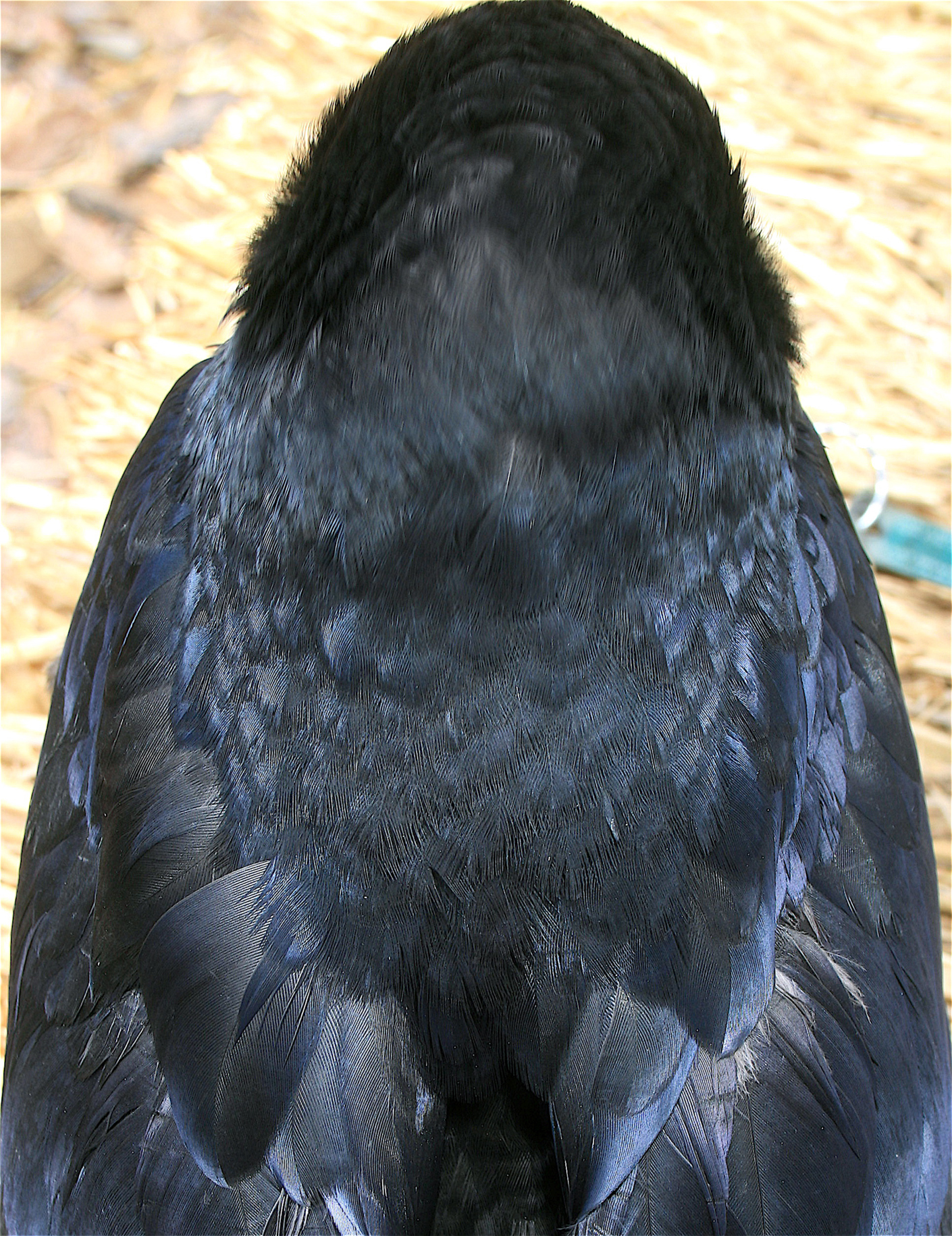
On one hand the rehabilitator had given Poe antibiotics, which undoubtedly had helped.  But for 4 of the 5 weeks, she had kept him indoors in a small dog carrier.  His breast feathers were abraded and missing.  His tail feathers were a complete mess.

In the last week she had released him to a larger cage outdoors, but on the adjacent property, literally a few dozen feet away, they were literally blowing up a limestone cliff.  The air was filled with the deafening sound of jackhammers.  And on the other side of the yard several large dogs barked incessantly.

This was madness.

Mazie and I stepped into Poe’s cage and sat down with him.  Drowning the overwhelming cacophony, he looked around skittishly.  He sat in a pile of dried dogfood – basically the staple of his diet.

It has vitamins in it, the rehabilitator assured us.

Poe looked up toward us and made his customary feeding calls.  He recognized us as his feeders. But this time the calls were soft and plaintive.

The rehabilitator went to retrieve a scale so that we could weigh him (I guess this is vital to rehabilitation), but as she approached, Poe grew even more skittish and flapped his wings aggressively.

The rehabilitator said that he didn’t like her because she had been forced to tube feed him.

As she tried to step in, Poe edged out of the cage and immediately made for the open yard.  The rehabilitator herself grew agitated and she turned to get him back in.

I looked around.  The expansive yard was surrounded by an eight foot fence.  Tall ponderosas shaded the grass.

What’s the problem? I asked.  Is there a dog?  Anything that can get him?  Let’s give him some space, I said.

Well, umm. It’s just that he might try and get away, she stammered.

Get away?  First off, isn’t that the point?  And secondly, he had a busted wing.  This bird wasn’t going nowhere.

The rehabilitator acquiesced, but not before reminding me that from a rehabilitator’s perspective, it wasn’t safe and that I wasn’t trained in this.

Under the trees, Poe easily relaxed.  He began to play with twigs and branches and dig in the ground looking for grubs.  Mazie and I sat with him as quietly as we could given the roar of the jackhammers.

Perhaps I could let him out a few times during the week, she offered.

The rehabilitator made an attempt to weigh Poe, but she couldn’t tell if his weight had gone up or down.  We helped her get him back in his cage and bid farewell.

Once inside the car, Mazie turned to me.

Did you see all the other animals she had in cages? she asked.

Offerings

One morning I go out at dawn to walk the orchards.

Is this a good place? Is it safe? What life will present itself?

I walk among trees laden with apples. The coastal mist dampens my skin. I imagine Hopi plants and how they would drink this moisture up. Gopher holes riddle the loamy ash colored soil. A civilization of them. I find old walnut shells. And ancient gnarled California oaks bend exquisitely toward the ground. An oyster shell pokes up from the dirt. There’s evidence of artesian springs.

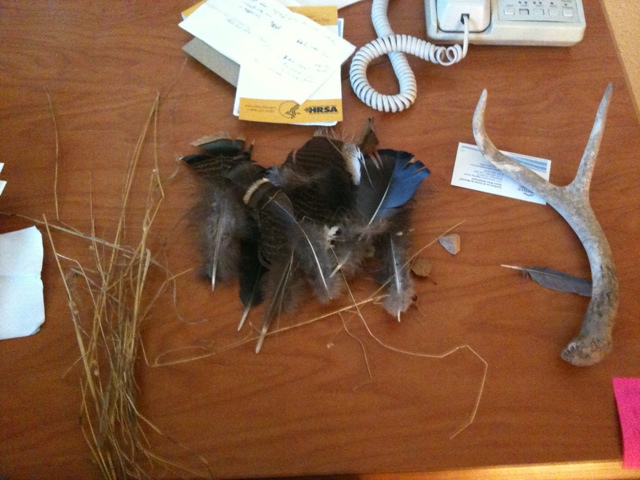
A flock of wild turkeys waddle toward the vineyard. Everywhere I find turkey feathers. And jay feathers.  And the horn of a deer. Quail dart among the trees. I see large cat prints. Rabbit pellets. Fox scat. Chickens wander in the distance. The grapes just now are coming onto the vine. A line of does steps up from the hollow. Later I learn that a mountain lion was spied coming up the Blucher creek. I see a few corn stalks volunteering among the Gravenstein apple trees.

I hear the sweet call of the crows. And then, at last, the rasp of the ravens in the fog. Two sentinel redwoods tower above one of the old farmhouses.

These are the beings that govern this place. The LaDukes. Me. My family. We’re all interlopers. We need the help of the others if we’re going to live here. And likewise we have an obligation to all of them. If nothing else, simply to let them live.

20110825-121155.jpg

The Farm

Feeling the watchful eyes of all those who protect, I pay a visit to the County Recorder’s office in downtown Santa Rosa.

I’m accompanied by our real estate agent and I want one favor from him. I want to trace back the chain of title on this house we’re buying. Eventually I want to go back to 1848 and the end of the Spanish land grants, but for now I’m just looking for one particular event.

—-

Our prospective house is old. Although it recently went through an extensive remodel, you can still see the outlines of what was once a craftsman bungalow from the 1920’s. But the current owners found in the walls a rolled up newspaper dating from 1893.

I suspect that our house was the original farmstead on what would have been a 40 acre homestead parcel.

You see, I’m the patron saint of all things lost. If you’re inhabiting a house, you’re taking on not just the house of today, but all the past lives of that house and the future ones as well. Everywhere we walk we’re surrounded by ghosts and what are we if we don’t choose to recognize and honor them?

By definition, life is a process of perpetual disintegration. Or rather, it’s persistence in the face of disintegration. Life wants to live. And in order for it to live, we must put ourselves forward as a countervailing force. Life is summoned in the face of death.

In this case, there was once a boy who lived in a sleepy seaside down in Southern California. The boy lost his parents and he watched the canyons and coastal chaparral be chewed up by a tide of development. He dreamt that one day he’d live in a place where he would be safe from loss and protected from those things that diminished life.

And once in Sonoma County there was a farm. The land supported orchards of cherries and nut trees and eventually Gravenstein apples. Over time it was divided up into ever smaller parcels, but by some miracle the orchards were never taken out and the land stayed under cultivation. And all the while an old green farmhouse and it’s inhabitants set themselves on that land and oversaw whatever life went on there.

But it only takes one change of ownership and that will cease to be.

—-

In the County Recorder’s office, I scan the yellowed maps on the wall. You can see the outlines of what were once the Blucher Rancho and the adjacent rancheria. Our parcel now exists on the border separating the two land grants. In hand I have an existing parcel map for our area, showing the house we’re looking at and two smaller adjacent parcels. One is owned by an old woman with the last name Horstmeyer. The other by an elderly lady with the last name Edmunds. Still under orchard, in all these years the land has never been visited by either of the ladies.

Before delving any deeper, I already sense the story.

The county recorder pulls up the chain of title on the computer. She can only go back to the mid-1960’s. But just from that we can see the current owners bought it 10 years ago from a fellow named Robinson. And Robinson bought it from a fellow named Percy LaDuke in 1964. to learn more, we need to go to the map ledgers.

We flip through a large book containing fragile maps until we come to one particular change of title in 1964. We see an original parcel comprised of our house and the two other plots of land. And in lavender pencil, two neat hand-drawn incisions divide the one parcel into three.

I turn to the real estate agent. The two old ladies – they were Percy LaDuke’s daughters, I tell him. When he sold the house, he deeded two portions of the land to them and their descendants. He loved the land. He had to sell the farm, but he didn’t want to lose it. He felt that there was value in land and that the land should go to his daughters.

We now turn to the microfiche. It only takes a bit of searching to find images of the change of title. And there it is. Percy LaDuke selling the farmhouse and in two separate documents he subdivides the property and conveys title to Mrs. Horstmeyer and Mrs. Edmunds.

I can hardly contain myself now.

The woman were already married. That means they were at least in their twenties.

The real estate agent is shaking his head now.

That means the two women were born in the late 40’s. It’s all so clear now. If they were born in the late 40’s, they were early boomers. They were born just after the war. If Percy were selling the house in the 60’s once his daughters were married and gone, that means he would have been young enough to serve. He’d fought overseas and once the war was over, he was discharged, he bought the farmhouse and he and his wife had settled down to raise their family. They’d all grown up here. Once his family was gone, the farm was sold off and divided.

To trace back the chain of title any further, we need to do it manually and the Recorder points us to shelves of dozens and dozens of volumes organized alphabetically and by year.

How do we find the previous transaction, I ask.

You have to go through each year, she tells me.

But there’s little need for that.

I walk directly to 1948-49, pull one book off the shelf and flip to the L’s. We turn a few pages and there we have it. Two contiguous, handwritten entries in black ink. The first registering Percy LaDuke’s discharge from the Navy in Oakland, California. He had fought in the Pacific theater. The second entry recorded his purchase of the farm.

20110825-115213.jpg

Guardians

Poe ensconced with a wildlife rehabilitator in Flagstaff. And Mazie and I are camped out in Sonoma California, trying to piece together a new life out here for our family.

We’ve found house to buy. It’s big and green and old and wonderful. But after eight years at Hopi, it’s hard to imagine a life as wild and wonderful and full of serendipity as the one we now have. Is this it? After decades of wandering, are we now settling down? Where’s the adventure in it?

On a Tuesday morning, sitting in the courtyard outside the Sebastopol Inn, I call our friends Kerry and Kristina back home. I’m worried, I tell them. How are we going to make a new life for ourselves out here?

Kristina’s answer is simple. This thing that we need to do is too big, she says. We can’t do it alone. So we need to put it out there, we need to seek out our allies and be available when they present themselves.

As for Kerry, he points out that when driving into Walpi Housing in the middle of a barren desert, would we have ever imagined that it was an ideal spot for building large wooden structures, and butchering a cow, and raising a mess of ravens? Could we have even conceived of the adventures that awaited us there?

Two hours later, Mazie and I sit in the Holy Cow coffee shop in Sebastopol. I’m despairing. Will I be able to talk to the ravens in our new home? I ask Mazie.

Daad, she says, and rolls her eyes in a way to indicate that once again I’m proving myself an embarrassment.

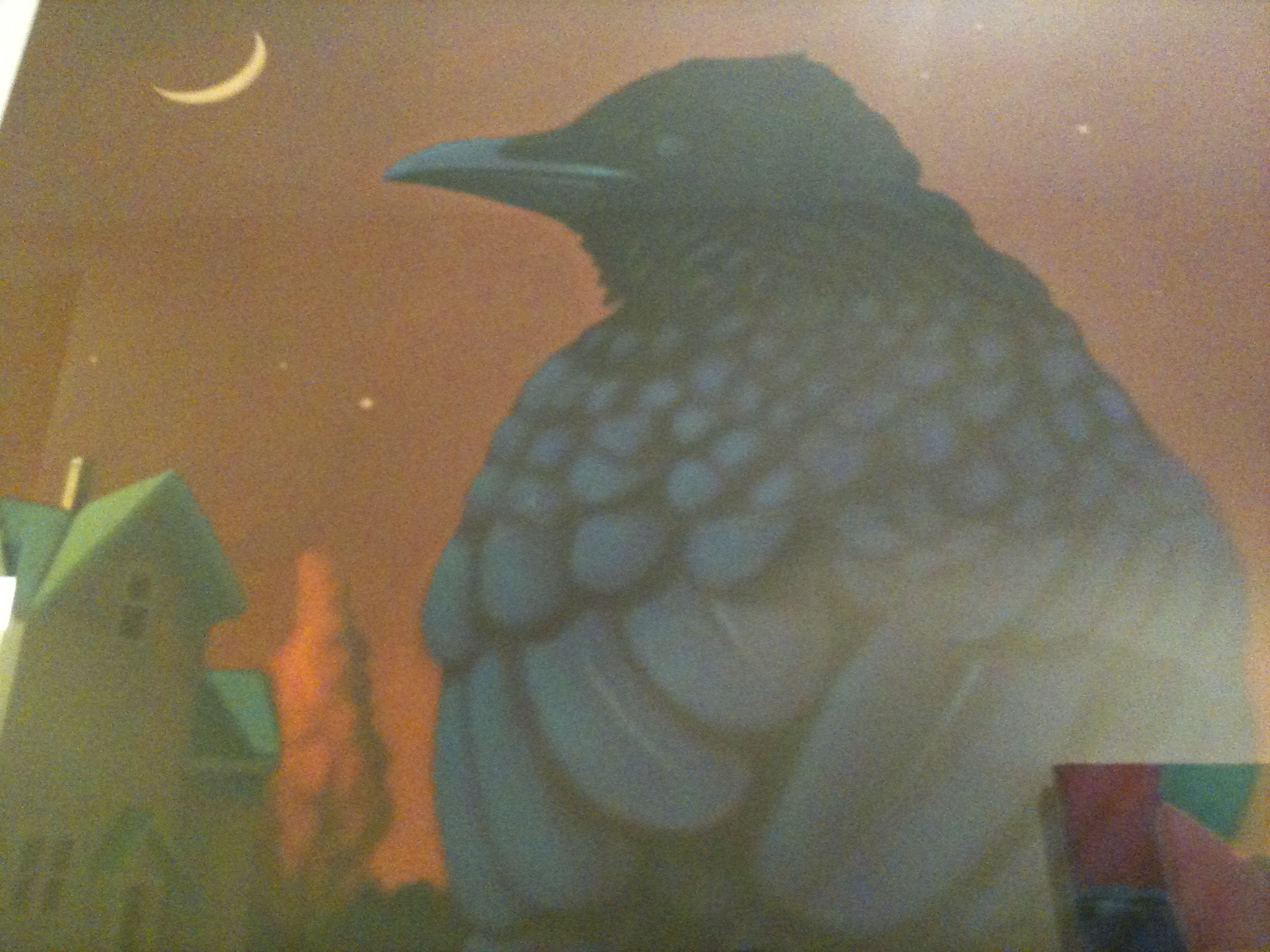
On the wall behind her hangs a large painting of a young girl cradling a crow. And further down, another canvas of an enormous raven perched on the body of a baby. I step up to take a picture of it and an older woman sitting at a nearby table asks if I’m interested in ravens.

She’s read all about them, she says.

Bernd Heinrich? I ask.

Heinrich is amazing, she says and we high five.

I tell her the story of the wash ravens and she tells me about herself. Her name is Maryann Markus. She used to teach, but she’s retired and she’s built herself a studio and she spends much of her time drawing nests. She is fascinated by ravens, she considers them her totems. There’s something I’ve never shown anybody, she says removing a velvet pouch from her purse. Inside, a hematite figurine of a raven. I squeeze it in my hand and rub it and squeeze it again. It’s heavy and has the dense sensibility of a low rumbling current.

She looks at me. It’s yours now, she says. They’re such powerful birds, guardians really. She asks if I’ve met Michael, the owner of the coffee shop and to fellow who did the paintings. She leads me to the back to introduce us.

He’s my age more or less, introspective and gentle seeming. Michael, too, says he can’t get his mind off these birds. He’s been fixated on them a while and keeps working them, making image after image. They’re deep, intense creatures, he says, and we’re afraid to let them into our lives. He says that the image of the baby and the bird scared people, but that they misinterpreted it. I see him as a protector, he says.

I tell him about the raven in our care and how our neighbor killed and maimed two of them. How I was fed up and in a weird way it was a last straw for us. I just wanted to get out of there.

But that’s all part of it, too, he says. You can’t run from that either. He says he hopes our move here works out well and that things take a good turn with the house. Before I leave, he gives me a hug.

I walk out of his office and see one more canvas.

20110825-100821.jpg