Analog

Interesting © Kerry Hardy

My problem with our species?

For all our gloating about our big brains, we still are largely only able to comprehend two states of being at once.  Good and bad.  Black and white. God and the Devil.  Republicans and Democrats. And then we often try (very hard) to reduce them to only one.  That’s about all we can handle.

Like good sound recordings though, the the universe is not binary, but analog.  There exists a whole range of states, meanings, perspectives – a vast heterogeneity of experience.  How could we possibly distill something to being solely good?  Or solely bad?  How about something in between and open ended, something like…”interesting”?

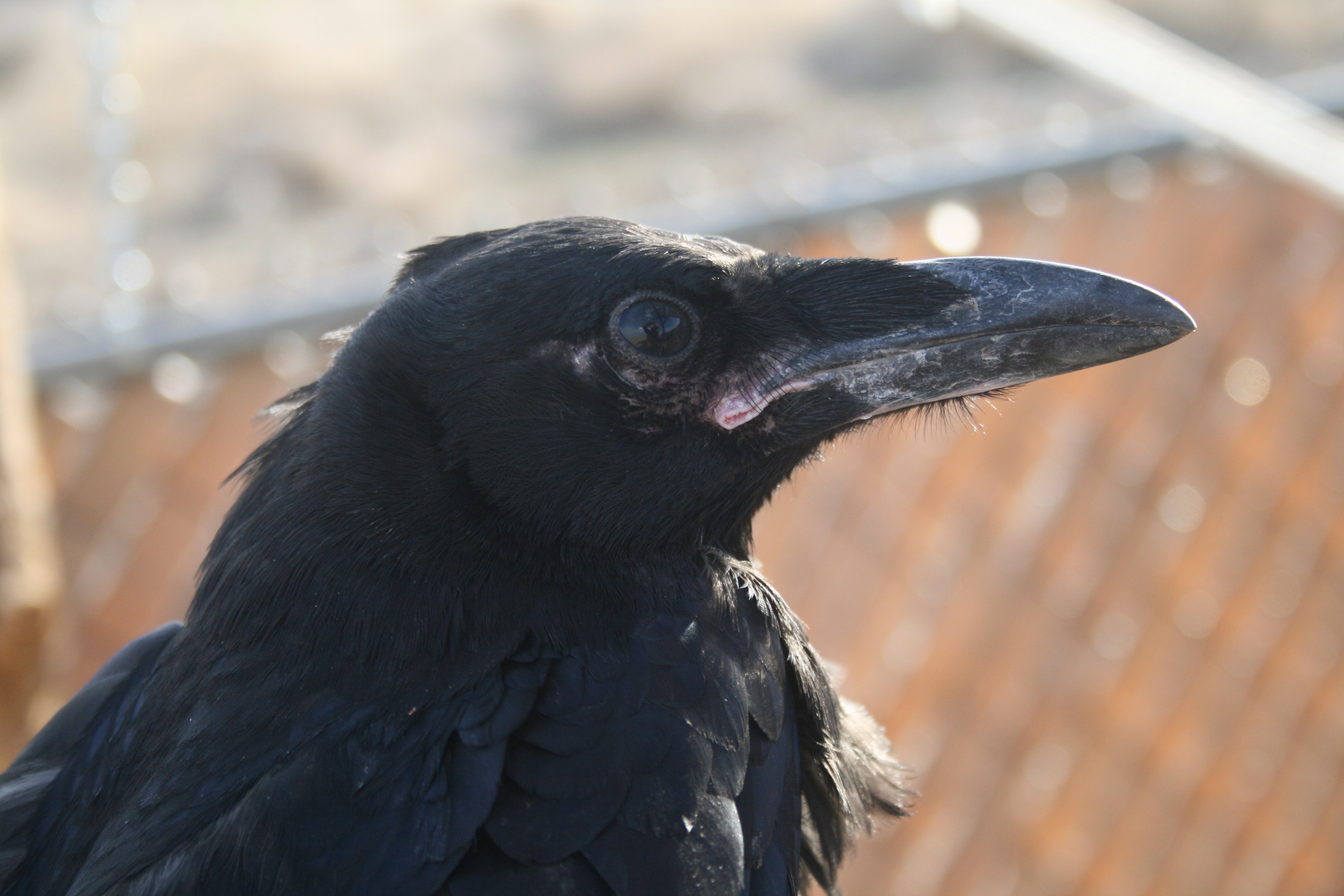
So what brings me to this?  Ravens, of course.

Yesterday morning, Kerry and I together went through the wash routine with the birds, now down to three (or really just two and a half).  I swaddled Poe (we’ve now identified Broken Wing as him, partly due to his consistent aloofness from the other two, his blazingly independent cross-desert walks, and his consistent backward twisting of his head when we feed him), and we led the other two across the desert to the trees in the wash.  Once there, we all settled down in the shade:  the ravens to play, Kerry and I to talk.

What a wonderful gift to observe these creatures at such close range.  And how sad that many of our neighbors continue to miss the opportunity, just because they’ve chosen to label them a nuisance.  Even more ironic, we’re pretty certain that one of them is (intentionally or unintentionally) responsible for killing one bird and injuring the other.  Without his engagement, we’d now have four ravens flying freely out in the desert essentially minding their own business.  Instead, Broken Wing Poe still depends on us for feeding and the others routinely come back to hang and visit with him.

We all had some nice doings out in the wash, though.  Never and More played tug of war with sticks and grasses.  More found some meat scraps and tried several times to cache it in the sand.  We observed More, as always far more quick on the wing and the first to grab stinkbugs and treats when he spies them.

We watched the birds hunt insects.  At close range, you can also see their eyes can be directed forward and hence may be capable of stereoscopic vision (a hallmark of predators).  Which suggest that these guys may not be just scavangers and feeders of carrion. They may be able to hunt lizards and small animals, putting them in the same hallowed space as eagles and hawks.

Poe, meanwhile, hung in the shade, tested his wings, knelt in a cooling position, and sometimes talked.

And in all, very, very interesting.
Disaster’s Playing Field

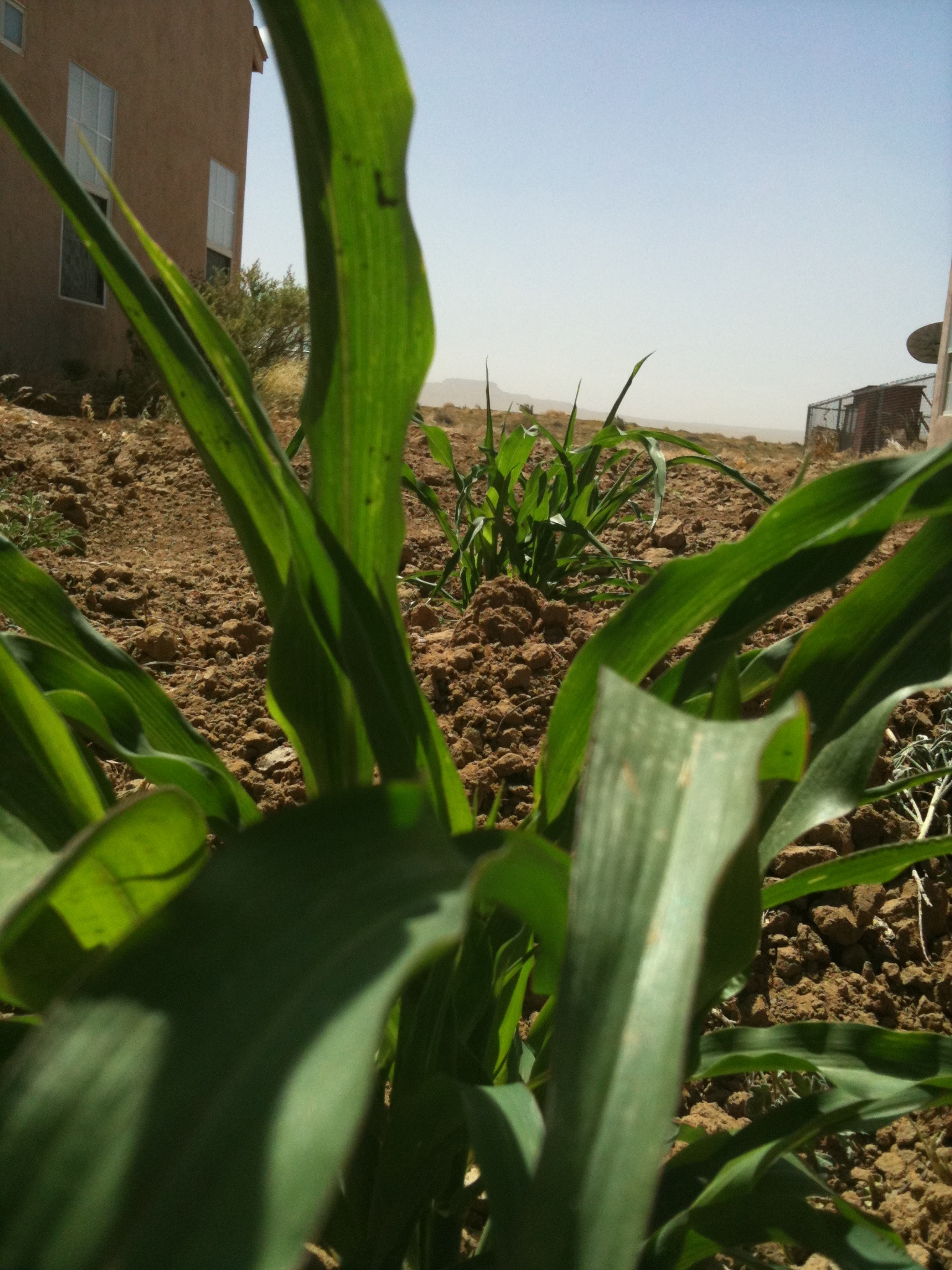
Two nights ago, I lay awake at 2 am listening to the howling wind. It was hot and dry, and blowing at night no less. Usually the winds die down by dusk. Even more importantly, this stuff is supposed to be done with by the middle of May. This year, we’re coming up on July and the wind is still blowing relentlessly.

If this is just an abnormal year, that’s totally fine. Abnormal means we have a normal to return to. Some year’s it’s hot. Some it’s cool. In the end it all works out. But if this (or something like it) is the new normal, I believe we may be in trouble. Here, unless you’re really good you can’t successfully dry farm under these conditions.

Dry farmers in this part of the Plateau depend on the pulse of moisture that arrives in January and February. If you’re lucky it soaks in and permeates deep layers of clay. If you’re even more lucky, you get a light pulse of rain in April or May that will jump start the seeds when you put them in. Even when the winds hit in May, the corns are well enough adapted to withstand it.

But when the winds blow through June, you can’t even get out there to plant. And if you do, the old moisture is evaporating so quickly out of the soil that the tap roots may not be able to chase it down fast enough. And if the winds blow through July, well, hardly any plant can survive that.

Or rather, they can if it comes upon them slowly. Technically speaking, dry land farming is, in part, about applying gradual selective pressure to seed stock so that over time it can evolve to withstand extreme environmental conditions. But that’s not what’s going on. Last year, the winds quit at the beginning of June. Now it’s four weeks later. Plants may not be able to adapt quickly enough.

If this is the first sign of our agriculture being suddenly bludgeoned to death, we can’t stand on the sidelines. Now’s the time to jump onto the playing field. Why? Because extreme conditions breed extreme diversity. You see it in edge ecologies – biomes that exist on the edge of a stable ecosystem evolve much more quickly with far stranger and exotic and powerful results.

This morning I was out hoeing and I caught sight of my Hopi neighbor watering his corn. It’s pretty much a daily routine for him, almost to the point where you might as well consider it aquaculture. I have to hand it to him, though. One, he’s farming. A lot of people are not. Two, he cares enough to keep his stuff alive at all cost. Three, he’s been maniacal about keeping his yard clear of ragweed and Russian thistle (which few people do around here). I’m highly allergic to both and his house is upwind of mine, so he’s graciously saving me from a huge autumn headache.

We’re growing for completely different things, though. He’s growing for corn. I, on the hand, am growing for resilience and strength. I don’t need a hundred ears. I just need few. In general, I’m not watering. On the worst wind days I’ve applied a cup or two of water just to keep a few of the plants alive. I don’t even necessarily want to keep them all alive, just the strongest. Let the environment dish out everything that it can. The few plants that survive, why, they’ll be the ones. I want something capable of a deep taproot and extreme resilience in the face of catastrophic wind. Overall, this kind of farming/gardening is a terrifying tightrope to balance.

Hopi corns are very smart. Smarter even than a lot of people I know. It figures out conditions quickly and responds physically just as fast. But even so, I fear the conditions may be changing even faster. I need to goose my plants just enough for them to stay alive, but not too much to drive them out of the race.

In the face of a looming disaster, our human lives may depend on it.

20110630-103833.jpg