Poor More. It’s the first time he’s met a human without arms.
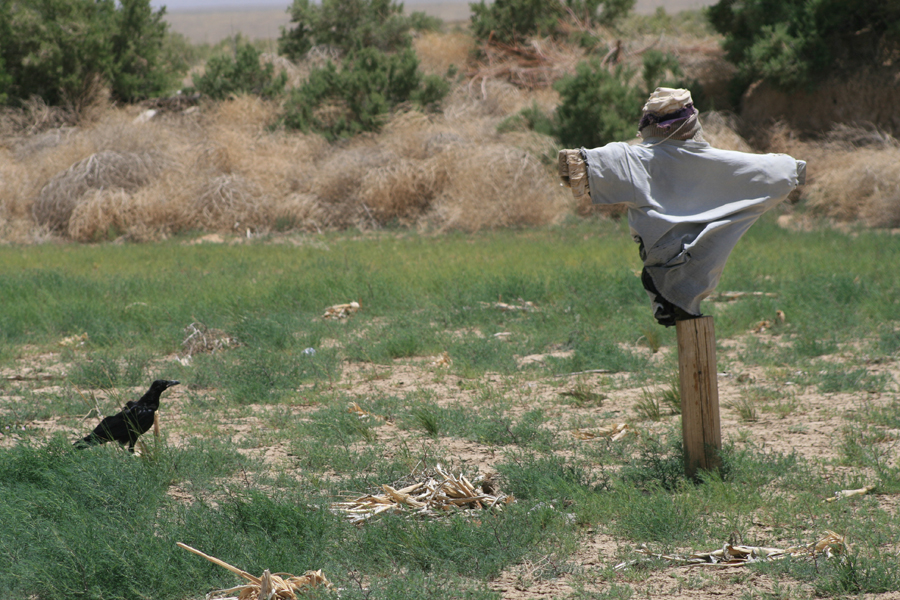
Pleased To Meet You © Kerry Hardy
Poor More. It’s the first time he’s met a human without arms.
Pleased To Meet You © Kerry Hardy
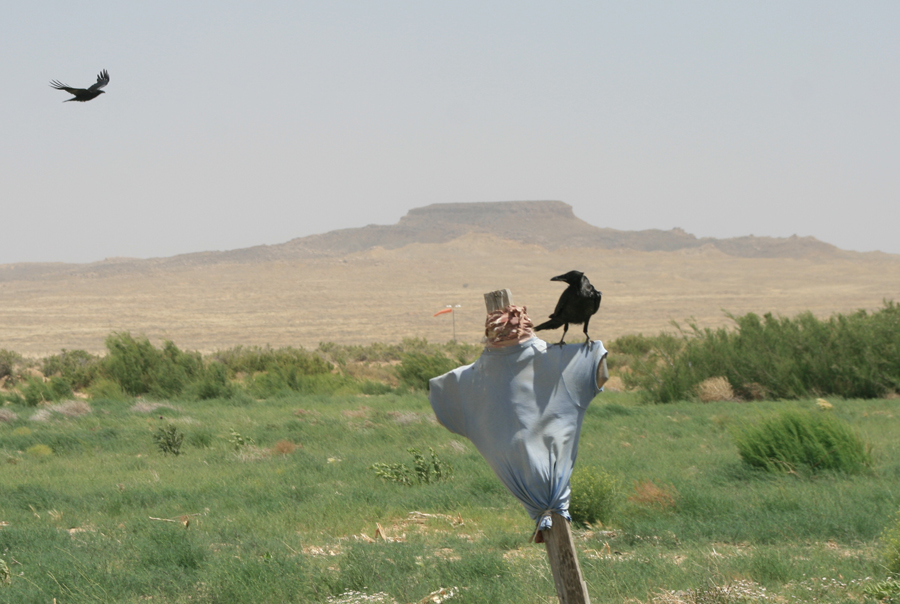
Baby and Parent Flyover © Kerry Hardy
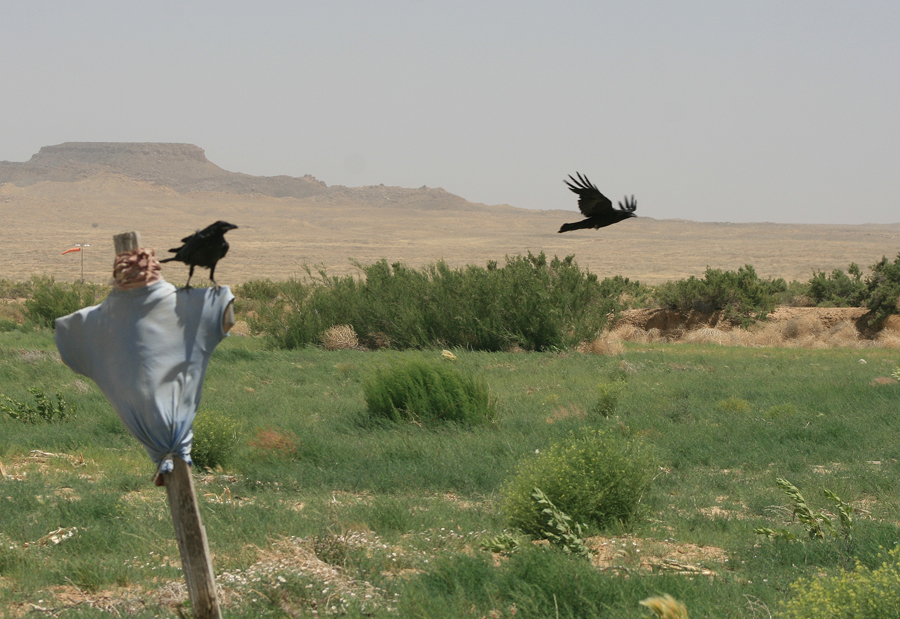
I love this picture for reasons other than the humor.
The house raven feels comfortable perching on the scarecrow. The wash raven doesn’t.
That suggests that the dang things learn. And if they can learn one thing, they can learn another. A wash raven has learned to fear and distrust the human form and so it steers clear of it. The house raven, though, has grown up perching on our shoulders. It associates those shoulders with sustenance. To perch on a shoulder is no biggy.
The wash raven and the house raven probably consider one another deranged.
But what if farmer and animal got to know one another? More, meet Lloyd. Lloyd, this is More.
As for the farmer (I’m talking to you, Lloyd), behavior is malleable. In what way can we encourage good behavior? Is it possible to both preserve the corn and coexist?
For those that have been following the saga, I’m providing Kerry’s notes, straight from the horse’s mouth. If anything, they suggest the richness and nuances of the relationships, interspecies and otherwise. Hurray for Kerry:
Big doin’s in the wash. When I took them down there, they got separated (because More freaked out a bit and got out of the cage) and were too skittish to recapture. So, I put the more timid of the two in the nest box which was about 150 yards away from where More was hiding in the sagebrush. I was pretty concerned about them finding each other, so a few hours later I went back down.
They were each exactly where I’d left them. I used water to coax Never(?) down out of the nest which he came to immediately. He seemed very affectionate, so I started squawking to him and walking towards More, and sure enough he followed– and meanwhile More was interested enough to fly and walk a bit closer, down into the cornfield.
My squawking brought two mature birds almost instantly; they did some real close flyovers. Finally the two babies spotted each other– and I’ll tell you, it was quite touching to see them figure it out and hop together for a nuzzling. Palpable relief on all parts, myself included.
Then I walked back to the nest. Never followed along, and More did too at a safe distance. When we got back Never drank some more, and More almost dared to. When I gave Never some elk scraps and he went into full open-mouth-begging calls, More broke down and came over for his share too. So– they’re fed, watered, and both know where the nest box is, and they’re together (at least when I left them).
Lola and I sneaked away and they went off to explore the wash. Parents stayed in sight at all times– fingers crossed that they’ll adopt, rather than attack. Never even pecked and ate a bug at one point. If Broken Wing is still looking chipper tomorrow, I’ll take him down along with their breakfast. More heart-rending photos expected then. Enjoy these! A memorable Father’s Day, in its way.
Who needs TV.
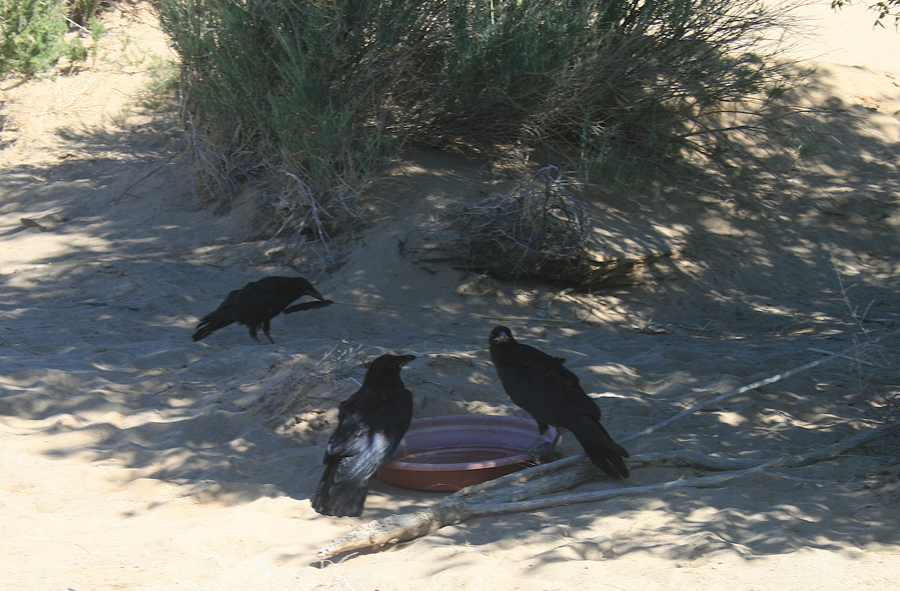
Settling In © Kerry Hardy
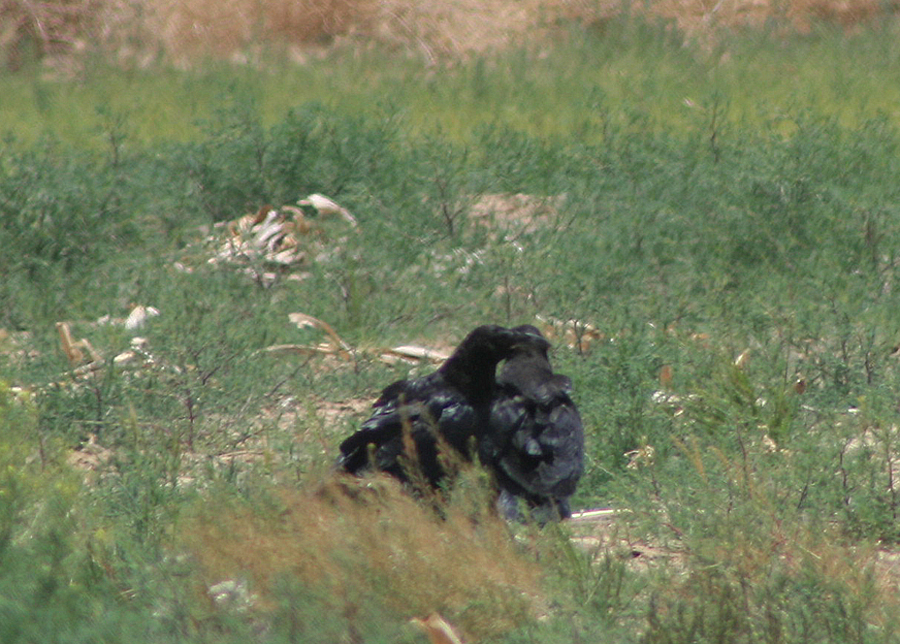
Reunited © Kerry Hardy
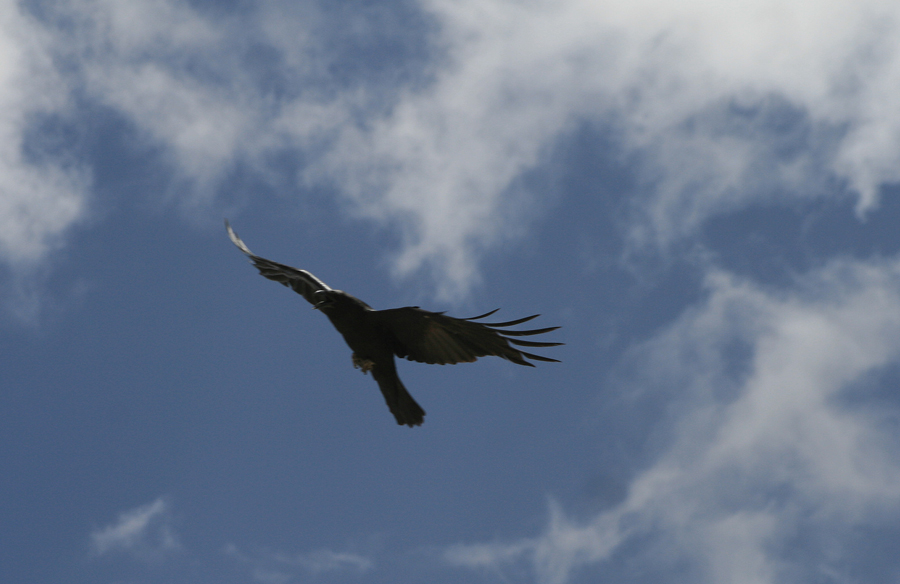
Parent Flyover © Kerry Hardy
The day that the fourth raven died. Kerry pushed onward:
I procured a 3′ long bullsnake that a friend had bravely bludgeoned with a 2 x 4 yesterday. I opened its belly and wove the whole schlange into the top of the chainlink fence with the two bravest ravens watching intently. . . and before I had made it to the road, they were both up there pecking, and seemed excited. One grabbed some intestine and flew down to the gravel roadway with it; the other joined him and the two of them danced around it like it was some great exotic delicacy. So there’s hope for them as ravens. . . of course, if the smell of day-old dead snake in 90º weather hasn’t faded out of the Prius by tomorrow morning when we go to Flag, there may be no hope for me. Hang in there, I’ll see what I can do tomorrow once we get back from Flagstaff.
Kudos to Kerry for doing the snake. Although our house now resembles some charnal house with heads on pikes, etc.
Our wonderful house sitter is none too happy with it, though. She’s worried that it’ll begin to stink and will attract flies and that the neighbors will go ballistic. The whole thing is horrifying. She asks to take the snake down and give it a respectful burial. She also wants to take the remaining ravens up to the Cultural Center and leave them there where they can pick through trash.
Which summons a whole range of thoughts.
But our poor house sitter. She (along with the rest of the neighborhood) are under the impression we want to keep them as pets. Time for a massive media campaign. Perhaps through a blog or something.

Trust © Kerry Hardy
The ravens are returning to the wild.
We’ve waited until they’re confident in their flying and they can safely evade predators. Unfortunately, I’ve been away for the reintroduction and it’s fallen on Kerry Hardy’s shoulders. Don’t get me wrong. Despite his shameful and perennial unemployment and his poor standing in his wife’s eyes, he’s capable enough. He’s from Maine, after all. But what an opportunity to miss.
High wind day at Hopi. Kerry went up on the ramada despite it all and removed the straw bale windbreak and the nest. Two of the birds pretty much out and about for most of the day while the other two stuck to the yard.

Prison Yard © Kerry Hardy
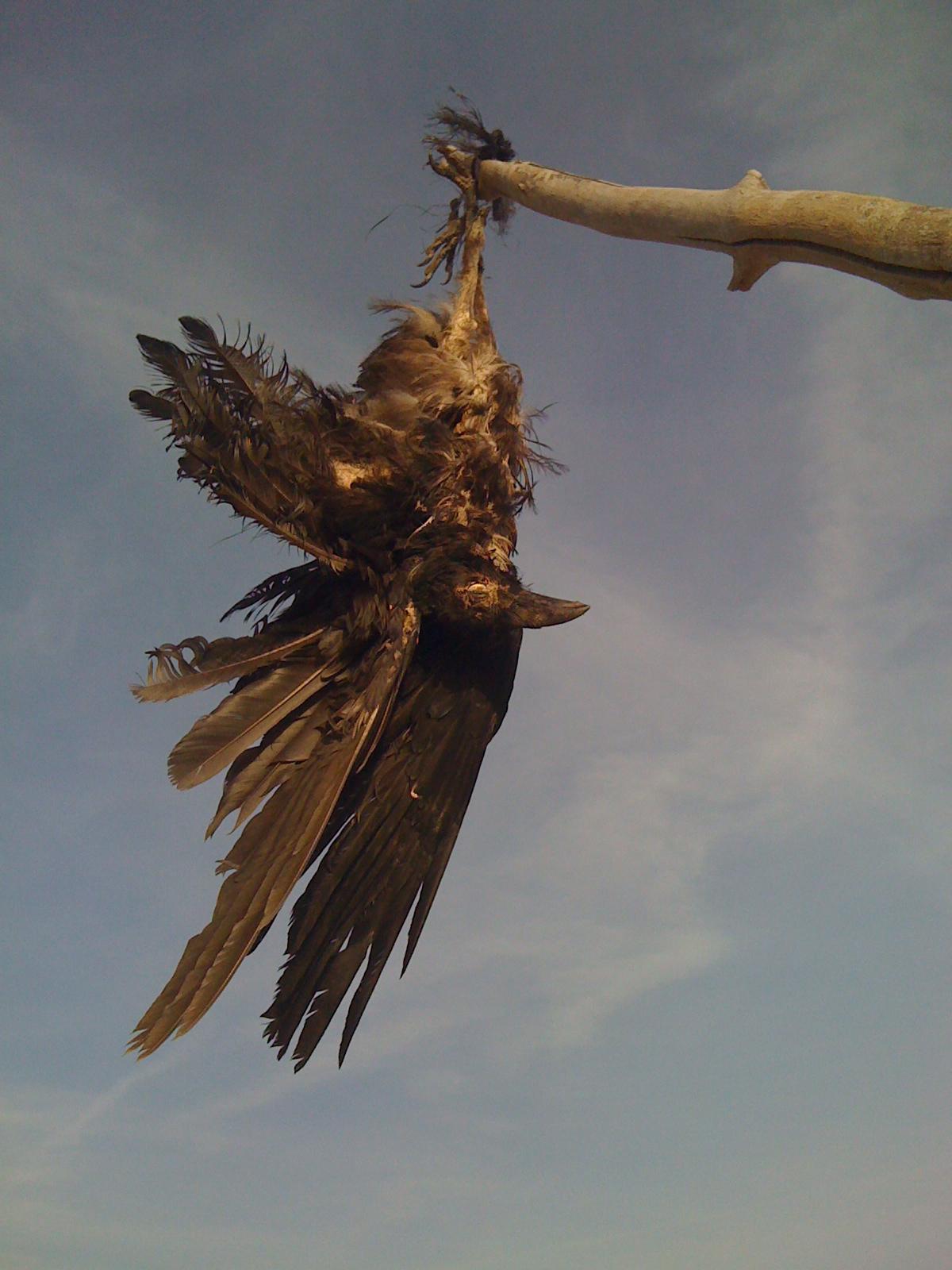
Hanging © Andrew Lewis
I think I’ve had it. Forget this abortion we call civilization.
A few days ago our house sitter called all in a panic. The vibe in the neighborhood was getting bad, she said. The neighbor was upset because the birds were going to get his corn. And they were loud. Another was upset because they were flying to his house and shitting in his yard. Another complained that one of the birds was calling outside her son’s window in a threatening way.
They’re birds. Simply birds. And they’re beautiful. Beautiful when they squawk. Beautiful when they fly.
They care for one another. They don’t sell meth. They don’t kill their spouses or their young. They don’t watch TV. How many ways can I count my love for thee?
The following evening our neighbor returned one of the ravens to us. It was threatening his corn, he said. Never mind that his corn is only a couple inches high and that the birds don’t yet feed themselves.
The bird was injured. He wouldn’t take food and he couldn’t move his wings. By the next morning he was dead. Our house sitter buried him in the desert.
Every Hopi who’s heard of our raven adventure has expressed aversion. Not just surprise, but something close to downright disgust. They’re ugly black birds. And they eat the corn. I might as well tell folks that I’m raising rats.
Last fall I found a bag of shotgun shells and a bottle of soda beneath the wash nest. A farmer had perched on the bank and set to taking pot shots at the infants. In talking to farmers here, they here don’t distinguish between the young and the adults. They don’t even distinguish between the ravens and the crows. How can they set to killing them?
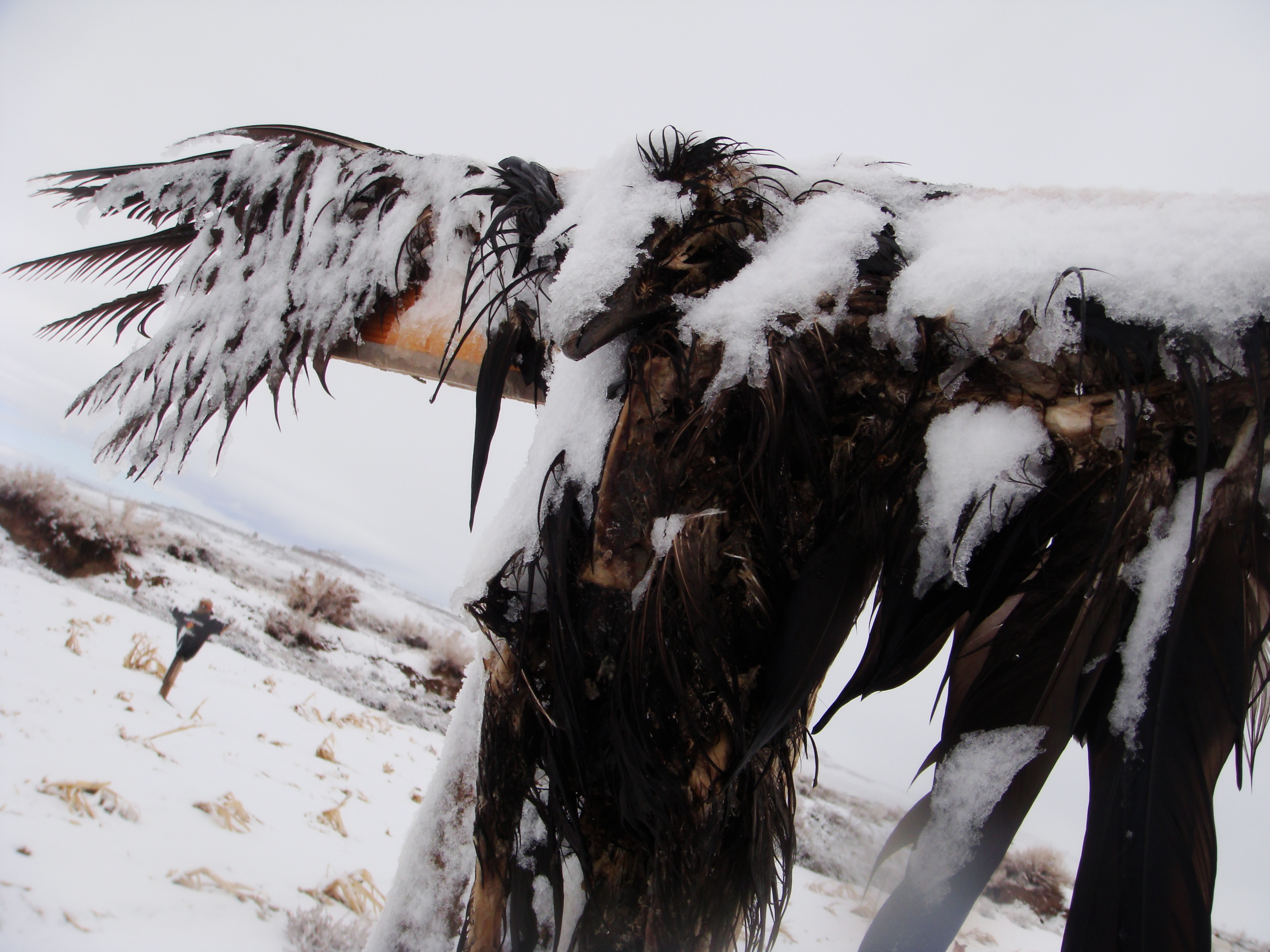
A farmer once told me that he crucified the “crows” in his field because, he said, “Crows are like Navajo. They’re afraid of their own dead.”
Funny. True on some counts, but not on others. First off, the things hanging in his field are ravens and not crows. Secondly, I’m sure the ravens can recognize their dead. And they probably know to steer clear. But isn’t that a sign of a higher intelligence? And shouldn’t intelligence of any sort be respected? And then there’s the likening to Navajos. In contemporary Hopi culture, they’re seen as raiders and thieves. I can’t speak for the Navajo, but the ravens out there are as much a part of the ecosystem. And though Hopi trump all other human occupation on the plateau, the ravens were here long before the Hopi.
But in some ways I get it. Crucify the bird. Set an example. But do it with prudence. And attention. And thoughtful care.
I transplanted vegetable starts last week. Within an hour the chickens had decimated them. Chickens and children willfully trample our gardens. But our first instinct isn’t to haphazardly kill them and hang them in a corn field.
And christ, if you’re going to kill it, at least know whom it is you’re killing. Know it by it’s name.
No. Our first option should be to figure it out. In the garden incident, I erected a small chicken wire barrier around the vegetables. In another, I might discuss the matter with the child.
Isn’t it our responsibility to protect without killing? If not, what are we then, but beasts?
Easy enough.
In recent years, what have we learned about them?
They may have more distinct vocalizations than any other bird. Some believe they may have a highly developed language. Although they’re frequently confused with crows, they are distinct both in a behavior and appearance: they’re larger, have longer more pronounced beaks, a bearded tuft beneath their chins. They raise their young for up to two years. They have extended family units and complex social networks. They can distinguish friend from foe and can share this information with other ravens.
They’re omnivores, but primarily feed on carrion. That means they keep things clean. They eat grasshoppers and rodents that feed on corn.
But them just things I’ve heard. What have I personally observed?
At times when I’ve approached a nest filled with fledgelings, the male (I assume) has shadowed close (within 15 feet) making loud distress calls. The female remained in the nest guarding the brood. At other times, both would follow me with loud calls, chasing me away from the young.
Over the years, as I’ve worked in the yard in the early mornings, the mating pairs have settled on light posts and observed me. When I’ve called to them, they’ve responded. Some mornings they approach and call out during their flyover.
When we first placed the young ravens on our ramada, the parents responded to their distress calls. Since then, they’ve made multiple flyovers, seemingly observing their young.
The parents have relocated to the wash and have joined the nesting pair there. At times I’ve seen all four perched in the cottonwood, collectively staring toward our housing a quarter mile distant.
The young at our house each have distinct personalities: Poe, the recluse. More, the insistent. Never and For hunkered together like twins. They display affection toward one another and toward us. When spoken to, they respond with vocalizations.
They’re curious. And keen observers.
But there’s more.
Serendipitously, they’ve also provided a new lens through which to observe the world. Through their personality and behaviors and all they’ve summoned, new realms, ideas, relationships, phenomena have risen in sharp relief.
So listen for them. And observe. Perhaps the best we can do is to follow their call.

Raven Dusk © Kerry Hardy
 Snowflakes Edge