
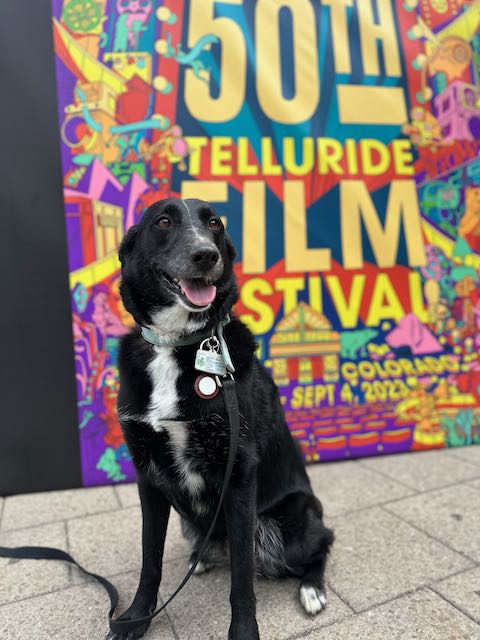
For fifteen years now I’ve been lucky to work at the Telluride Film Festival each Labor Day weekend. It’s all a bit strange. A little bit Sesame Street, whizzing around town on a pink townie bike checked out from the library, running into friends from over the years. A little bit of Same Time Next Year as thousands of people (guests and staff alike) reconvene to share the changes in their lives and bask together in immersive stories inside darkened theaters. A little bit of glam – lots of chance encounters and conversations in line for coffee. A little exhausting (15-20 films in 5ish days). And a lot dreamlike – you’re at altitude already feeling a little wonky and all those stories bleed into one another.
For those interested, here are some recommendations. My most favorite were the small ensemble films with just a few characters. And good news: as we are driven more towards our home screens and hand held devices, a good number of these take great advantage of the large screen and the power of communal viewing.
I’m happy for those in LA, Seattle, New York, and other places that have strong art house theaters. You all should be able to see most of these.
Tehachapi: French artist JR enters Tehachapi prison in California to work with inmates to create large scale portraits of them in the prison yard, their eyes turned skyward. Crushing images from inside the facility (typically you can’t even enter those places with a pen or paper or even wallet, let alone with a film crew. Ultimately about the redemptive value in treating others as human.
Daddio: A conversation between a cabbie (Sean Penn) and his passenger (Dakota Johnson) in a 45 minute cab ride from JFK to midtown. Filmed entirely inside the cab. Despite it’s miniature premise, it blows up on big screen with the intense chemistry between the two characters. Lots of the story told simply through the looks in Penn and Johnson’s eyes as reflected in the rearview mirror. The screenwriter called it her love poem to New York. It moved me to tears.
All of Us Strangers: A ghost story with a twist at the end. Lonesome gay man in empty London apartment building begins to visit his long dead parents. Fearless performance from Paul Mescal, lovely appearance of Jamie Bell (Billy Eliot) and Claire Foy as the parents. Mournful throughout, and deeply sad in the end.
Taste of Things: This was a sneak not listed in the program. From Trân Anh Hùng, the director of Scent of Green Papaya, a mouthwatering intersection of the sensuality of food intertwined with the sensuality and love between people. About the love between a kitchen cook and the gourmet chef with whom she works. Long, patient sequences in the kitchen of the preparation of intricate meals from scratch. A textbook on how to eat and how to live. I saw it the first time standing in the Pierre theatre. I wanted to leave after the first ten minutes because it was so gorgeous that I couldn’t bear seeing it without Anna. But I couldn’t walk out because I was standing next to the director.
Zone of Interest: In its quietude, one of my hands down favorites. Apparently the director Jonathan Glazer was so traumatized by the poor reception of his film Under the Skin at Telluride ten years ago, that he vowed never to come back. I was, I regret to say, one of those who savaged that picture. After seeing this, I want to go back and revisit. The Mill Valley Film Festival I believe wrongly describes this Auschwitz film as portraying “the tragedy through the blinkered perspective of the monsters who orchestrated it.” I resist descriptions of Auschwitz as “evil” and the perpetrators as “monsters”. Once we remove lived historical events from our understanding of normalcy and relegate the participants to non-human status, we necessarily suggest that bad unthinkable things are only perpetrated by non-humans, or beings not like us. It falsely privileges us with “goodness” and by extension removes us from moral culpability.
The sad truth may be, that not unlike the architects of the concentration camp system, we go about our daily lives blithely engaging in or actively contributing to all sorts of acts of death and destruction (factory farm systems, petrol economies leading to civilization destroying global warming, exploitative labor practices, or willful assassination of civilians based on the color of their skin). Like us, many of the perpetrators actually believed that they were doing good, until some of them may have dimly realized that they were not. The film focuses on the foreground — dinners, playing with children, trying on clothes — while the true story occurs in the background — odd smoke in the air, a cough, a crying baby, screams somewhere in the distance. Like with Daddio best seen in a theater with a big screen and a superior sound system.
Wildcat: Ensemble performance directed by Ethan Hawke and starring his daughter Maya and Laura Linney as a young Flannery O’Connor and her mother. Hawke and Linney seamlessly move between portraying the O’Connors and characters in O’Connor’s stories as they begin to emerge within Flannery’s consciousness. 95% of the dialogue is drawn from O’Connor’s stories and her prayer journal. A meditation on creation and faith.
Anselm: Wim Wender’s stunning documentary about the post-war German artist Anselm Kiefer. A very small number of you will have access to the 3D version. If so, I urge you to go, and for those who don’t, it’s still worth seeing on the big screen. Kiefer’s work is of such scale, or in such places that few of us will ever have the chance to view them firsthand. Over the course of the film, as we descend into the vast labyrinth of his studio outside of Paris, and eventually the 200 acre Barjac site that houses much of his work, we feel as if we are winding our way through the fiber of Kiefer’s consciousness itself.
Kiefer’s work is a vast and single-minded exploration of the consequences of the things depicted in Zones of Interest. How can you paint a landscape that has been shattered with lead and sown with the bones of the dead? And how and into what can we transmute the those experiences so that we can live again? His life’s work is an attempt to answer those questions.
Others
Poor Things: Brave performance by Emma Stone. Frankenstein meets A Room of One’s Own and garbed in steam punk. Vaguely reminiscent of Paul Bowles haunting short story “Here to Learn.”
Perfect Days: Did not see. But rave reviews for Wim Wender’s second film at the festival.
Holdovers: I loved seeing Paul Giamatti (I love him in just about anything) as a priggish Ancient History teacher at an elite New England prep school in the 1970’s. Giamatti, the son of former Yale University president Bart Giamatti, channels the rarified academic family he came from. The grainy wintry period piece feel from Alexander Payne uncovered certain perennial aches in my soul.
El Conde: Bunuel kind of absurdity with Pinochet and Margaret Thatcher as vampires. Now streaming on Netflix.
Food Inc 2. Another necessary polemic against the gravely immoral commodification of life that is foundational to the immoral factory farm system that most of us tacitly and blithely get much of our food from.
NYAD: I love Jimmy Chin’s documentaries, but less so his first dramatic feature. Annette Benning plays well the severely unlikable Diane Nyad, but despite their great talents as actresses, I found Benning and Jody Foster’s performances and the story overall to be cartoonish.
The Royal Hotel: This is one room you definitely want to get out of. Especially for those of us who have young daughters. Two young travelers end up getting jobs at a bar in the middle of the Outback and slowly realize they are in far deeper than they bargained for. I feel sorry for Julia Garner. What must it be like to know that any time your agent calls, you are going to have to do something really bad, or something really bad is about to happen to you? I would call this a great uncomfortable movie that made me never want to go to Australia ever again.
Saltburn: The Talented Mr. Ripley meets the British class system and Oxford. The first 20 minutes gave me a big fat stomach ache as I remembered my first few weeks at Yale. And it ends up not being the movie that you think you are watching at the beginning.
The Monk and the Gun: Bhutan learning how to have a democracy. How do we make morally pure choices in times of societal inflection? Delightful to be in another, more slow, perhaps more innocent world. If only for just a few minutes or hours.
Teacher’s Lounge: I would strongly recommend that all teachers see it. And I would not recommend that any teachers see it. Well meaning new teacher in Germany accuses a Turkish student of thievery. Severely discomfiting picture about how sometimes we are wrong when we think we are so right. That by doing right you can do wrong. And sometimes those who do wrong are right. Those who are coexisting in the Teacher’s Lounge are in a pretty yucky mess as the screws in this film tighten.


 Snowflakes Edge