7. The story of the third forest

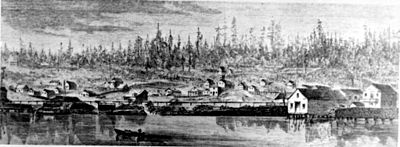
Yerba Buena Harbor, 1853

Patience yet.  In due time we’ll get to the Boat.  We still need to finish with the forests.

The story of the third forest

Once upon a time, through a series of ecosystem successions, great hardwood forests emerged on the eastern seaboard. The first Europeans to experience the woods were astonished at the almost park-like feel – the result of centuries of thinning and burning of the understory by the native inhabitants who each spring would clear the woods to make it easier to track and follow game. The Europeans experienced grassy glades shaded by maples and conifers, their trunks an easy ten feet in diameter.

We all know what happened, of course. Within a couple hundred years all of New England was timbered out – by the 1800’s 98% of Vermont had been deforested and the land turned over to sheep and dairy. A chunk of that wood made its way down to the McKay Shipyards in Boston and Kennard & Williamson in Baltimore where it was refashioned into clipper ships, vessels so strongly masted and engineered that they could cut around Cape Horn with record speed.

These were the ships that carried the miners to San Francisco after 1849.  When they set port in San Francisco Bay, their crews jumped ship by the droves and headed up into the mountains to work the gold fields. With no one left to sail the ships back, and the investors and owners left holding the bag, that forest of masted clippers and schooners floated idly amouldering in Yerba Buena Harbor, a nation of hardwood that was gradually dismembered and refashioned into the parlor houses, cribs, gin joints, and Victorian filagreed domiciles that graced the city.

That was until 5:12 a.m. on Wednesday, April 18th, 1906, when the ground shook so fiercely that the city of San Francisco collapsed and the gas lines burst into flames.  Within days the Great Fire had consumed over 25,000 buildings.

In a strange arc, those wonderful ancient forests tended by the Algonquin and Abenaki, and tendered by hundreds of years Atlantic nor’easters, as well as vast stands rounding Seattle rooted in tons of salmon flesh, came to be consumed in a holocaust at the gateway to San Francisco Bay.

But not all of the wood burned.

Regardless of what forest or what ocean she came from, some of that wood fashioned of steelhead and moutain fiber made it’s way to a spot of land newly parceled out from the Blucher Rancheria in newly incorporated town of Sebastopol in Sonoma County.  The boards were stacked on the open meadow on the knoll at the crest of our ridge.

One morning in 1901 or 1902 a few sawyers and carpenters arrived and, through their hands, the Room of Requirement wrought as ocean, and then as wood, in all cases ferrying whatever was into Safe Harbor, entered it’s Third Incarnation.

5. The Room of Requirement: The Second Incarnation

Stumptown

The Room of Requirement was built of wood, not water.  How did that come to be?

The story of the first forest

The Russian River opens out to the Pacific at Bodega Bay just northwest of here. From there it winds easterly and northerly through Monte Rio and Guerneville.  It’s fed by many small tributaries, including one, Salmon Creek, that has it’s origins near the small town of Occidental.  For thousands of years, The Chinook would run up the Russian River much as they still do today, depositing themselves in the pools and on the sandbars to spawn and to die. Bear and other predators once ate their carcasses, leaving much of the fish on the forest floor.  The fish provided nearly a quarter of the nitrogen taken up by the riparian forest.  The ocean became fish.  And the fish became trees.

The wood for the Room of Requirement could have been milled near around here in the heavy first generation forest that once layered much of West County.  The first sawmill was built in Guerneville by John Heald, William Willits, George Guerne, and John Bagley.  The first three of the men would go on to establish towns of their own.  Who knows what went south with the fourth?  Nonetheless, they worked with such intent felling the giant redwoods, that the surrounding area eventually came to be known as Stumptown.  Other mills sprung up:  six in Occidental, one in Freestone, many of them supplying timbers for the nascent narrow gauge railroads that were extending their tendrils north.  And once the railroads were in place, the wood could be shipped to the still infant metropolises to the south.  By 1901, however, that area of the Russian River watershed had been largely deforested and many of the mills shut down.  Thirty years prior, so many old growth redwood grew here that the region may have had the densest biomass on the entire earth.

Seattle deforested

The story of the second forest

Or the wood for the Room of Requirement could have come down from the timber stands near Seattle.  Seattle was a late comer in the Anglo settlement of North America. The Denny Party didn’t land in the Puget Sound until September, 1851, but in short order, some members of the pioneer group set the saw blades spinning.  At that time the entire Sound was blanketed in 2000 year old fir standing 400 feet high.  Nothing like that exists in the world today.  Here too, the stands of trees were seasoned and nourished by the vast flow of nutrients that each year swam seasonally up from the Pacific.  Near uncountable number of Steelhead, Coho, and King had over the millennia born a treasure of maritime wealth in their bodies, coursed it up rock and rapid to lay it rest in the woods of the Pacific Northwest.  Functionally the fish were a way to transport potential energy from the ocean upstream in the system and back onto land.  Eventually much of that energy stored in timber mass, through human agency, would find it’s way back to the ocean and to new distant shores where it would one day be released in a conflagration.

Initially the wood was harvested up on the ridge lines of Capitol and Beacon Hill and then slid down on skids (in order for the logs to slide smoothly, the skids were greased by the original grease monkeys, a well-equipped and perhaps racially-tainted slur) to Henry Yesler’s harbor side mill at the base of the slope. There the logs were cut, loaded onto large timber ships that ferried the wood to San Francisco where it was devoured up by the Gold Rush building boom. The muddy timber camp, most likely the first skid row, was a sloppy mess of a place lined with bars and piled with rowdy lumbermen, windfall buckers (those logging mercenaries hired out to buck the worst of fallen trees), sailors and drunks.  Subsequent generations civilized the area into Pioneer Square, but it never really shed it’s cantankerous bearing. A hundred and forty years later on a cold spring Seattle night, Kurt Cobain stood up in a sweaty bar room in the OK Hotel in Pioneer Square and sang for the first time, Smells Like Teen Spirit.  The band was originally called Skid Row. A few years and name changes later, they had become Nirvana.

Grunge music, of course, leads us inevitably to the Story of the Wawona.