Vaccines

At a recent gathering I stepped into a dispute about the efficacy of vaccinations for children.  I haven’t been paying too close attention, but I guess there’s been a growing backlash against vaccinations.  Anti-vaccine adherents have cited studies showing a causal tie between vaccines and autism (the data which was later shown to have been falsified), or are driven by a general distrust of Big Pharma. Some believe that vaccines may actually compromise our immune systems, by making them “more dependent on outside drugs” and less robust.

Well, here’s one.  In a widely cited study of measles and pertussis vaccinations and outbreaks in Colorado, CDC researcher Daniel Feikin discovered that children who went unvaccinated were 22 times more likely to contract measles than vaccinated children.  That’s perhaps to be expected.

The interesting kicker is that the unvaccinated children were actually vectors for measles outbreaks among children who had been vaccinated.  Schools with pertussis outbreaks had three times as many exemptors. The chances of there being an outbreak in a county basically increased with the number of vaccine exemptors.  Believing that they had the right to tend to their own bodies how they saw fit, anti-vaccination proponents put the larger community at risk.

As Dr. Feikin noted, “A single unvaccinated child in a community of vaccinated children holds a strategically opportunistic high ground, protected from risk of disease by herd immunity while avoiding risk of exceedingly rare adverse events associated with vaccination. Yet, when too many parents want their child to be that child, the entire community is affected.”

The final grace note?  My wife is a doctor within Kaiser.  Where do the greatest number of unvaccinated children in the Kaiser California system reside?

Marin County.

One of the most affluent community in California chooses not to vaccinate their children.  They’ve never seen the effects of measles or polio.  What risks can those diseases possibly pose?  So they opt out, thinking it won’t affect the larger community.

A national study shows that unvaccinated children come from well-educated, upper income, predominantly white families.  And in Colorado?  It’s San Miguel County, home to the wealthy and largely liberal San Juan ski towns.

Take that cake and eat it.
Frenchie

Mid-day I went down to visit Frenchie, our neighbor next door who had come home to die.  Her daughter called because Frenchie needed to be moved and the daughter wasn’t strong enough to do it.

Frenchie is 88, a feisty Quebecois.  Her husband, now gone, was from Montreal.  Over half a century ago they had bought their cottage in Sebastopol as a weekend retreat and eventually moved up here.  She was a devoted gardener who waged perennial war on the gophers.  She held dominion over this area as residents came and went and the old Gravenstein apple farmers grew old and went on.  In later years she filled her home with stuffed animals to keep her company.  Her menagerie, she called it.

Frenchie lay on a bed in the living room, hooked to an oxygen tank.  She still had fire in her, and when prompted she could eke out a yes or a no and a fierce yet gentle smile. You could feel the shimmering though, the giving way:  her struggle was palpable. I stayed for a bit, and told her she was beautiful and strong.  She was a lovely lovely woman.

It was a beautiful California day that felt to me strangely gray.

That evening Anna and I went to hear Jolie Holland at the Hopmonk. A founding member of  The Be Good Tanyas, Holland came out of the Gulf Coast and her musical heritage has broad Acadian roots.   I told Anna I felt so fragile, that I could feel Frenchie slipping such that any loss, even the closing of the damn record store in Sebastopol, felt like a sharp abrasion.  It just felt so sad.  Holland’s voice was sublime and provided some measure of relief, but nonetheless Anna and I were tired and we got in one of those kinds of fights that leave one drained and aching.

I fell asleep at home and awoke at 3 and couldn’t sleep.  My chest compressed with that feeling of blank dread. I went downstairs and lay on the couch in the darkness, waiting and observing.  I dreamt that I was on my way to Telluride but a snow began to fall and impeded my progress.  The ache slowly dissipated.  At some point I felt a release and opening up somehow and I fell into a thick slumber.  At daybreak the dogs went mad with barking and raced to the windows.

Later Anna came and pulled me from my stupor.  We should go see Frenchie, she said.  I threw some clothes on and we walked down the road.  Her son Louie stood in the dewy yard by the fence.  She died this morning he told us.  It’s funny, the others had all been dying lately.  One 88 year old neighbor just last week.  Frenchie was the last to go.

I later explained to Mazie that it’s like we’re a fabric, each person a knot of sentience in an immense dense weave.  And as any one creature starts to go, unravel, whatever, the area of fabric around the knot shifts and shimmers and vibrates as that knot is unraveled into the nothingness.  The description is of course not quite right, but perhaps close enough.

I lit a candle for Frenchie and let it burn for most of the morning.  What is a flame, but the release of matter over time as light and heat and disintered material?  A flame, be it life or fire, is again a verb, less a noun than a process.  And when the time came, my breath pressed against the flame struggling to hold purchase on the wick.  But the energy of the process couldn’t withstand the prevailing force which always is and it gave way and eventually extinguished.  How does a flame go out?  First there is the sequence of when it waves and bucks and bows. Followed by a brief flare before disappearing.  The ember tip of the wick remains for another moment, burning yet before it too goes black.  Then the long trail of whisping smoke that unfurls into space tracing designs and patterns until quite suddenly that too is gone.   We are left with the dissipated carbon dioxide to be absorbed by plants and in quick cycle returned to life.  And the inert stick of wax awaiting the next spark.

This Life We Were Born Into

I just got off a crackly broken phone conversation with my friend, Bill Scheffer.  It seems that more often than not that’s how they are these days.  He was taking his lunch break from his work in planned giving for Planned Parenthood.  He was somewhere amidst the cacophony of midtown, walking between work and Chipotle’s searching for a salad.

I was sitting in the sun on our back porch in Sebastopol looking out toward the oaks and overgrown garden beds.

I thought to myself that Bill should move to California and do development and planned giving work for Spirit Rock, a Marin mediation center that may be mid-stream in a large capital campaign.  But I shied away from suggesting it to Bill, thinking to myself that “that’s not the life he was born into.”

And it’s not.  At least I’m not sure it is.  For Bill, family and friends are very important.  And for several generations his family has been deeply steeped in Manhattan.  He has lived there, and he’s grown up there.  His rich network of friends and his spiritual life are centered in New York.  Most of the lines tethering him to this world are anchored there.  Moreover, like many of us, his parents are near old yet and it’s more important than ever to remain close at hand.  That larger body needs him.  It doesn’t matter how nice the job is:  I might as well suggest that Bill move to Mars.

What then of the rest of us?  I once dreamt of entering the foreign service. Or something like that.  I studied Russian.  But it was never going to happen.  I wasn’t well enough equipped coming out of the starting gate.  I didn’t have the temperament or the know how.  No matter how much I wanted to escape, I had my own wrecked family tying me to California.  I had my own past tying me to my own brand of dysfunction.

My classmate Fareed Zakaria was born to be Fareed Zakaria.  I can safely say that I was not.

Which begs the question as to what life I was born into.  And to that, I unfortunately don’t have much of an answer.  An array of weird experiences and encounters that if not culminating in, have at least deposited me here on this sunny morning in California, not knowing even which way is up. Which is a strange state of being for 47.

It begs a larger question:  For all of us, that disparate and manifold and brilliant sparks of sentience that we are, what is this larger life that we all more or less were simultaneously born into?  What hope that we ever truly will divine the texture?

Birthdays

When I was thirteen or fourteen my mom told me she would kill herself on my eighteenth birthday.

Which she did.  More or less.  Except the matter is a mess more complicated than that. So much so that I’ve spent a lifetime cracking and shying away from it’s telling.

And so today I’m sad.  Today is a lovely California morning.  The one we all were born to live for.

Streets of San Francisco

A few nights ago my family and I raced through Chinatown on a Chinese New Year Treasure Hunt.  Amidst pandemonium, explosions, dancing dragons, strip clubs, smoke and disaster, we cut through the crowds and down darkened alleys trying to decipher small clues on historical placards and scrawled on concrete walls.  It’s the hottest ticket in town.

What I liked?  It twists your sense of geography as you gyrate up and down the streets from angles. It keeps telescoping your attention from the macro (what street do we go to?) to the micro (a tiny date on a sticker posted on a mirror in a small stairwell leading up to Grant Street.  It’s one of the ever fewer activities in this world that renders our devices largely useless.  It’s all about pun and metaphor and the deciphering of a physical environment that is best done by humans.  It leaves you racing against a surreal dragon.  And best of all it makes you feel like Karl Malden running through Chinatown trying to catch a kidnapper or short circuit a bomb plot.

A rare gift to even have the chance to pretend to be heroic.

Beings

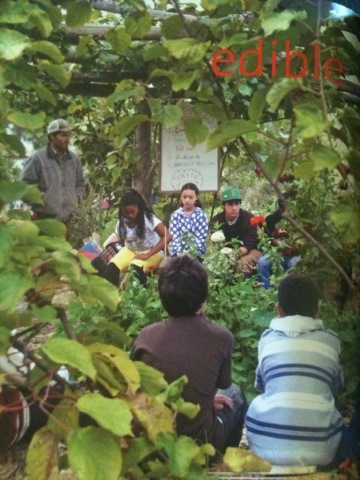
This picture was taken at the Edible Schoolyard at the Martin Luther King School in Oakland. It’s the sort of place I would love for my daughter to go. In the picture you can see a handful of young human beings sitting in a garden surrounded by young plant beings. Vines curl their tendrils around the beams of the ramada, flowers break open their blossoms, canes send forth their berry.

Both the children and the plants are at school together. They are all learning. They are all peers.

The young human beings nurture the young plant beings. When it comes time for the children to eat, they take the body, the leaf, the fruit, the seed, the progeny from the plant beings and ingest it. Their own beings use the energy from the plant beings to grow and emerge.

Ideally, their own waste – the carbon dioxide they exhale and perhaps even their own shit – one day may become food for the plant beings.

That whole process is what we call life. It’s a verb: to be.

Quite tragic and beautiful, really.

20120213-130400.jpg

The 30th Anniversary Party

A few weeks ago I was reading the book commemorating the 40th anniversary of Chez Panisse.  It’s a beautiful compendium of photographs and memories from the Chez Panisse family, illustrating the force of that restaurant and Alice Waters and the tremendous effect they both have had on what we eat and how we do so.  I think I’ve loved alice since she first entered my frame.  But now I think I’ve fallen absolutely in love with her.  As well as with her fantastical mercurial impossible visions that again and again have become her and our reality.

And I especially love the delightfully sour entry by her former general manager describing his experience at the 30th anniversary celebration at Berkeley back in 2001.  A small meal for 150 became a feast for 600 chefs and patrons and filmmakers and artists – a soft leisurely afternoon beneath the Berkeley campanile that would evoke the spirit of the Pagnol films that long ago had inspired Waters. In the planning phase, Gilbert Pilgram, the former general manager of the restaurant (and eventual owner of Zuni) kept asking how they would manage the clean up and Alice repeated with ever more irritation that “it was taken care of.”  After the big fête, everyone else had retired to the after party and Pilgram was left largely alone with a handful of Tibetans and sullen teenagers to clean up the mess.  Very little had been taken care of.  And so they toiled away exhausted and alone until the sun rose the next morning.

We may not be able to have a decent life without Alice.  But we can’t have life at all without Gilbert Pilgram.