Chickens

Have we talked about chickens?

Let’s talk about them.

20111230-183057.jpg

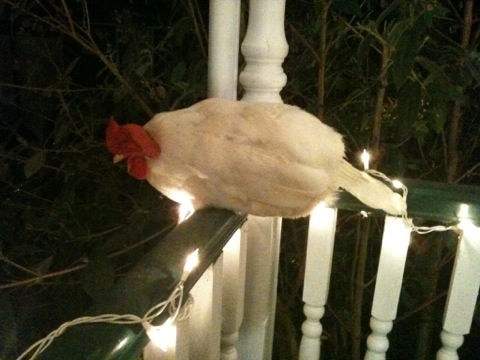
This is little white chicken. We don’t really have a name for her, so that’s what we call her. She’s also the sole survivor.

She started in a brood of five. All of her siblings were taken out by other animals. She was joined by a black Austrolope who was taken out as well. And then later we added three Bardrocks, all gone. She’s basically an Auschwitz survivor.

I’m writing about her because four weeks ago she took to roosting on the front porch. Up until then she was totally happy roosting in her coop. For two years, at dusk each night she’s gone in there and put herself to bed. It was fine. But four weeks ago her last sister was taken out by a dog right next to the coop. Ever since then, she’s been afraid to go to sleep in her customary home. So instead, at dusk, she goes up on the porch and puts herself to bed on the railing where it’s much more safe.

Let’s think this one through. She’s a chicken. But she prefers this to that. Even more fundamental, she can discern this from that. That means she has discernment. And she has preferences. Preferences and discernment define sentience. She is aware.

Furthermore, she doesn’t go near her old home because she associates it with the death of her sister (she was besides herself the morning it happened). She had an emotional response. A bunch of neurochemicals kicked off inside her. It doesn’t matter whether those neurochemicals expressed fear or sadness or anxiety. She felt something and associated that feeling with an event. She has chosen to sleep somewhere else because she will be safer. She feels and she is self-aware.

On Tuesday morning, I heard her going nuts in her coop.  I looked out the window and saw the two dogs that killed her sister running about maybe 600 feet distant. They were hardly visible, let alone a threat.  But she appeared to remember.

Each day she goes over to play with the chickens next door. She prefers this. Then she comes back with them to have a little party at our house. They eat and scratch through the compost pile. She prefers to be with other chickens. She craves the social interaction. She is a social animal who finds pleasure or safety or satisfaction in being with another living creature similar to herself.

In the evening the chickens return to their respective homes and put themselves to bed. And it begins all over again the next day.

Granted, she would have a hard time building a rocket ship. But then again, so would most human beings.

When can we stop privileging ourselves over others?


The Boat

As far as this story goes, the boat’s journey began on the back porch of Arlo Guthrie’s farmhouse in Massachusetts. It had sat there for a lot of years. I don’t know how Arlo came to have it or what his plans were. Apparently he doesn’t really like the water.

His friend Jack, though, loved boats. He once took the thing out on Arlo’s pond that was hardly bigger than a small room. And I guess Arlo said Jack could have it.

So Jack drove the thing from Massachusetts to Colorado on a flatbed trailer and the boat pretty much sat upside down on someone’s property for a lot of years and then it was driven down to Palm Springs where it sat upside down for a lot more years. Jack may have floated it in a swimming pool just to see what it was like.

Eventually the boat came to Tomales Bay where it weathered untended to for more than a decade. The gunnels rotted out as well some of the sidings. It had once been a lovely Penguin Dinghy much like a boat that Jack had once owned that had been swept away in the great New York hurricane of 1953.

Just before Thanksgiving my boat building friend Brett was driving down the 1 toward Bolinas when he spied a prickly pear cactus adorned with fruit. He pulled over, got his tongs and gloves and set to gleaning a bag of fruit. He was interrupted, though, by a winsome woman, a complete stranger, who seemed to have materialized out of nowhere.

We need help, she said. We need to save Jack’s boat. She suggested that it was in some sort of imminent danger and that she needed assistance.

Well, I’ve worked on boats, Brett offered. He looked around at the neighboring docks on the bay. Where is it? he asked. I can come over and see what I can do.

The woman looked at him incredulously. The boat’s not here, she said. It’s in Sausalito.

Okay, Brett said. Give me Jack’s phone number and I can call him and I can see what I can do.

The woman became very unnerved. You can’t call Jack! she exclaimed. Everyone wants to talk with Jack. Jack calls you!

So she took Brett’s number and told him to wait ten minutes and the call would arrive.

Which it did. And by the next day Brett was in a Sausalito boat yard listening to a day full of boat yarns and traveling history and loading the boat onto a trailer hitch and towing it to Bolinas. And a few days later he was at our house standing outside the chicken house with a sack of apples in each hand, staring in reverie, wondering what our plans were for the chicken house.

Our friend Evan Nichols the writer had christened it the Room of Requirement. Everyone who stepped inside was possessed by a different overpowering vision. For Mazie, it was the ping pong hang out room. I saw a cider pressing and cheesemaking facility. Evan saw a writers retreat room. His wife Amy saw a yoga room. Anne Harley envisioned a singing studio. The vultures have found it quite useful as a dinner plate.

And Brett saw a boat restoration house.

The room is one and all of these things.

And that’s how last Monday Jack pulled up in his three quarter ton truck pulling the boat. And that’s how Arlo Guthrie’s penguin dinghy came to sit inside our chicken house. And why I will spend a better part of my winter sanding and planing and painting wood.

Because if you do things right, all of this, every bit, is required.

The First Feeding

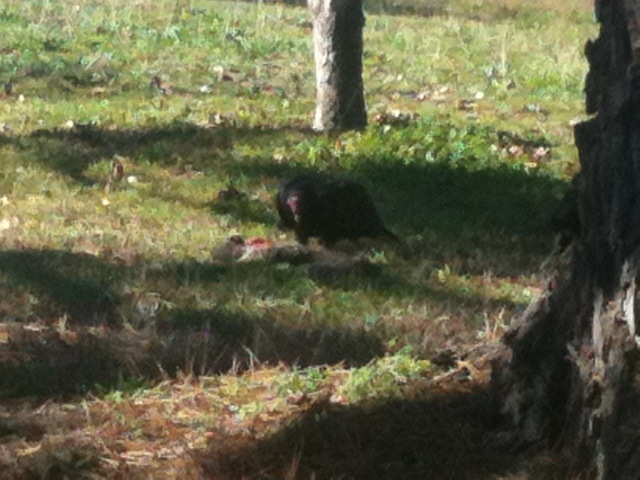
20111222-124051.jpgThe turkey vultures have come to feast.

It took three days. But they’re here now in full force. And it’s been quite the party. They circle low and Mango loves chasing them. Even the horse down in the corral down the way became excited. Our neighbor came over and was wondering what had gotten under his skin – he was prancing and snorting, his tail held high. The vultures, however, had been circling and feeding for much of the morning. In addition to the impression of their tremendous mass, what feelings do they incite in other species? The horse was clearly unnerved.

What other conjecture do the birds summon?

  1. They are patient, keen observers. The splayed open body of the raccoon rested on the roof of the chicken house for two days before I noticed the first flyover. It was near dusk and two vultures flew slowly over the chicken house, circled once and continued on their way. They waited another two days before they began to work the body. I wonder how much they observed before they decided it was safe to eat? And do they use the close flyovers to test the animal to see if it’s still alive? Living creatures tend to run and bolt at the flyovers.
  2. They have at least some semblance of cognition and work their food. They didn’t feed on the roof. Instead one of the birds lifted the raccoon corpse off the roof and moved it 7 feet to a spot on the ground where they could easily circle and rest while picking at the flesh. They ate the first side of the raccoon on the first evening. The next morning they rotated his body a full 180 degrees to more easily get at his other side. Later I moved the remains and hanging entrails to the tree outside our house. Within hours they had removed the body from the tree and once again were working it on the ground just outside our dining room window. Do they have a set routine in how they will dismember and eat an animal?
  3. They may be highly social animals that work collaboratively. So far I’ve seen a primary pair that are sometimes accompanied by a third. Only one bird eats at a time. The other two either perch in the tree, on the backs of the garden furniture, or sit on the ground. In all instances they face outward toward the open meadow, watching it seems for any advancing threats. This morning when the neighbors pit approached from the meadow, the feeding raven stopped and joined the other two gazing outward. As the pit advanced, the birds slowly took flight. Two of the birds seemed to have disappeared for the day, while one remained in the tree. When my friend Danny walked outside, the bird descended from the tree and circled the carrion raccoon as if protecting it. Was the bird guarding the food? Or was it taking flight in self-defense? How do they communicate? How are responsibilities divided among the group? Is their a pecking hierarchy?
  4. They may have an acute sense of hearing. I was watching the birds with binoculars from our dining room window. At some point my cellphone sitting on the far side of the room in the kitchen chirped when an email came in. The turkey vulture outside and 10 feet from the house started and looked up in my direction. I know for certain that I would not have been able to hear the phone from outside the house. How to test their audial and visual acuity?
  5. They can quickly discern friend from foe and react accordingly. The first few times I walked outside in their presence they were startled and flew away. They watched, however, when I retrieved the raccoon and relocated it. And they also watched a couple times as I walked in and out of the house without bothering them. It only took a couple passes before they became accustomed to my presence and ignored me. Mango with all his bark and scampering on the other hand, is another story.
  6. Their necks and beaks may have adapted to small prey. Watching the vulture pick flesh with it’s beak, I thought of the vultures on the Mara. The birds there have long extensible necks that they thrust deep into the chest cavities of the wildebeest, elephants, or whatever other megafauna they feed on. North America hasn’t had megafauna for at least 15,000 years and nothing on the scale of what was in Africa. Did different carrion birds evolve different beak and neck structures that would allow them to feed on different kinds of animals? Have carrion birds evolved different strategies for dismembering corpses? I would imagine that an adult vulture has a far keener understanding of raccoon anatomy than I do. They’ve undoubtedly feasted on dozens of roadkill.

There you have it. Twenty minutes of observation and six questions.

And I haven’t even planted the garden bulbs. Or assembled the apiary.


20111222-124114.jpg


20111222-124211.jpg

Where We At?

20111219-094009.jpg

In broad strokes:

We’re set on a low ridge about 18 miles inland from the ocean. We’re high enough that the ridge holds back the maritime fog and moisture, yet close enough to the coast that we escape the summer heat of the valleys to the east. There’s lots of water.  Artesian springs seep out all along on this slope, while atmospheric moisture rides in as fog most mornings.

The San Andreas fault – that neat crack marking where the Pacific Plate abrades against and is peeling away from the North American Plate runs just to the west of us. Coming down off the ridge, you can actually see the gash in all it’s violent beauty. You can even drive into it. As you approach the coast, the rounded hills bunch up like crumpled tissue. As you push out you emerge into the narrow strait of Tomales Bay where the ocean has seeped into the San Andreas. Just across the water rests Point Reyes, slowly calving away from our continent at a pace at which we can actually feel it. I hid out there last month, and from the rocks at dawn I watched the tidal pull and stared back at that old land from which I was then receding.

By another designation we’re in the Green Valley sub designation of the Russian River appellation. We have soft sandy soils. The cool moisture and the more moderate temperatures make us good for Pinot and perhaps Chardonnay, though I don’t know much about that.

Just to the south the ridgeline gives way to a wide channel that draws the moisture inland from the Pacific toward Petaluma. That swath, buffeted by cold winds in the winter and summer, is marked by high undulating grassy hills best suited for dairy and grazing. In the spring it looks a bit like Ireland. That’s where you find loads of goat farms, Bill Niman’s beef, Straus milking cows, the Cowgirl Creamery and a wide range of artisinal cheese makers.

But where we are to the north it’s considered the banana belt – a perfect marrying of temperatures that near anything can grow here. Luther Burbank’s original farm sits about two miles to the north. There he developed hundreds of new varieties of apples, stone fruit, cacti, vegetables, ornamentals and what not. He supposedly thought it was the most perfect growing environment in the world. The land we sit on has grown cherries, prunes, plums, apples. It can support Meyer lemons and blood oranges. Figs and olives and grapes and walnuts. Peaches, nectarines, lettuces, winter brassicas. California oak acorns and redwoods. You name it.

And by yet another designation, the north of us is home to a vestigial group of Algonkian speakers – Yurok and Wiyot left over from the ancient middle incursion onto the continent. They most likely stayed put on the coast while their relatives pressed onward to the east, ultimately populating the entire eastern seaboard. The Algonkians are surrounded by a once heavy population of Athabascans – later arrivals from the third migration. They had come down from the Alaskan interior and the Arctic circle, having left their Inuit and Yupik cousins sometime way back. Resourceful opportunists they filled in the territory in north eastern California. Their De’na relatives pushed further, of course, down into Idaho, Colorado and the Southwest. To the south and east of us, it’s mostly Uto-Aztecan, the domain of the Paiute that ranged into the Sierras along with many of the central valley Sonoran tribes: Colorado indians, the Chemehuevi, Mojave. Some were Quechuan. But most, like the folk down south on the coast – the Kumeyaay, Diegueño, Cahuilla – are mostly cousins of the Puebloans – all folks left behind on the great historic primary migrations from the south.

As for us, we’re living on Pomo and Coastal Miwok land. Back in the day, winters were spent on this ridge line where we now live. In the summer, families and clans settled on the perimeter of what is now called the Laguna de Santa Rosa – the enormous seasonal estuary that extends from Petaluma and the Bay tidal marshes all the way up to the Russian River and Dry Creek Valley. The lagoon is the heart of this place. In the summer, the flat oak studded grasslands extend across the valley to the Mayacama mountains and the delightful hump of Mount St. Helena. In the winter, the tidal reach and flooding extends right up the valley, inundating the land near to the Gravenstein Highway. The lagoon is rich land. Our food comes from there. Literally. For the time being we get our veggies from Laguna Farm – a group of industrious folks who have intensively planted a small area on the edge of the lagoon. Right now we’re getting radishes, kales, chards, brussel sprouts, broccoli, an abundance of salad greens, carrots – most of it hauled out of those wetlands or the areas planted on a knoll adjacent to our house.

I was born in California. It’s my native land. And now after decades away we’ve returned as Californians. I explain to my daughter that this ultimately is the place which we are from. But we also return as guests of those residents that preceded along with all those energies still present.  In the morning after the fog burns, I look out the window.  The possibilities are manifold.  The world sparkles in all it’s glorious frission.
 

The Host and the Kill

20111219-091557.jpg

Time to get back with the program.

I found him in the morning while walking Mango. He lay on the side of the road at the other end of the 40 acres, his body fully intact. His chest cavity still had a trace of warmth, though rigor mortis had started to set in. Without any real clear intent, I picked him up, much to the chagrin of a waiting turkey vulture that immediately took flight.

I thought he was beautiful. He was heavy, heavier than one might think. Carrying his dead body, he felt something like a small dog. The pelt was thick, and the tail less pliable than it looks. His teeth and claws are predatory, ready to sink into any small vole – or wounded raven, perhaps – that he might happen across.

It all led to the basic question that ultimately faces everything: how best to send him on?

I could bury him, though that seemed respectful only in our world in which we seek to hide the look and stink of death. A waste of a perfectly good carcass, as Kerry Hardy would put it. I could gut him and do something with the luscious pelt, but I felt his native form was too beautiful to render into ornamentation. I could only screw it up. Kerry suggested eating him. Anna, of course, was worried about hydrophobia.

It took a good day for the answer to present itself.

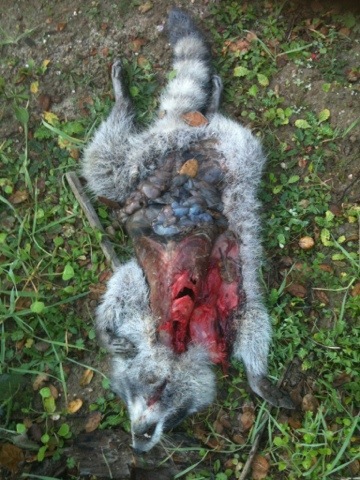
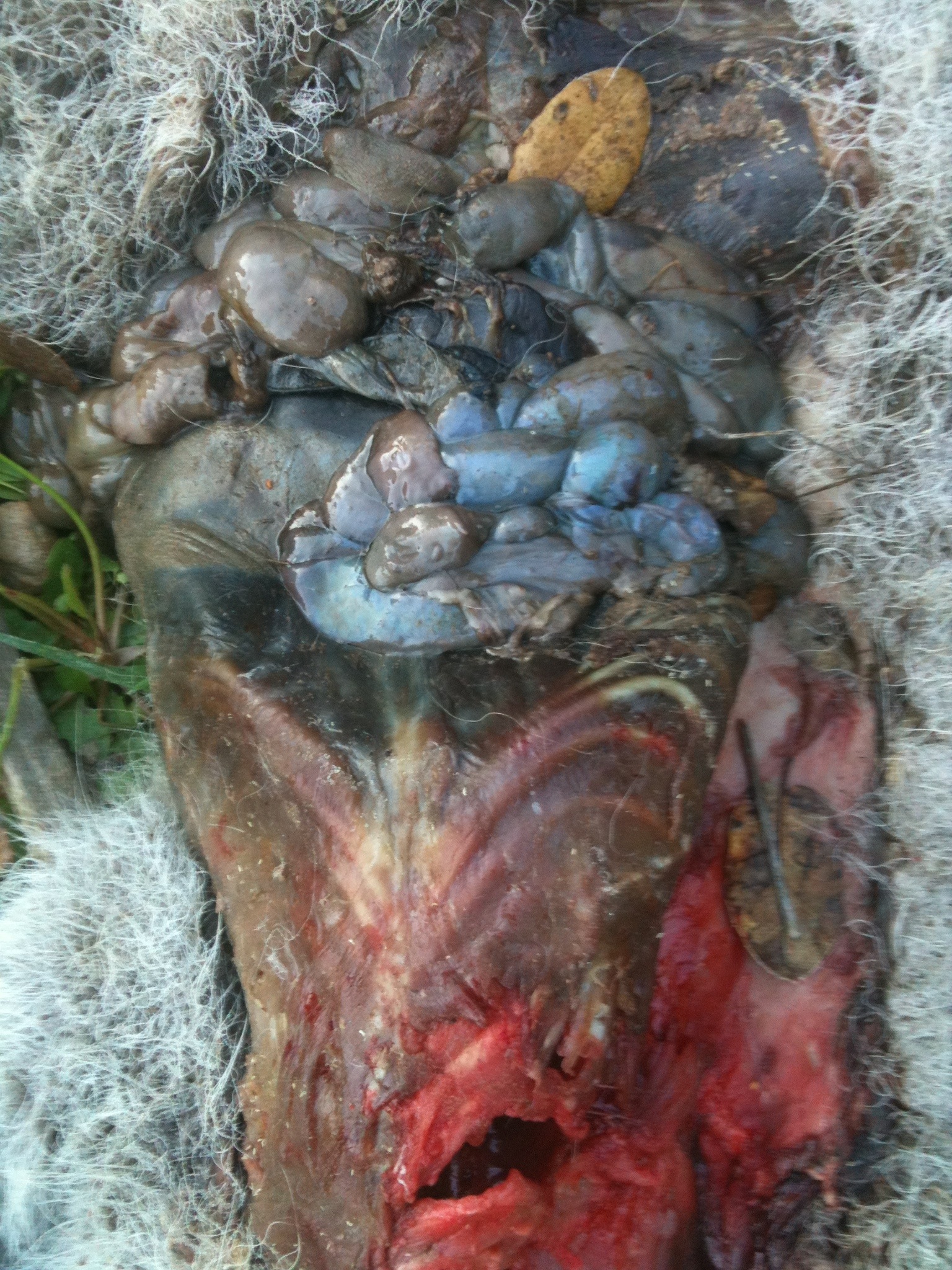
This morning I drew a knife neatly down the middle of his chest and peeled back the pelt revealing the rose bloom of his chest. Lacking animus, his body now existed nearly exclusively as matter. But not quite. His matter still contains resident within a potency. We call it vitality. Enough that other creatures may seek to take it and draw it into their own.

We call this eating. On one side of the divide: sacrifice. On the other, rendered by consumption, it becomes the sacrament and the eater the sanctified.

Isn’t that ultimately what it meant in the transformation of the Host?

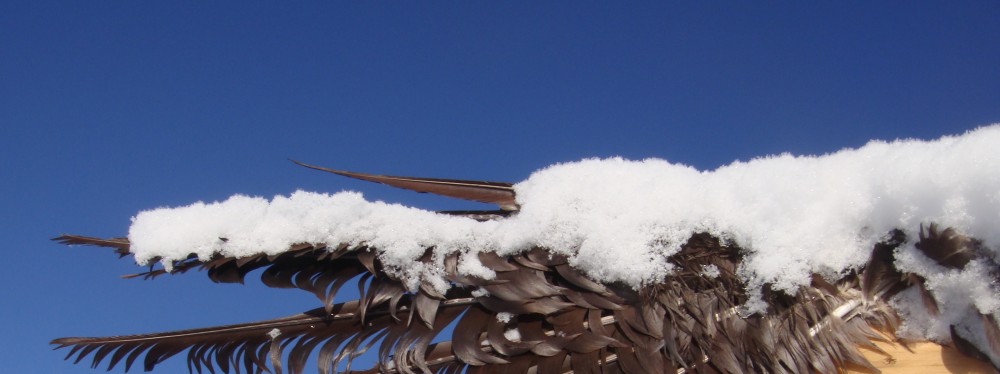
I took the body of that poor coon and splayed it on the roof of the old chicken barn out beyond our house. It’s within clear line of sight of our deck and bedroom windows. In a few days it will begin to stink.

If I’m lucky, the neighboring creatures will be hungry enough to overcome the fear of this place and of us. You all are welcome here I say to them. To the ravens. To the crows and vultures. To all the scavengers. I want them to come to this home and feed.

It really is time for me to get on with it. We have a wonderful home. And I’m back in it.

Here’s the invite. If you’re wild, I’ll feed you raccoon.

For the rest of you, I have a table to build. And things to grow. And kill. And render. It will be beautiful and delicious.

Come. You’re all welcome. It’s time to sate the hunger.