15k in Therapy

Something got into our yard this morning and decimated the chicken flock.  The black hen dead, the two Plymouth’s carried away, the Yellow Leghorn freaked out.

I’m done.  Done with neglect.  Done with rabid dogs.  Done with unnecessary death.

I spoke with my friend Patrick yesterday morning.  He called me the prophet of loss – all that which has occurred and that which is yet to come.

He’s right.  I stood on the Sonoma plaza looking up at those California oaks and I realized he was absolutely right.  It’s the story of my life and my writing voice and all I really care to think about.

All of that loss.  And more to come.

Yet who are we without it?

Faultlines: James Acord

James Acord is dead.

I thought of him while sitting on the Sonoma town square.  No reason in particular, really, but I thought I’d look him up.

He committed suicide on January 8th of this year.

Acord was the subject of one of those 60 page New Yorker profiles way back a lot of years ago.  He was a sculptor who ultimately completed only a handful of works:  Monstrance for a Grey Horse, a few reliquaries, and a large portfolio of fine drawings of seedpods and nests and the like.

And yet the breadth of his mind and spirit were immense.  He was at heart an alchemist who sought to transmute base unstable material into, well, something safe and eternal, into something else.  He wanted to build a container to hold the sacrament of our age – nuclear material – and he dedicated decades of his life to the planning and carving of the Monstrance.

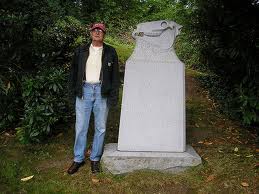
He spawned in me my affection for Barre granite – the hardest, most inert rock on earth.  And he gave me faith to at least contemplate the big idea – the vastness of time or the true nature of materials.  For years I’ve had a manila folder with his name on it containing information about him and his works.

I looked him up for some reason in Seattle back in 2001.  He had just returned from a teaching gig in London.  He felt gentle and doe-eyed and a bit forlorn and a bit suspicious, wondering why I wanted to talk with him.  He talked about the bus system and he needed some rides around town, I think.  Something about him felt off – he was living in Pioneer SQuare and he couldn’t quite hold his thoughts together and I realized something had happened to him between the carving of the Monstrance and now.  It was as if the power of those things he was working with was too strong, and in the face of it, unlike that Barre granite, his consciousness had begun to shatter.

Ultimately he lost the strength to carry on.  How strange to think of those hard crystals chiseled by his calloused hands, the malignant grin of the horses skull, of how it will remain yet, carrying forward for thousands of years into time a small vessel of highly radioactive uranium.  One day it will be opened by nature or by beast.  And that transformed material into this world will once again be released.


Raven Cognition. Raven Food.

I’ve been trying to feed Poe industrial hamburger meat (from Circle M).  It’s the only time I’ve ever seen one of these ravens spit food out.  And we call it fit for human consumption…

Call it the end result of what we call civilization:  Advanced Meat Recovery.  In a modern day slaughterhouse, they  blast a carcass with a high pressure hose to recover any last bit of flesh and gristle and then churn it into hamburger.   Or as Kerry said, it’s what you do after you’ve already taken the lips and asshole and served it up to some poor unsuspecting consumer.

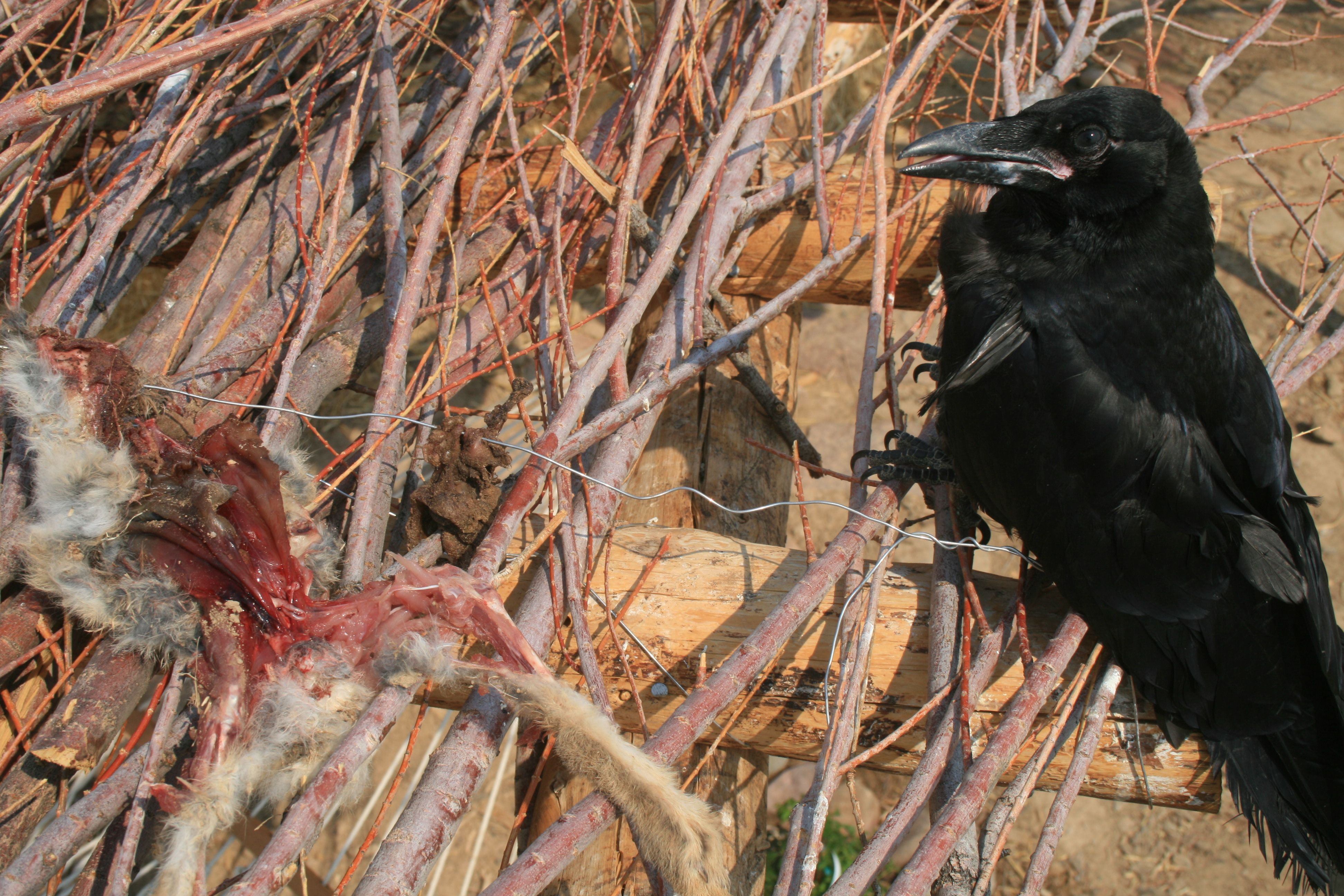
This morning Kerry brought over a dead rabbit that his dog had caught.  He fastened it to the top of the ramada and placed Poe proximate to give him a chance to pick and feed in a more raven like way.

He also set out to retrieve the other two ravens from the wash.  But as he stepped away from the yard (us conversing loudly all the while), we saw two lone figures making a swift approach in the distance.

Sure enough, it was Never and More.  They soon circled the yard and alighted on the fence near Kerry.  They kept bouncing and circling around him.  Amazing window into their cognition.

  1. Ravens recognize Kerry as a source of meat. This idea has persistence in their brains over many days.
  2. They recognize his voice as distinct from other voices.
  3. They associate his voice with him.

Not receiving food from him, they took to the ramada where Poe was, but they boosted away from him and the carcass pretty quickly.  Again:

  1. They showed a fear of a new foreign object.  A dead one at that.
  2. Death is scary.  That is, until we recognize it as food.  Then all is fare game.

Kerry brought his hand beneath the carcass.  The other ravens caught the gesture, squawked and flew back to the ramada.  He fed some rabbit entrails to Poe, they observed. He tried baiting Never and More with intestine, but they wouldn’t take it.

  1. They need to learn that a carcass is food.

How long will it take them to learn?  If the parents were present, would they teach or model behavior and would the ravens learn more quickly?

  1. Poe began pecking at the carcass.  Never and More squawked.
  2. Never and More gave their danger squawk.  We looked outside and saw Lola approaching.
  3. More grabbed rabbit entrails and took it to the ground.
  4. Poe continued feeding and Never ascended to observe.  He later flew down to join More.
  5. More, however had cached his meat on the ground.  Never found the meat and began to taste it.  I’m sure that caching is a sign that an object is of interest.  If More cached something, it must be good, it must have value.
  6. Never and More got into an intestine contest.
  7. Poe continued at his chowing up top.
  8. A lone adult perched on a lamppost facing us and called out in four short repetitive, gutteral trills.

Neighbors wonder if the ravens are hanging out at Kerry’s now, looking for food.  Folks don’t get that we have complex relations with these birds, that they come and go and fly about based on a whole set of variables.

The house sitter thought at one time taking them to the wash was too close if our goal was to make them go away.  Again, she missed it.  Our goal is not to make wild things go away.  Instead it’s to reintegrate these birds back into their environment and ecosystem.  That ecosystem includes the Wepo Wash, the other flocks, the parents, and to a limited extent, Walpi Housing.  For years the mating pairs have been doing flyovers, observing us, perching on the lamp posts, scavenging nest materials form our yards.  It’s fine that the birds come here, as long as it’s within the context of the larger environment and they’re capable of surviving on their own.

I hear the other young calling out in their playful sing song from somewhere out in the wash.  Never and More playfully follow the motions of the dancing hummingbirds.

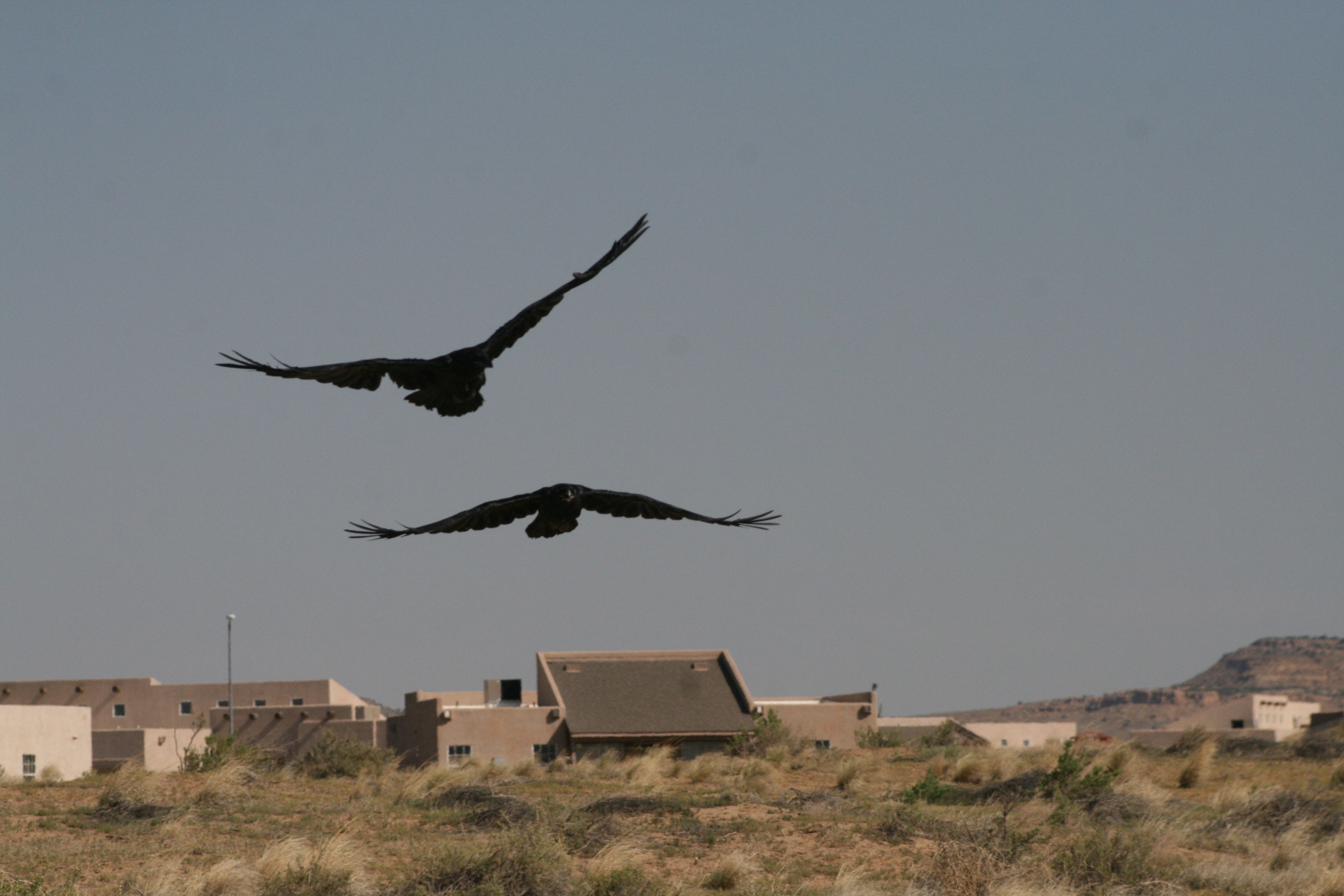
The young flock approaches and circles and dives above our house, calling all the while, and eventually break apart and disappear to the south.

As I sign off, Poe has descended from the ramada.  Never soaks in the water.  More explores the yard.  Two hummingbirds circle.  the Plymouths rest in the shade.  The two other chickens scratch by the honeysuckle.  Two doves hang on the fence.  Lots of flies (call them pollinators).  Mango sits at my feet, watching it all.

Going Wild

More and Never didn’t roost at home last night.  But we think we know why.

While on his run yesterday, Kerry spied six ravens in the wash tributary by his house.  He displayed some raw elk meat (leave it to a downeaster to be running around with raw meat in his pocket), but none of the ravens were interested.

Later though, after he had fetched Poe from the wash, two split off from the pack and landed right next to him.  For the second day, Poe and More had been hanging with the adolescent flock!

Earlier I thought I had heard the sing song call near our house which now seems quite possible.  The new routine for Never and More now includes some house time (they like picking through the chicken feed and hanging with Poe), and lots of away time.  They’ll come and go during the day.  When they get bored at our house, they’re just as soon to take off and maybe check out Kerry’s or to go off elsewhere, presumably with the other birds.  If they can keep it up, we all will be quite happy.

More questions, though.  What’s the normal routine for the other adolescents?  Are they always in a pack?  Do they split off into singles and pairs as well for part of the day and then recongregate?  Are they roosting communally?

Do they perhaps have a set feeding period in which they all split off to find food individually (less competition for a single resource)?  More and Never know right away where there’s some good pickings – they can get free water and lots of scavengy refuse from the yard and compost.  They also like the chicken feed.  The other birds may go off in different directions and catch as catch can.  They may then recongregate in the afternoon for hang out time.  Lots yet to figure out.

As for Poe, we’ve decided that  since we’re no longer leading More and Never to the wash, he might as well stay at home in the yard to recoup his strength.  If More and Never are out and about, he’s basically alone down there and it doesn’t seem to push him to develop strength.

He’s a sitter and observer.  At least in the yard he has the stimulation of the other animals.  And the approaching dogs sometimes keep him moving, which is good.  We also have more chances to incent him to flap his wings and get a move on it.  I fear, though, that he may be settling into his crippled mode and perceiving himself as disabled.

That dang bird.  I love him so.

I’ll have to look into adaptive skiing programs.

Poe Learning © Andrew Lewis

Hay Fever (and climate change)

It’s not the hay, though.  It’s the ragweed.  Ambrosia artemesiifolia or Ambrosia psilostachya, both from the Sunflower family.

I’ve had ever-worsening allergies here at Hopi for the last five years or so.  Last summer was the pits – Kerry even had to give me a lift to Flagstaff (my eyes were swollen shut) just to escape the pollen.  Keep in mind, I’ve never had allergies until now.

The cause?  As best I can tell it’s the ragweed.  And the Russian thistle (a brush against the plant causes my arms to break out).  And also perhaps lodgepole pine (up at Vail the second week of June, I’m a runny, congested mess).

Yeah, yeah, yeah.  We’ve all heard it.  And we all have allergies.

Which is my point exactly.  In the last few years, it seems that everyone here is walking around with itchy red eyes, swollen faces, and congested sinus.  Hopi Health Care ER is full of it.  And this year I’ve done my own informal survey, asking every checkout clerk in Flag, every person in a chance conversation, etc. if they have allergies.  The answer has been uniform, 100%.  Yes.  But not like this.  Or not until now.  Or never this early.  Or it is way worse then I’ve ever experienced.  100%.  Not one person (out of perhaps 100) answered differently.

Hmm.

I asked the pharmacist in Walgreens about it.  “There’s probably some pollen or something in the air that they’re allergic to,” she said.

Now there’s a waste of eight years of education.

What’s interesting is to have a widespread allergic response at Hopi.  They’re an isolated, genetically uniform population that have been living in this environment for over two thousand years.  By now folks would have either adapted to allergens native to the environment.  Or if they had always been this severe,  I doubt people would have settled here in the first place.

So at a birds eye view, what’s going on?  Non-native invasive species (ragweed and russian thistle) have moved in.  But that happened with grazing and land disturbance at least a hundred years ago.  What’s happened in the last few years?  It could be diet or lifestyle related – think homeopathy.  Bodies were once able to cope with local allergens because folks spent most of each day out on the land and had exposure year round, as well as consuming micro quantities through the local food.  Now people are holed up inside in cubicles or watching TV at home.  But it still doesn’t quite add up.

The best answer through my lense came from Bill McKibben a few weeks ago in his book Eaarth.  It’s climate change.  According to McKibben, a recent study showed that ragweed grows 10% taller and puts out 60 percent more pollen with increasing temperatures. Ten of the hottest years on record have occurred in the last 13 years.  In addition, the pollen season has extended because the growing season is longer.  And ragweed pollen can travel hundreds of miles.  It doesn’t need to be growing here.

What holds true for ragweed may hold true for other plants.  A friend who was in Beaver Creek this last month (and is normally not prone to extreme allergies) was a mess.  She described walking through “storms of pollen raining through the air”.

Which means climate change isn’t going to just result in trivial disasters like super cell storms, class 5 hurricanes, severe flooding in the upper and lower midwest, 365 straight days of rain in Columbia, and massive tornados wiping out Joplin Missouri.

All of our eyes will be swollen and itching, too.


Quoth not the Raven

I heard a new sound from the wild ravens today.

When Never and More returned (or so it appeared) with the four wild ravens, the four adolescents called out in a delightfully sweet sing-songy call.  Even after they settled in the desert 50 yards from the house, the continued to fill the air with sound.  Never and More, however, sat mutely on the fence.

According to Heinrich, ravens may have the greatest number of vocalizations out of any other birds [Any readers who’ve gotten this far have to check out Ravens in Winter].  But he also cautions that we shouldn’t get sidetracked by this idea of “language” as a sole proof of cognition.  Animals (including humans) can have (and communicate) symbolic or visual ideas without expressing them through “language”.  What’s key here might be whether the birds can use sound and motion to communicate intent and information to influence the behavior of their peers.  Clearly they can.

Our ears here at Walpi Housing have detected at least 6 distinct vocalizations.  There’s the loud relentless hungry call.  They would do this as young, their mouths gaped open, yawning to be fed.  Then the defensive/aggressive call used to scare away an intruder.  It’s feels like a shrill growl and is sometimes accompanied by a circling and prodding forward and falling back (imagine a boxer baiting an opponent in the ring).  Third, there’s the gentle gurgle when being fed or recently sated.  Fourth, the call and response murmur. It’s like a brief purr, or the “hmmm…yes…hmmm” that you get from a good active listener.  Fifth is a conversant squawk.  I squawk, you squawk.  But it’s not aggressive and more like a loud animated conversation between friends.  Except that they know what’s being said and we don’t.  And now lastly, the playful, sing-song call.

Of course, I would bet that these birds can say a hell of a lot more than that.  I’m just slow at learning raven.  As with prairie dog speech [Also check out the great NPR/Radio Lab story on prairie dogese], their language could possibly include a range of microtones that our ear can’t detect.  Their language could also include accompanying behavior or gestures or the simple (and complex) modeling of behavior.

Our birds have largely grown up feral:  they’ve been removed from raven society and have had to grow up in a human/cat/dog/chicken society.  Although we’ve done our best to feed and care for them, any well-meaning raven equipped with a cell phone would have long ago called CPS.

We are totally unskilled at communicating the wealth of information and skills a parent raven would model and teach their young. We can’t fly, let alone fly efficiently.  We don’t know good food from very good food, from bad.  I can’t build a nest with my hands let alone a beak.  And though I can pretend, I can’t talk raven.

Of course, that’s not entirely true.  Inter-species communication revolves in part around communicating intent.  And that may or may not involve words.  It may happen through creating a “sense” in one’s mind and being, and letting that sense communicate itself (through sub-conscious behavior or telepathically or whatever).  It sounds wacky, but how many times have you walked into a room, seen someone and recognized immediately, I like that person.  I want to be with them.  It’s Malcolm Gladwell’s “first handshake” – that the majority of your impressions of a person are formed within the first five seconds.

Or take our recent time away.  A nervous house sitter stepped in and the household slipped into chaos.  The cats ran away (for 15 days!), Mango the dog was afraid to go out, the stray busted into the chicken coop, and the chickens stopped laying.  Ravens wouldn’t allow the house sitter to approach, while Kerry could just saunter up.  Then we returned.  A few minutes of meows and calls by the hospital and the emaciated cats poked their heads out from the culverts.  Chester the stray returned to his characteristic abeyance.  Mango perked up, and we’re back to two eggs a day now.  We’re back to a peaceable kingdom.  How is it that our presence can communicate “all is well, all is safe” and balance be restored?

Think also of Cesar, the Dog Whisperer.  Or better yet, the original Horse Whisperer [the recent documentary Buck is a must see].

So back to the sweet sing-song call of the ravens.  I heard it from the four wild ravens, but not from Never and More.  It could be that they were wary, or didn’t yet know the social cues that would help them fit in with the crowd.  But it made me wonder about the language instinct and language acquisition among birds.  I hazard that something like the language instinct is there; even without the influence of the parents, the ravens share information.  Hungry birds call out shrilly (imagine the nerve-rattling quality of a baby’s cry).  Or dog approaches Poe, and Never and More call out defensively.

But what of more nuanced communication?  Like humans, do ravens have a critical period in which the parents can jumpstart the language acquisition ability, and if they miss the window, the birds won’t be able to get it?

I think of the girl Genie [check out the classic New Yorker article by Russ Rymer]   who in the 1970’s was raised in far more feral conditions than our poor ravens. She spent the first 13 years of her life locked in a room tied to a potty chair.  Her father beat her and silenced her whenever she attempted to make a sound and other family members were forbidden to speak to her.

Genie grew up without language.  And despite being strikingly intelligent and communicative, she could never learn how to communicate her ideas through speech.

What of our birds, then?  We’ve spared them from grievous abuse (as far as we know), but have the poor things missed a window that would have allowed them rich communication with their fellow birds?  Why should emergent neural pathways in a highly developed and socially oriented avian brain develop any differently than that of a human?

I want their fellow birds to ask them.  And what if they can’t answer?  What if quoth not the Raven?  What if Nevermore?
Mowgli

This morning, Poe alone in the yard.  No Never.  No More.

In the west toward Floyd’s field, a mile distant, I heard a few calls.  I suspected it was More and Never, but wasn’t sure.  Two days ago on the walk back from the wash, a solitary raven did a fly over.  Poe (in my arms) was the first to catch sight of him and struggled excitedly.  One of our ravens observed where the wild one landed and flew over to join him.  The second raven soon followed.  Never and More had taken off to join one of the wild ravens.  Since it was solitary, we assumed it to be one of the parents.  And there they remained together, all three flitting about in the desert and getting acquainted.

At dusk, Never and More returned and settled in for the evening.

So now, this morning, I have little doubt that the two are off with their new found friend.  But lo, what do I see approaching?  What appear to be six adolescents, dipping, soaring, circling around one another as they approach the house, all the while calling out playfully (more on this in the next post).  I step to the back yard just as four of the ravens settle onto the rise beyond our yard.  And there are Never and More perched on the fence.  The wild ravens continue to call.  It’s not defensive, but more like a summons:  come out and play, join us, why are you sitting on the fence?  But More and Never don’t respond.

I swaddle Poe and set out toward the wash, hoping the other two will follow, (as part of the on-going experiment, I don’t overtly lead them with food this time, waiting to see if they’ll just follow Poe) but they remain where they are, tired perhaps from their morning exertions.  The four wild ravens, however, follow (and lead) us out, and eventually settle in the brush on the far bank while I put Poe in his customary place beneath the tree.  I feed him and he turns to face in the direction of the other birds.  I also leave meat out for them, hoping to attract them to Poe.

I feel like a doting parent trying to introduce my child to new friends on the first day of pre-school.  Please, I want to say, he’s a good bird.  Please, will you be friends with him?

Poe, Alone

We’re trying to help the ravens return to their kind.  But it’s hard.

They’ve all had a good number of Wepo Wash days.  We have to carry Poe, but Never and More will go back and forth between our house and the wash at will.  At dusk, though, they return home to the ramada to roost.

Yesterday was blazing hot.  We were to be gone into the evening and so didn’t take Poe out because we wouldn’t be able to retrieve him before dark.

Never and More didn’t leave either, though. Instead they chose to hang around with Poe.  It could have been that it was just too dang hot (all the birds sat around, following the shade, their mouths gaping open as a cooling response).  Or it could have been that they enjoyed being in close proximity to water.

Or perhaps they just wanted to be with Poe.  A couple times when one or the other of the dogs approached him (Poe tends to hang out on the ground), the other two alighted near by and cawed defensively.

When I returned that evening though, More and Never were nowhere in sight.  For the first time, they chose not roost at the house.  A good thing, I thought.  But that left Poe, alone, roosting on the back of one of the porch chairs.  The dogs sniffed at him and he was safe, but I thought it not good for him to become too comfortable with our house.

I carried him over to a log leaning against the ramada and he clambered up it in an ungainly way.  It wasn’t too comfortable of a roost and he had to work to stay balanced, so I brought the ladder over and he soon alighted on that.  He took to his customary habit of staring off silently into the desert, as if awaiting for someone or something.  He’s one to always look out, away from even his siblings.  I wish any of you could experience his gaze, so solitary and at once both hopeful and resigned.

I lay in the hammock, looking up at the stars.  And I talked to Poe.  And he murmured back.  I felt sad and worried for him, stuck with my meager human company.  He needs to get better.  He needs to fly.  Or soon he will be left behind, first by his siblings and then the other ravens.  And then even by us.  It felt too unjust.  Too undeserving.  And with only that, he and I continued to wait.  We stared out into space and that deluge of stars.


Truth & Amanda Knox

I’m not an Amanda Knox watcher.  Although I did read the first lurid account of the murder (sex orgies, drugs, good girl gone bad while abroad in Italy, etc.), I haven’t followed it since.

But yesterday I happened across the Rolling Stone article on her appeal.  Juicy, juicy, juicy. And alluring and sad.  We don’t know what the hell went on in that flat that night in 2007, but by any measure there’s more wrong with the prosecution’s case than is right. What’s more cogent a story: naive well-mannered girl from Seattle wrongly implicated in her roommate’s murder, or that once out from under her parent’s wing she fell under satanic influence and partook in drug fueled orgies?

All other friends of the murdered girl lawyered up and left the country.  Knox blithely stayed to answer questions.  She became the object of a muddled interrogation.  She signed a typed confession in Italian (which she could barely understand).  No evidence linked her to the scene of the crime.  A convicted perpetrator has confessed to the murder and stated that she wasn’t present.  Accusations of satanic ritual have come from a prosecutor who has charged defendants in three other cases with having performed satanic acts.

And then you have the tabloid industry that has fed tirelessly on the girl (and sold tons of pulp as a result).  And the British sport of maligning Knox speaks more of a general anti-americanism and displaced anger at our role at sinking the global economy.  Woe to Knox for deciding to go abroad just when the market began to crash.  We in the world want blood and, in the last few years it seems, we’ve been dining on hers.

If only Arthur Miller were alive today.

As I read the article though, I thought too of my own daughter, and even myself at 19- at my proclivity to sing out loud or at times be inappropriate – and how easy it is for someone young to the world to wander into a situation that is far out of their league.

And this thing we call justice is less about truth, and more about martial campaigns to twist the sentiments and perceptions of a jury or judge and spin a narrative that will inflame the imagination.

Knox’s family is on appeal.  They’ve hired a new legal team.  And also a media manager.  Coverage in support of her is ramping up.  God help them.