Cages

A recent visitor asked what sort of cage he would need to keep a pet raven.  What to say?    Except that we can’t own another living thing.  No animal.  No plant.  Not even our children.  I was about to say “our own children.”   They are autonomous forces moving freely through the world.  A raven was born to fly.  Humans were born to walk.  Not live in cages.  Not stay at home forever.  Would we consider caging our own children?  How then could we do that to a raven?

Let’s be honest though.  How is our raven experiment truly any different?  The ravens stay at our house even though they’re not caged. They may end up staying because we feed them. Or because they sense this a safe place.  Or worse yet, because they are learning to be with humans and not their own kind.  In which case we will have erected a far worse cage – the one that exists in their own mind.

By extension, what cages have we erected about ourselves they keep us from doing things?  The should’ves.  The have to’s.  The “it’s easier”.  Or more comfortable.  Or we don’t know any different.  Or “it’s what everybody else does.”  Or it’s always been that way.  Or the huh – I don’t know.  Never thought about it.  Or I’m scared.  Or the I don’t know how to.  Or my own kind vs. their own kind.  Or my ideas.  My own mind.  Your own mind.  Us.  Them.

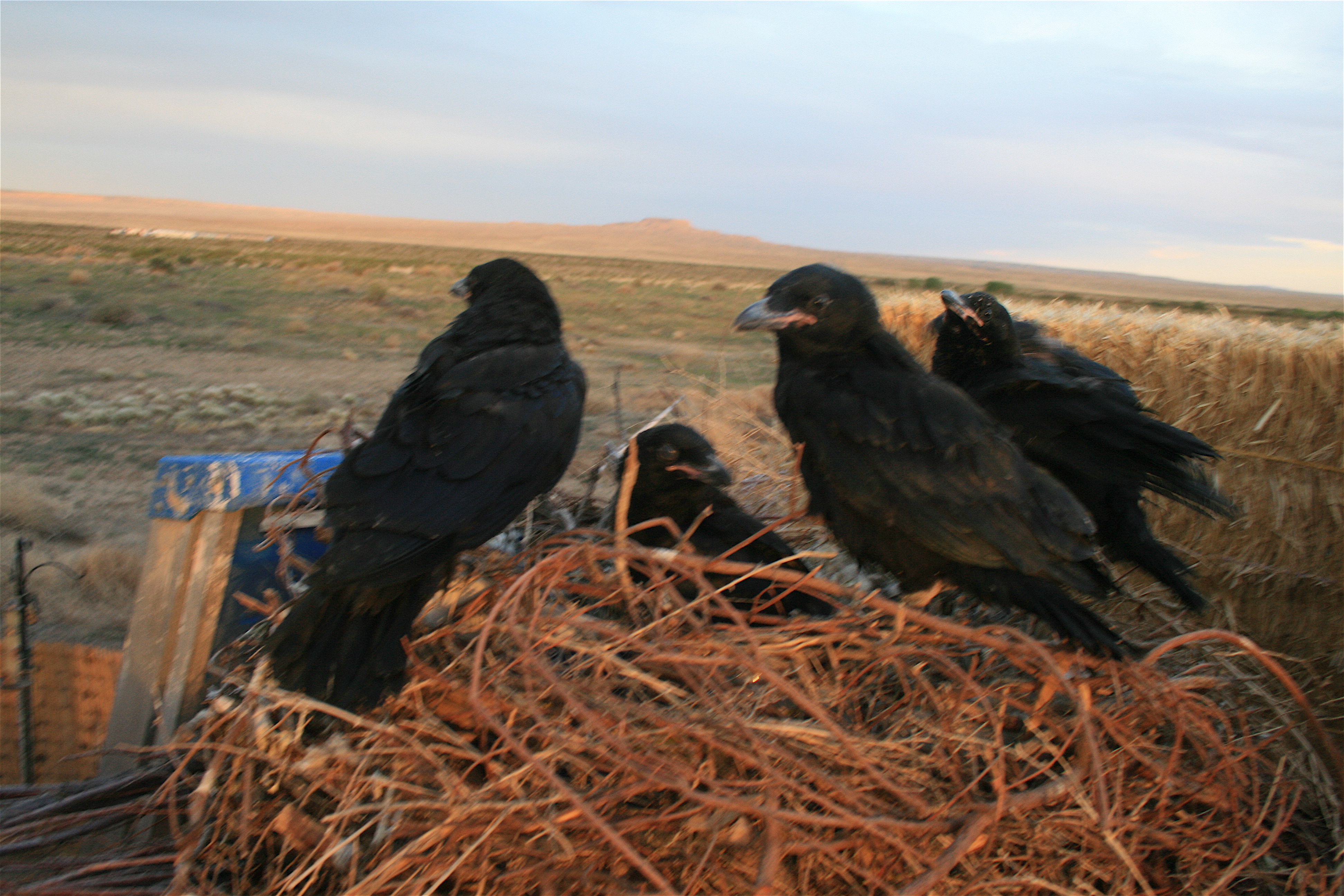
Categories are learned behavior.  Other learning would result in other categories.  We often pass learned behavior off as knowledge.  But this knowledge doesn’t exist a priori as an absolute truth.  It’s the framing of the universe through the senses and experience and information available to us.  Other species with other sense organs or physical experiences may perceive it entirely differently.  A raven raised in a yard only knows the yard.  The ravens in the wash, why they’re wash ravens.  Their neural pathways, if only slightly, will evolve differently.  If even in that a wash raven doesn’t trust us.  And the yard ravens do.

I’m scared.  We need to make them go.
© Kerry Hardy

Food

We continue to teach them to feed.  In medieval Europe they foretold death. They would recognize approaching armies and flocks would fly ahead in anticipation of the carnage. 

In the times to come, these birds may be our harbingers and beacons.  Watch carefully and they may serve as guides.  In payment they will dine on our flesh.  And pick out our eyes.

They need to learn to feed. On other things and then one day on us and then we will see again and our bodies will soar.

© Kerry Hardy

Feeding

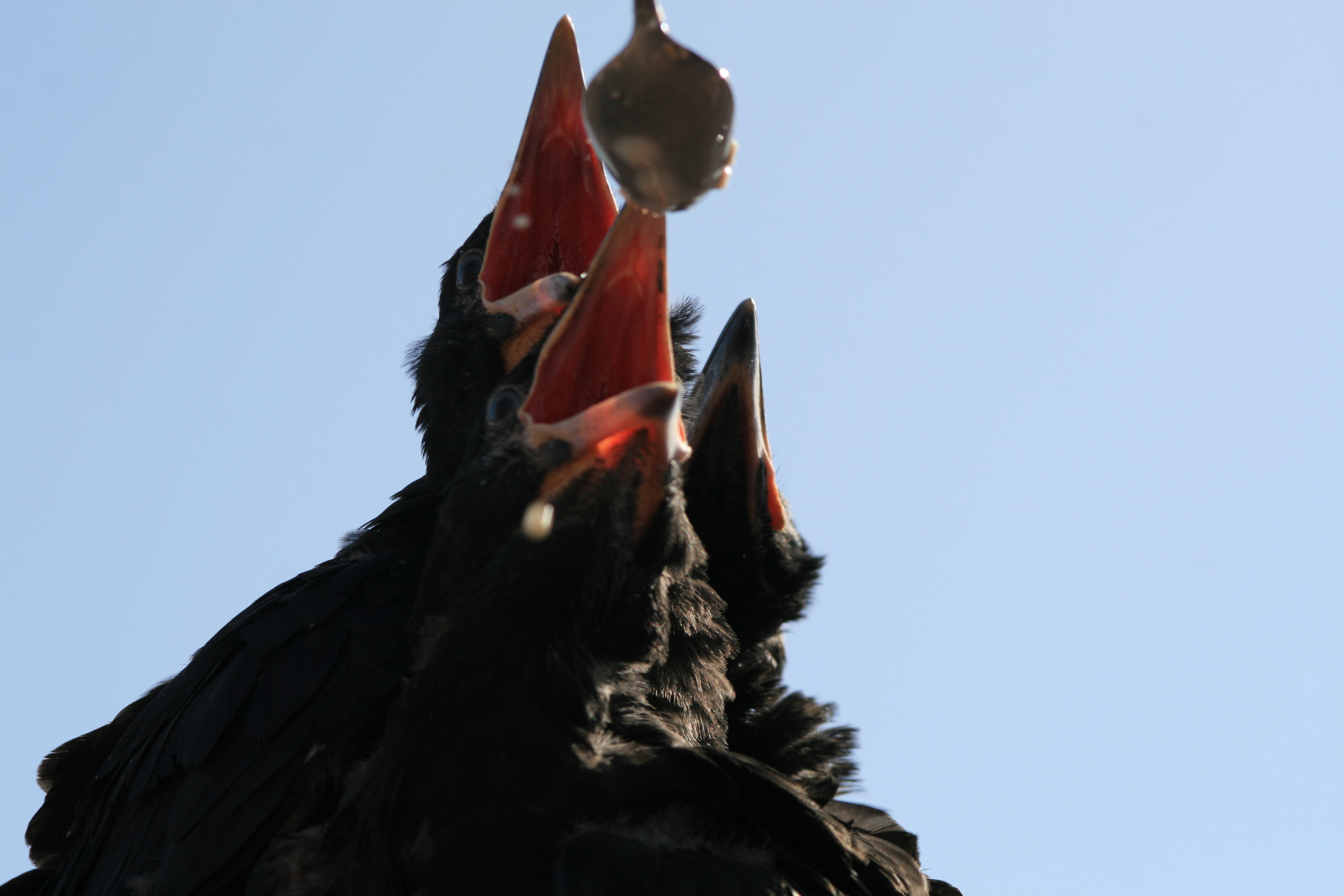
The ravens are learning to feed themselves.  Kind of.  You would think that feeding would come naturally to any living thing.  But with these birdies, perhaps most birdies, it’s different.  As young fledgelings, they call, you drop food in their gaping gullets and they’re happy.  You put food down in front of them, however, and they don’t get it.  They don’t pick at it, they don’t look at it, they walk on it, walk past it, do just about anything but recognize it as food.

Kerry thinks it’s a cognitive thing.  Food is something that is dropped in your mouth, it’s not something lying about.

So now the new method.  Dangle the meat in their mouths and slowly lead their beaks down to the nest and drape the food on the branches.  Hopefully they get the idea and pick it up themselves.  After a few tries, they mostly get it.

Poe, oddly enough, seems to have the most difficulty.  He’s the first to take flight.  Most mornings he’s perched on the fence or the roof or the hammock, or across the street on someone’s car.  He’s figuring out the wing thing pretty quickly, but when it comes to food, he can be starving, but won’t approach to grab the meat. You have to go to him.  And he has a heck of a time positioning himself properly, in some cases twisting himself into an avian pretzel.

But you have to have faith. Earlier I’d watched one of the chickens eye the bird feeder hungrily.  After some consideration, he followed the example of the finches and hopped to the top of the fence and commenced to feed with them.  Fortunately for us and for chickens, if hungry enough, even a dinosaur can learn to fly.

Later from below I watch Kerry dangle a strip of flesh above a waiting beak.  Who’s training who?  I see us doing this day after day.  In this sparse environment,  I suddenly understand how invention leads to habit. Habit becomes ritual.  Ritual, ceremony.  And ceremony becomes religion.  Each spring, legions of our descendants will ritually feed a captive raven in the spring.  It will symbolize stewardship and love for all creatures.  We will have forgotten how it all began in the first place.

Feeding © Kerry Hardy